All species › Passerines › Monarchs and allies › Broad-billed Flycatcher
Broad-billed Flycatcher | Myiagra ruficollis
Kaneelborstmonarch | Monarca piquiancho
The Broad-billed Flycatcher is the mangrove flycatcher of tropical northern Australia, and the only Australian Myiagra in which the male too wears the orange throat that in its relatives belongs to the female alone. That makes it a solution and a problem at once: unmistakable once you know what to look at, and yet the species for which every female Leaden Flycatcher in the mangrove is wrongly taken. The broad, flat bill that gives it its English name is the decisive character.

Voice
A series of clear, slightly plaintive whistled notes falling in pitch, mixed with a soft, hoarse tzzhr. The voice is less buzzing than that of Leaden Flycatcher and less harsh than that of Satin Flycatcher, and the whistled series are longer and more musical than in either. In the mangrove it often calls from just above the water and is easily drowned out by the far louder Shining Flycatcher, which occupies the same thickets.
Recording: Ross Gallardy — CC BY-NC-SA 4.0 · Tanimbar, nr Kormomolin, Yamdena Island, Maluku, Indonesia · xeno-canto
Identification
A small flycatcher of fifteen to sixteen centimetres with a conspicuously broad, flat, triangular bill — the one character that works under all conditions. Both sexes have a warm orange-rufous chin, throat and upper breast running fairly far down the chest, with a dirty white belly beneath. The upperparts are dull blue-grey; the male's head is a little darker and slightly glossier than the female's, but the difference is small and the species is barely dimorphic. The tail quivers in the usual Myiagra manner.
Confusion species
The female Leaden Flycatcher (Myiagra rubecula) is the real pitfall, for it too has grey-blue upperparts and an orange throat and occurs in the same northern Australian mangroves. Three things separate them: the bill of Broad-billed is clearly broader and flatter, the orange is deeper in tone and runs further down, and the upperparts are duller, with less gloss on the head. The decisive point, however, is the sex of the bird: if you see an orange-throated individual and beside it a male with an orange throat as well, they are Broad-billed Flycatchers — in Leaden Flycatcher the male is grey with a dark bib. Shining Flycatcher (Myiagra alecto) shares the habitat but is stouter, and its female has a rufous back rather than an orange throat.
Habitat
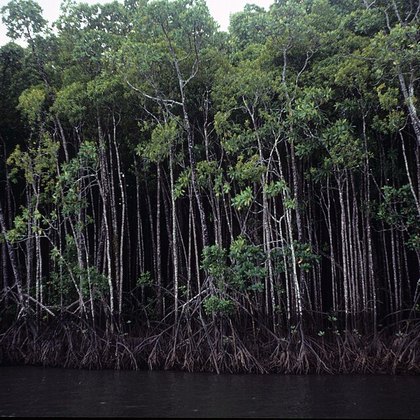
Mangrove first of all, and beyond that monsoon forest, vine thicket and dense growth along tidal creeks and the lower reaches of tropical rivers. The bird hunts in the middle storeys of the mangrove canopy, taking insects in a short sally from a branch and returning afterwards. It reaches into adjoining paperbark woodland but seldom moves far from the coastal strip.
Where the bird is most often found, arranged by main group and formation.


Range and movements
In Australia confined to a narrow coastal band of the tropical north, from the Kimberley across the Top End and the Gulf of Carpentaria to Cape York Peninsula. Beyond that it is a widespread species of the Lesser Sundas, Timor, the Moluccas and New Guinea; the Australian population is the southern edge of a much larger Indo-Australian range. Resident, with at most local movements along the coast.
- Resident
- dark = core range, pale = thinly spread
Where and when to look
Search the mangrove at eye to mid height and check the bill first: broad and flat points to this species, narrow and fine to a Leaden Flycatcher. Then try to find the pair — two orange-throated birds side by side settles the identification, since no other Australian Myiagra does that. In the mangrove the descending whistled series is often the first sign that the species is present.
Conservation
Least Concern (LC). The world population covers a large Indo-Australian range and the species is not scarce in suitable mangrove. In Australia itself its strict tie to mangrove and tidal creeks keeps it nowhere numerous and everywhere dependent on a narrow, vulnerable strip: degradation of mangrove through sea-level rise, altered freshwater inflow and coastal development affects it directly. There is no evidence of a national decline, but the species is little studied and its Australian numbers are poorly known.
Scientific name
Myiagra ruficollis | (Vieillot, 1818)
Louis Pierre Vieillot described the bird in 1818 as Platyrhynchos ruficollis; New Holland was cited as the locality, but the type almost certainly came from Timor; because it now stands in Myiagra, author and year are in parentheses. The genus Myiagra is built from Ancient Greek muia ('fly') and agra ('catching'). The epithet ruficollis combines Latin rufus ('reddish-brown') with collum ('neck') and describes the orange throat worn by both sexes. The English Broad-billed Flycatcher and the Spanish monarca piquiancho take the broad bill, the Dutch Kaneelborstmonarch the cinnamon breast.