All species › Passerines › Monarchs and allies › Leaden Flycatcher
Leaden Flycatcher | Myiagra rubecula
Zilvermonarch | Monarca plomizo
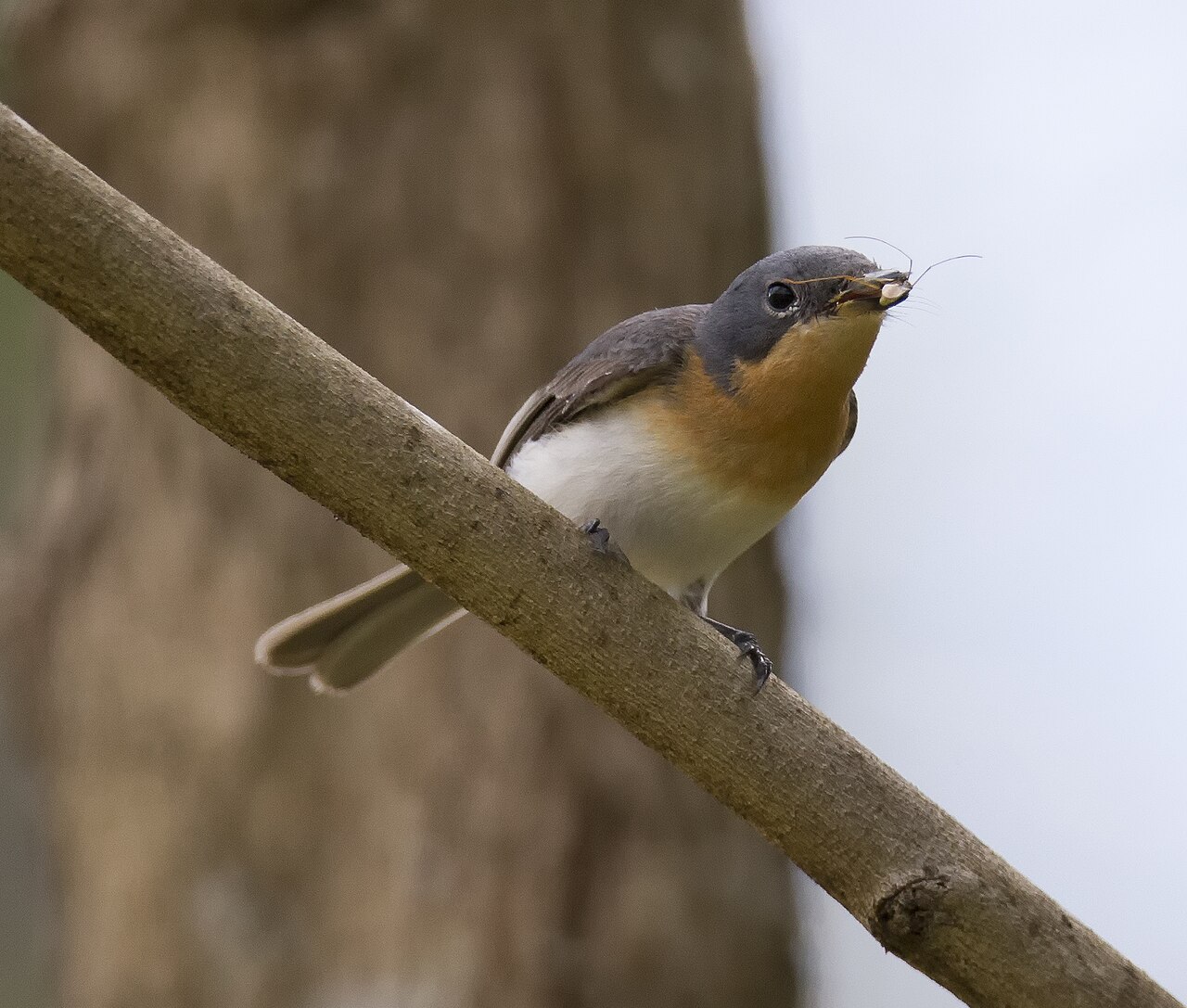
The Leaden Flycatcher is the commonest and most widespread monarch flycatcher of Australia, a small bird of open eucalypt forest that is never still and quivers its tail without pause. The male is leaden blue-grey with a dark bib and a white belly, the female has a warm orange throat. In the north it stays all year, in the south-east it is a summer visitor — and everywhere it is the species with which Satin Flycatcher is confused.
Voice
The most characteristic sound is a buzzing, slightly nasal dzzt or zzhurr, softer and lower than the harsh rasp of Satin Flycatcher, often given in short series alternating with a mellow, repeated whistled tu-wee tu-wee. The whole voice is less penetrating and less sharp than that of Satin Flycatcher, and it is precisely that difference in tone quality that gives the most usable separation between the two, since it works equally for males, females and young birds. The buzz carries less far than the bird's readiness to call would suggest.
No freely licensed recording has been found for this species yet; what to listen for is described below.
Identification
A small, slim flycatcher of about fifteen centimetres, perching upright, with a tail that quivers sideways almost without pause. The male is leaden blue-grey above, on the head and on the upper breast with a dull gloss; the dark bib ends relatively high on the breast and the transition to the white is less sharply drawn. The female has grey-blue upperparts with a dark head and an orange-rufous throat and upper breast, usually paler and less extensive than in Satin Flycatcher, with much white below it. The wings are shorter and rounder than in Satin Flycatcher.
Confusion species
Satin Flycatcher (Myiagra cyanoleuca) is the classic pitfall and the difference is genuinely hard. The male Leaden is duller and greyer — leaden rather than deep blue-black — with a shorter bib ending higher on the breast, and has shorter, rounder wings; against the light in the canopy little of that survives. The females are barely separable: the orange in Leaden is usually paler and runs less far down, but the variation overlaps so much that a silent female on a single view is better left unnamed. The call is the most reliable character: buzzing and soft here, harsh and rasping in Satin Flycatcher. Besides that, the female closely resembles Broad-billed Flycatcher (Myiagra ruficollis) of the northern mangroves, which however has a broader, flatter bill and in which the male too wears an orange throat. Restless Flycatcher (Myiagra inquieta) has a pure white throat and no bib at all.
Habitat
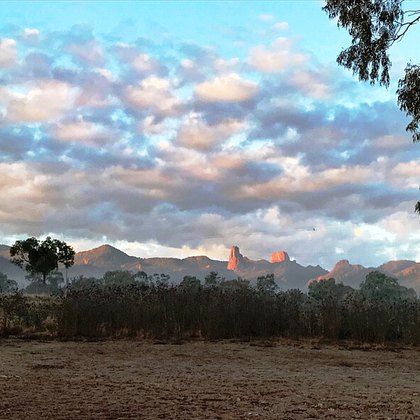
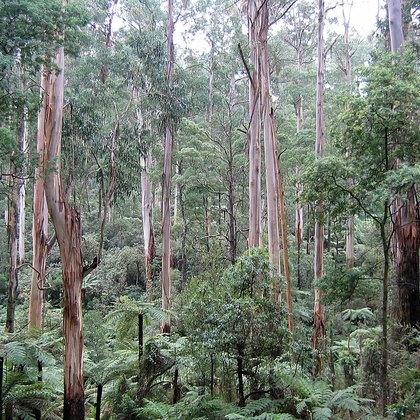
Open eucalypt forest and woodland with a half-open canopy, forest along creeks and rivers, and the edges of denser forest; in the north also mangrove belts, monsoon forest and paperbark woodland. The bird hunts from a perch in the middle and upper storeys and sallies out at passing insects, returning each time to the same branch. Large gardens and parks with old eucalypts are used without hesitation.
Where the bird is most often found, arranged by main group and formation.

Range and movements
Widespread in northern, eastern and south-eastern Australia, reaching southern New Guinea, the Aru Islands and parts of Wallacea; the interior deserts and most of south-western Australia stay empty. The species is a partial migrant: in tropical northern Australia the birds are present year-round, while the breeders of New South Wales, Victoria and South Australia arrive in the southern spring and withdraw northwards in autumn. So one and the same species counts as a resident in one part of the country and a summer visitor in another.
- Resident
- Breeding (summer)
- Winter
- dark = core range, pale = thinly spread
Where and when to look
In open eucalypt forest watch for the ceaseless quivering of the tail — that gesture identifies the genus Myiagra before any colour can be seen. Then wait for sound: a soft buzzing dzzt makes it a Leaden, a harsh rasp a Satin. In the south-east the season helps as well: outside the summer months Satin Flycatcher has gone while Leaden may still be around.
Conservation
Least Concern (LC). The species is numerous, uses a wide range of forest types and adapts well to human-used country as long as old trees remain standing. Local declines are reported where old woodland disappears from farmland, since the bird needs stout horizontal limbs in mature trees for its nest. At the scale of the whole range there is no cause for concern.
Scientific name
Myiagra rubecula | (Latham, 1801)
John Latham described the bird in 1801 as Todus rubecula, from material out of Sydney. The genus Myiagra goes back to Ancient Greek muia ('fly') and agra ('catching'). The epithet rubecula is a Latin diminutive of ruber ('red') and is the same name that denotes the robin in Europe; Latham meant the orange-red throat, which only the female wears. The English Leaden Flycatcher and the Spanish monarca plomizo take the lead colour of the male; the Dutch Zilvermonarch takes the same grey tone, but from its lighter side.