All species › Passerines › Monarchs and allies › Spectacled Monarch
Spectacled Monarch | Symposiachrus trivirgatus
Brilmonarch | Monarca de anteojos
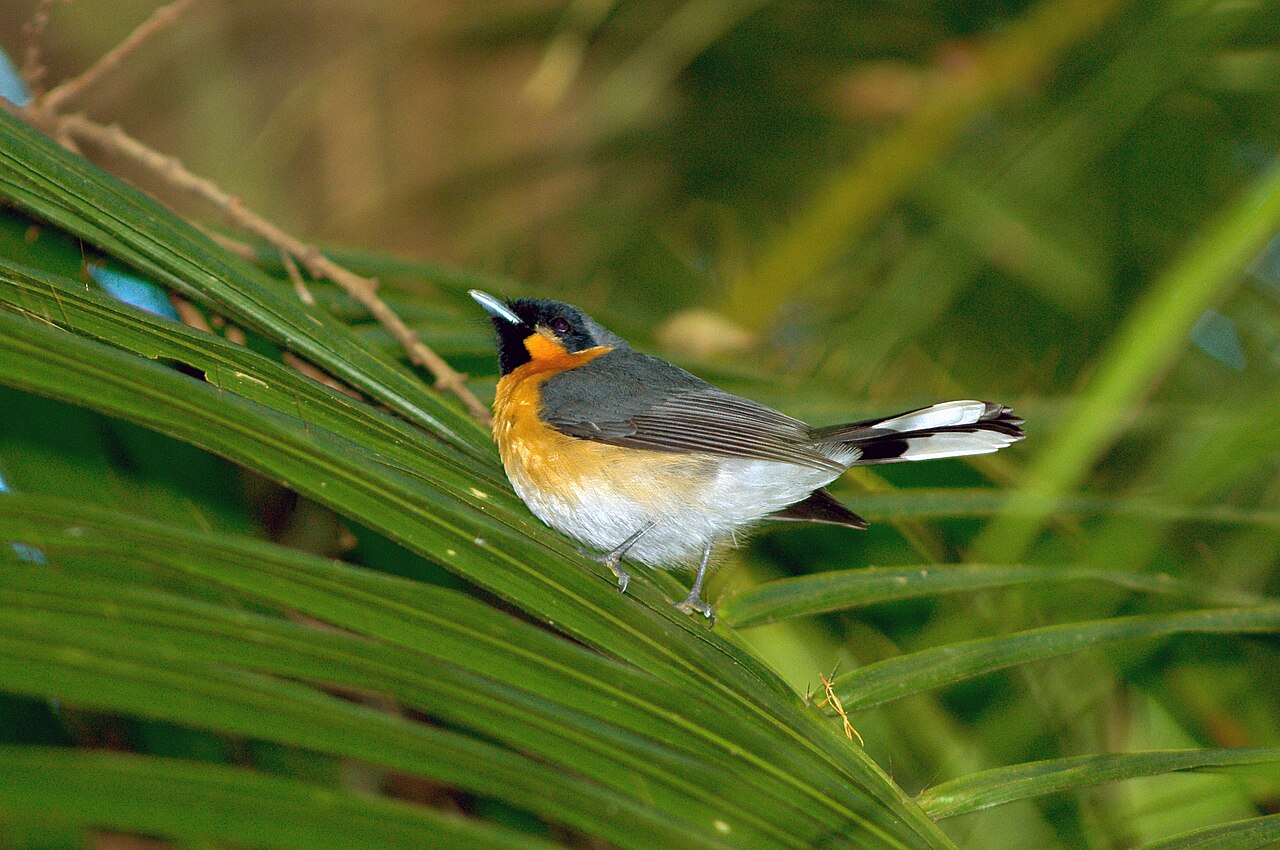
The Spectacled Monarch owes its name to the broad black area that sits around the eye like a pair of spectacles and stands out sharply against the blue-grey head. It is a lively, restless bird of rainforest and monsoon forest, constantly opening and closing its tail and flashing white tail tips as it does. It is the only representative in this guide of Symposiachrus, a large genus that otherwise lies entirely outside Australia and New Zealand.
Voice
A surprisingly varied repertoire for so small a bird. The song is a series of clear, slightly hoarse whistles, often in threes or fours and rising a little — rendered as which-which-which. Far more conspicuous is the scold: a hard, buzzing, rasping zzzert that hangs in the undergrowth and is usually the first sign that a pair is about. Birds foraging together also keep up a soft, high twittering audible only at close range.
No freely licensed recording has been found for this species yet; what to listen for is described below.
Identification
A small, slim monarch with a fine blue-grey bill and a long tail it often spreads into a fan. Head, mantle, wings and tail are blue-grey. Around the eye lies a broad black mask covering lore, eye-region and chin, giving the impression of spectacles — it does not extend as a closed hood over the throat, as in Black-faced Monarch. Throat and breast are warm rufous-orange, but belly and undertail coverts are clean white, so the orange reads as a bounded bib. The outer tail feathers carry broad white tips, lighting up as two white corners when the tail is spread; in a bird flying away that is often all one sees. The sexes are alike; juveniles have a duller, brownish mask.
Confusion species
Black-faced Monarch (Monarcha melanopsis) is larger and carries its black as a closed mask covering chin and upper throat as well, has the whole underside rufous-orange rather than just the breast, and lacks white tail tips entirely. Black-winged Monarch (Monarcha frater) is likewise larger and has black wings and tail. White-eared Monarch (Carterornis leucotis) is black and white and shows no trace of orange. Australian Rufous Fantail (Rhipidura rufifrons) also fans its tail constantly in the same understorey, but has a conspicuous rufous rump and tail base, a white-and-black scalloped breast, and no black eye mask. Outside Australia and New Zealand the genus Symposiachrus holds several dozen further species, spread from the Moluccas and the Lesser Sundas across New Guinea to the Solomons; within the area of this guide the Spectacled Monarch stands alone, so confusion within the genus does not arise here.
Habitat
Rainforest, monsoon forest and vine thicket, mangrove and densely vegetated gullies. The bird keeps to the lower and middle storey, flitting restlessly from branch to branch, fanning its tail and gleaning insects from leaves or taking them in short flights. It avoids open forest and dry woodland, but sometimes follows dense streamside vegetation some way into drier country. The nest is a neat, deep cup of fibre and moss, bound with cobweb and often capped with lichen.
Where the bird is most often found, arranged by main group and formation.



Range and movements
A markedly Indo-Pacific species: from the Lesser Sunda Islands — Temminck described it in 1826 from a bird taken on Timor — and the Moluccas across New Guinea and the Torres Strait islands into Australia. There it occupies the coastal strip from Cape York south along Queensland to central New South Wales. Northern birds are present year-round; the southern breeders are partly migratory and leave the southern part of the range in winter, shifting north.
- Resident
- Breeding (summer)
- dark = core range, pale = thinly spread
Where and when to look
Search low, not high. Follow a rainforest track along a creek and listen for the short, hard buzzing note in the shrubbery; then stand still until the movement shows. The decisive character is the boundary between orange and white below: if the orange stops halfway down the breast and the belly turns white, this is the species; if the orange runs all the way to the undertail, you are looking at Black-faced Monarch. The white tail tips are a good second check, especially at the moment the bird turns away.
Conservation
The species is common and widespread across a large Indo-Pacific range and there is no evidence of any appreciable decline. In the AviList edition consulted for this guide it is entered as Not Evaluated (NE). That reflects uncertainty not about numbers but about limits: the complex around Symposiachrus trivirgatus has in recent years been split into several species by various authoritative lists, and until that arrangement settles, the species as currently circumscribed has not been separately assessed for the Red List. No decline has been established for the Australian populations.
Scientific name
Symposiachrus trivirgatus | (Temminck, 1826)
Coenraad Jacob Temminck described the bird in 1826 as Drymophila trivirgata, from material taken on Timor. The epithet trivirgatus is Latin for 'three-striped', after the pattern of dark stripes on the head. The genus Symposiachrus was introduced in 1854 by Charles Lucien Bonaparte and goes back to Greek sumposiarkhos, 'master of the feast'; the species were long placed in Monarcha and have only in recent decades been separated from it again. The English Spectacled Monarch, the Dutch brilmonarch and the Spanish monarca de anteojos all name the same black spectacles.