All species › Tubenoses › Petrels, shearwaters and diving petrels › Broad-billed Prion
Broad-billed Prion | Pachyptila vittata
Breedbekprion | Petrel-paloma de pico ancho
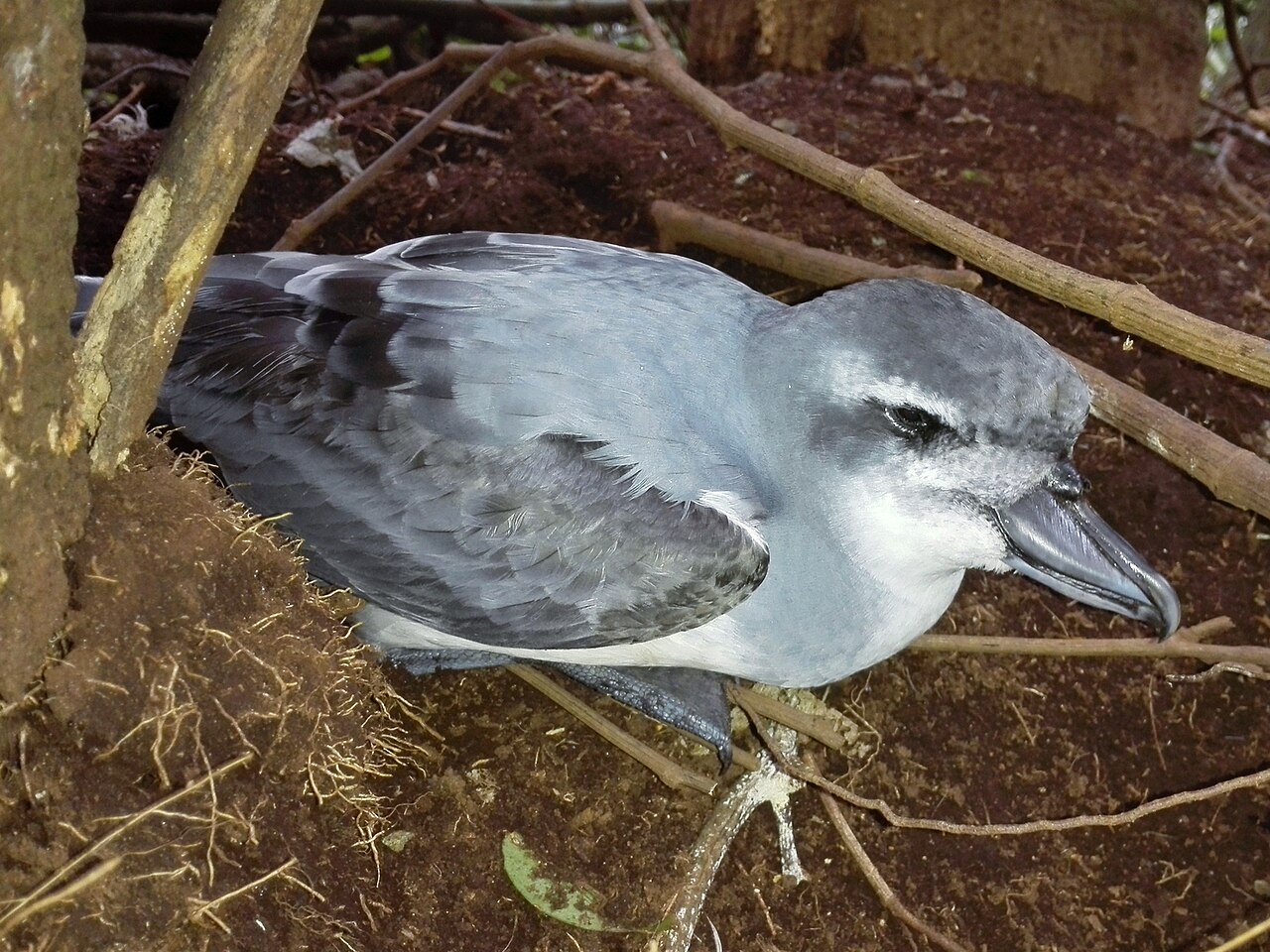
The Broad-billed Prion is the largest and heaviest built of the six whalebirds, and the only one worth attempting on shape alone: a high forehead, a short thick neck and a massive lead grey-blue bill 18.7 to 24.3 mm across — close to twice the width of a Slender-billed Prion's. It breeds in enormous numbers on the Chatham Islands and is the only prion that stays in New Zealand waters all year.
Voice
At sea it is silent. Over the colony, after dark, comes a hard rattling chatter alternating with a softer crooning; in a colony of hundreds of thousands of pairs the voices merge into one continuous murmur that hangs over the whole island. Birds that collide on the ground or fight over a burrow give a hoarse, strangled cry. The Maori name parara is formed after that rattling sound.
No freely licensed recording has been found for this species yet; what to listen for is described below.
Identification
At 28 cm and 200 g the largest prion, with the longest wing (about 19.5 cm) and the heaviest build. Blue-grey above with the blackish M across the wings, white below, the tail grey with a narrow black tip. The face is darker than in the other prions, with a heavy dark eye-stripe and a grey cap running down onto the upper breast, which gives the bird a 'dirty' look. The head settles it: the forehead rises steeply and the bill is broad, lead-grey to blue-grey and dull in tone, with the most strongly developed lamellae in the genus — on a resting bird they project below the cutting edge.
Confusion species
Salvin's Prion (Pachyptila salvini) is the hard case, because the two were once treated as one species: salvini is smaller (27 cm), with a noticeably narrower bill (13.5–17.5 against 18.7–24.3 mm), a smaller nail at the tip and a paler face. Antarctic Prion (Pachyptila desolata) has a bright, straight-sided blue bill of 11–15.5 mm on which the lamellae stay hidden when the bill is closed. Slender-billed Prion (Pachyptila belcheri) is the far extreme: 9.5–12.5 mm of bill width and a pale face with a broad white eyebrow. Fairy Prion (Pachyptila turtur) and Fulmar Prion (Pachyptila crassirostris) are smaller and more compact, with a short blunt bill and a strikingly broad black tail tip. MacGillivray's Prion of the Indian Ocean was until recently treated as a subspecies of this species; it does not occur in this map window.
Habitat
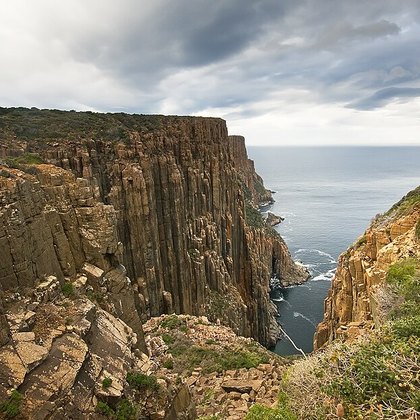
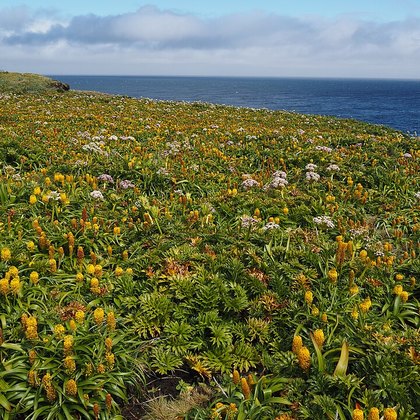
Sea over and along the edge of the continental shelf and the cool subtropical and subantarctic water around New Zealand; unlike most prions it stays close to home and does not go down to the ice. With its broad bill and fine lamellae it is the strongest filterer in the genus: hydroplaning with wings held open it sieves copepods, krill and other animal plankton from the surface water. It breeds in burrows and rock crevices under tussock, ferns and scrub on predator-free islands, and on mainland New Zealand only on a few steep Fiordland cliffs.
Where the bird is most often found, arranged by main group and formation.


Range and movements
The stronghold is Rangatira (South East Island) in the Chathams, with an estimated 300,000 breeding pairs. Beyond that it nests on islets around Stewart Island, on The Snares, on Solander and Codfish Islands and at a few Fiordland sites. Outside the map window a second stronghold lies on Gough and Nightingale in the South Atlantic. It does not migrate: it can be found in New Zealand waters in every month, from Cook Strait southwards. In Australia it is genuinely scarce — only after heavy storms do a few birds reach the south coast.
- Resident
- dark = core range, pale = thinly spread
Where and when to look
Sail out of Kaikoura or Stewart Island, or take the boat to the Chathams: this is the prion to expect around New Zealand in any month of the year. In a flock of prions look for the largest bird with the highest forehead and the darkest head — at sea that is the only feature that carries at range. For certainty, walk a west coast beach after a north-westerly gale in July or August: a wrecked bird can be named in seconds in the hand with a ruler, because no other prion reaches 18 mm of bill width.
Conservation
Least Concern (LC) worldwide, but classed as a relict in New Zealand because the species has been all but driven off the mainland. Rats, stoats, cats and weka take eggs and chicks on islands not yet cleared of predators, and Subantarctic Skuas pick adults out of the colony. The heaviest blow came from the weather: in the winter storm of 2011 an estimated 250,000 birds died, 80 to 90 per cent of the Fiordland, Foveaux Strait and Snares population, and that gap has not yet closed.
Scientific name
Pachyptila vittata | (Forster, 1777)
Georg Forster, naturalist aboard James Cook's Resolution, described the species in 1777 as Procellaria vittata; because the genus has since changed, author and year carry parentheses. vittata is Latin for 'banded', after the dark markings across head and wings. The type locality is Tristan da Cunha. The genus Pachyptila was introduced by Illiger in 1811, from Greek pakhus 'thick' and ptilon 'feather'; the word prion comes from Greek priōn, 'a saw', for the serrated lamellae that are most strongly developed in exactly this species. The Maori name is parara.