All species › Tubenoses › Petrels, shearwaters and diving petrels › South Georgia Diving Petrel
South Georgia Diving Petrel | Pelecanoides georgicus
Antarctisch alkstormvogeltje | Potoyunco de Georgia del Sur
The South Georgia Diving Petrel is the second of this region's two small divers: as small, as chunky and with the same whirring straight flight and the same habit of flying through a wave rather than over it as the Common Diving Petrel. It is a bird of the subantarctic sea, belonging within this map window above all to Macquarie Island, and at sea it can hardly be separated from its commoner relative.
Voice
At sea it is silent. In the colony at night comes a plaintive mewing that observers describe as clearly different from that of its close relatives, and in which male and female can be told apart in the field. These are short, thin, repeated notes from the burrow and from the air above the colony, not the full crooning of the larger tubenoses.
No freely licensed recording has been found for this species yet; what to listen for is described below.
Identification
A bird of twenty centimetres and about a hundred and fifty grams, black above and white below, head sunk into the shoulders. The underwing is whiter and cleaner than in the Common Diving Petrel, with less grey wash. Grey feathering runs up behind the eye like a pair of ear-muffs, lightening the side of the head. The rump feathers have white bases, the tail is slightly forked in a proportion of birds rather than square-cut, and the bill is finer — thirteen to sixteen millimetres, black with pale blue edges. The legs are mostly blue with black margins.
Confusion species
Common Diving Petrel (Pelecanoides urinatrix) is the only confusion risk and at the same time the hardest identification problem in the whole group: it has duskier, grey-white underwings, uniformly dark rump feathers, a square-cut tail, darker sides to the head and a heavier bill that is broader at the base. Every one of those differences is subtle and none is reliably visible at sea; the literature in practice restricts certain identification to birds in the hand or birds at the colony. Anyone who sees one at sea and can judge neither bill nor underwing should honestly write down 'diving petrel sp.'.
Habitat
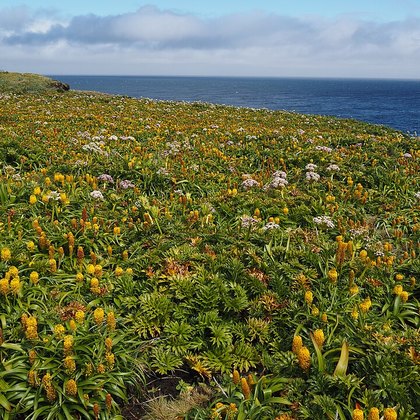
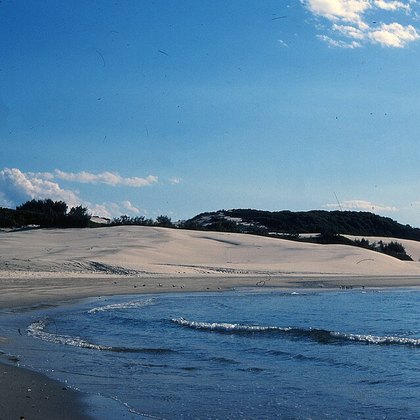
Subantarctic sea and cold water around the breeding islands, ranging further offshore outside the breeding season than the Common Diving Petrel. It digs its burrow in loose, free-draining ground: on Macquarie Island in slope and coastal terrain of tussock and feldmark, and in the New Zealand population in the sand dunes just behind the beach. That preference for sand and scree over firm peat makes it sensitive to any change in the dune or slope surface.
Where the bird is most often found, arranged by main group and formation.


Range and movements
Within this map window Macquarie Island — the Australian subantarctic island halfway between Tasmania and Antarctica — is where the species belongs; beyond it, it breeds on South Georgia, the Prince Edward Islands, Crozet, Kerguelen and Heard. The single New Zealand population sits in the dunes of Sealers Bay on Whenua Hou or Codfish Island near Stewart Island; those birds were described in 2018 as a separate, critically endangered taxon, Pelecanoides whenuahouensis, so whether they still fall under this species depends on the checklist followed. Subfossil remains show the bird formerly bred at the Auckland Islands, Stewart Island and the Chathams as well. At sea it is rarely seen and still more rarely identified with certainty.
- Breeding (summer)
- dark = core range, pale = thinly spread
Where and when to look
The only realistic chance is a ship calling in subantarctic waters at Macquarie Island, or an expedition voyage along the New Zealand islands in the southern summer. Watch for small black-and-white divers whirring away low and straight, and on every bird that comes close try for the underwing and the side of the head — a clean white underwing and pale ear-muffs behind the eye are the only two marks that still deliver at close range. Do not settle too quickly: most birds stay unassigned.
Conservation
Least Concern (LC) as a species, because the colonies on South Georgia and the Indian Ocean islands are large. The picture within this map window is another matter. On Macquarie Island introduced cats, rats and above all rabbits — which stripped the slope vegetation and let the ground slip away — hit the burrow-nesters hard; since rabbits, rats and mice were eradicated in 2014 the burrowing petrel community there has been visibly recovering. The New Zealand birds of Whenua Hou are in serious trouble: fewer than two hundred and ten individuals, threatened by storm erosion and collapsing dunes, by introduced dune grasses choking the burrows, and by advancing coastal forest.
Scientific name
Pelecanoides georgicus | Murphy & Harper, 1916
The American seabird authority Robert Cushman Murphy and Francis Harper described the species in 1916 as Pelecanoides georgica; because it has stayed in that same genus — only the ending changed to agree with the gender of the genus name — author and year carry no parentheses. The epithet refers to South Georgia, and the type locality is Cumberland Bay on that island. The genus Pelecanoides was erected by Lacepede in 1799 and means 'pelican-like', after the expandable throat pouch. The New Zealand birds carry the Maori name kuaka Whenua Hou, after the one island where they still breed.