All species › Tubenoses › Petrels, shearwaters and diving petrels › Fairy Prion
Fairy Prion | Pachyptila turtur
Duifprion | Petrel-paloma chico
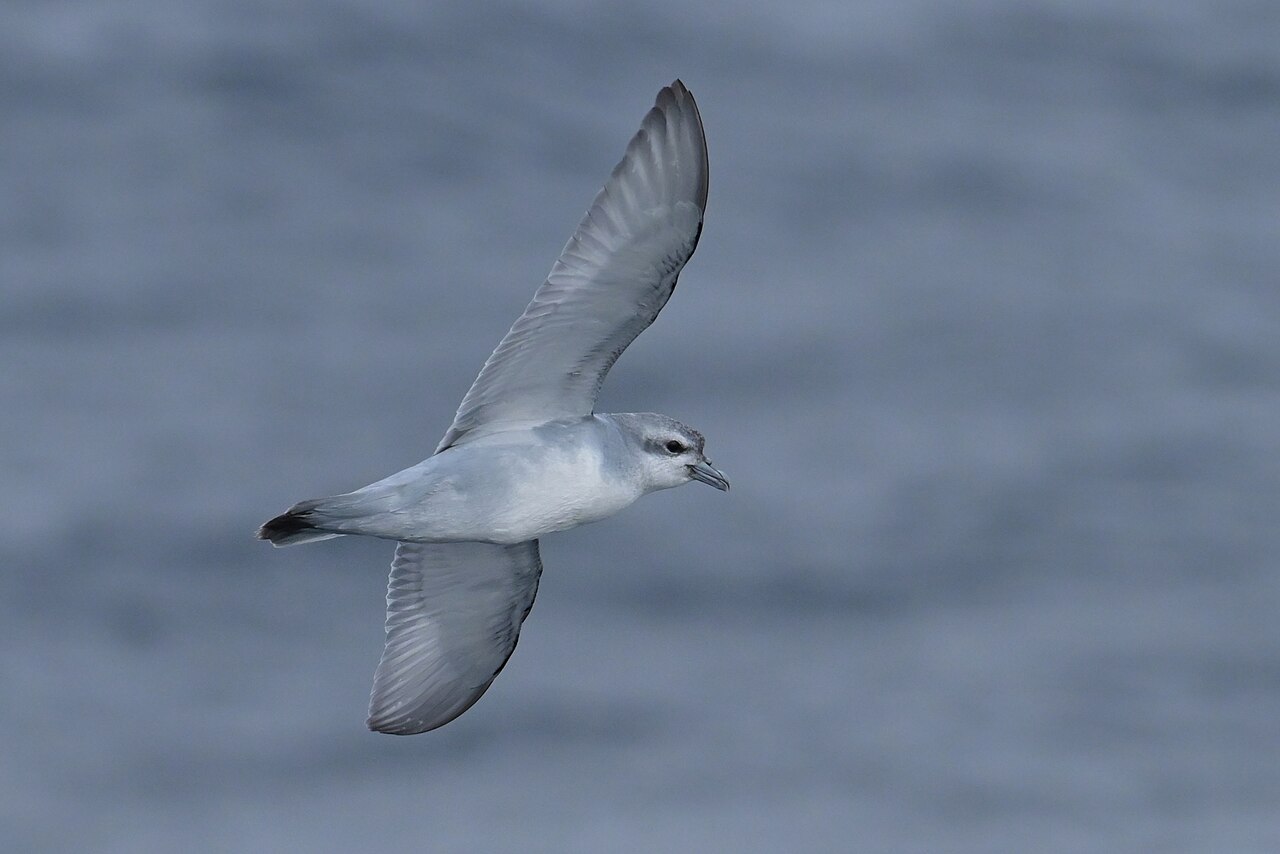
The Fairy Prion is the smallest of the six whalebirds and by far the commonest in this map window: a neat blue-grey and white seabird of barely a quarter of a metre that streams low over the swell in fast, swerving flocks. Its mark is the tail: the black tip is broad and cleanly cut, broader than in any other prion but its own twin species.
Voice
At sea it is silent. In the colony it is noisy at night: from the burrows come a hard rattling chatter and a softer crooning, and birds circling over the slope give short high calls. On a still night a colony on an island like Takapourewa sounds like a continuous gurgling that seems to come out of the ground itself. The Maori name titi wainui belongs to that nocturnal chorus.
No freely licensed recording has been found for this species yet; what to listen for is described below.
Identification
About 25 cm long and 120 g, with a span of some 56 cm — the smallest prion. Blue-grey above with the black M from wingtip to wingtip, white below, blue legs and a small blue bill. The face pattern is vaguer than in the other prions: the eye-stripe is weak and the eyebrow inconspicuous, so the head looks plainly grey. The bill is short and fairly stout but lacks the comb-like lamellae along the upper mandible edge that the big prions carry. What settles it at sea is the broad black tail tip, which flicks like a bar as a flock banks.
Confusion species
Fulmar Prion (Pachyptila crassirostris) is its image and cannot be separated from it reliably at sea: it is slightly larger (26 cm, 140 g) and has a clearly more robust, blockier bill with a bigger nail at the tip and a smaller gap between nostril tube and nail. The same holds for Pyramid Prion (Pachyptila pyramidalis), split off in 2022, whose bill is heavier still. The four large-billed prions fall out on the narrower black tail tip and on the bill: Slender-billed Prion (Pachyptila belcheri) at 9.5–12.5 mm with a pale face and a broad white eyebrow, Antarctic Prion (Pachyptila desolata) at 11–15.5 mm, Salvin's Prion (Pachyptila salvini) at 13.5–17.5 mm and Broad-billed Prion (Pachyptila vittata) at 18.7–24.3 mm with a high forehead and a dark head and upper breast. Anyone who sees a small prion-like bird at range without getting the tail is wise to leave it at 'prion sp.'.
Habitat
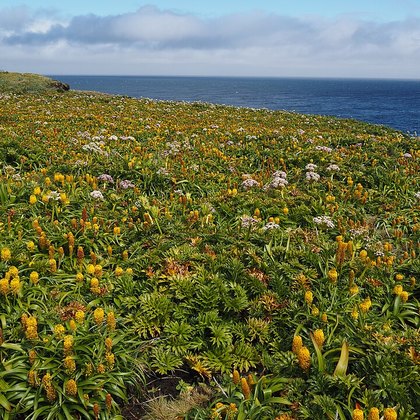
Exposed coastal water and sea over the continental shelf, especially from Cook Strait southwards; unlike many relatives it likes to stay within reach of its colony and avoids sheltered bays and fiords. It picks small crustaceans, krill and other animal plankton off the surface, partly while swimming, partly hydroplaning with wings held open. It breeds in burrows, rock crevices and under boulders on islands and steep coastal cliffs, beneath tussock, Poa turf or low scrub.
Where the bird is most often found, arranged by main group and formation.



Range and movements
The largest colony of the species — and one of the largest seabird colonies in New Zealand — is on Takapourewa (Stephens Island) in Cook Strait, with about 1.83 million pairs. It also breeds on the Poor Knights, on islets in the Marlborough Sounds, on Mangere in the Chathams, on The Snares, on Antipodes Island and on islets in Foveaux Strait and around Stewart Island. In Australia it breeds on the Bass Strait islands and along the south-east coast; the southern form is treated there separately as Pachyptila turtur subantarctica. At sea it is the prion you are most likely to meet in both Australian and New Zealand waters, with large numbers off the south coast in winter.
- Resident
- Passage
- dark = core range, pale = thinly spread
Where and when to look
In New Zealand, take the ferry across Cook Strait: in summer Fairy Prions stream past the ship in flocks, and that is the cheapest prion in the southern hemisphere. In Australia any pelagic out of Wollongong, Port Fairy or Eaglehawk Neck will do. Do not look at the back, which is the same in every prion, but at the tail as a flock banks: a broad black tip means Fairy or Fulmar Prion, and nine times in ten the former.
Conservation
Least Concern (LC), with a world population in the millions; in New Zealand it nonetheless counts as a relict, because it has all but gone from the mainland and holds on only in predator-free or steep, unreachable places. Feral cats, rats and weka take eggs, chicks and even adults; skuas and Swamp Harriers (Circus approximans) catch birds that come over land by day. After heavy westerly gales thousands wash up dead on west coast beaches, a loss the species normally makes good within a few years.
Scientific name
Pachyptila turtur | (Kuhl, 1820)
Kuhl described the species in 1820 as Procellaria turtur; because the genus has since changed, author and year carry parentheses, and the original work gives no type locality. turtur is the Latin word for turtle dove, after the size, the blue-grey plumage and the crooning voice — the same thought that lies behind the Dutch guide name duifprion, 'dove prion'. The genus Pachyptila was introduced by Illiger in 1811, from Greek pakhus 'thick' and ptilon 'feather'. The Maori name is titi wainui.