All species › Passerines › Thornbills, scrubwrens, gerygones and allies › Buff-rumped Thornbill
Buff-rumped Thornbill | Acanthiza reguloides
Vaalstuitdoornsnavel | Acantiza reguloide
The Buff-rumped Thornbill is the thornbill of the open forest floor: ten to eleven centimetres, a stout little bill, a pale eye and a rump that does not flare yellow but stays dull buff. It works the leaf litter and the tree bases in parties, climbs bark like a treecreeper, and gives itself away with a fast, jingling two-note phrase.

Voice
The song is an animated rapid rattle on two alternating notes, musical and jingling, often called fairy-like by observers; a party singing together sounds like a handful of small bells. There is also a shorter chip contact note and a fast pitta-pitta-pit. The sound carries well across open forest floor and is usually the first sign of the species.
No freely licensed recording has been found for this species yet; what to listen for is described below.
Identification
Ten to eleven centimetres, about eight grams. Olive-brown to olive above, with a buff forehead scalloped paler. The rump patch is buff to pale yellow, the tail carries a broad blackish band and a paler tip. The underparts are cream-buff to pale yellow, without streaking. The bill is fairly stout and the eye pale to white — still dark in young birds.
Confusion species
Yellow-rumped Thornbill (Acanthiza chrysorrhoa) is the awkward neighbour: larger, with a bright yellow rather than buff rump, a black crown spotted white and a dark eye. Western Thornbill (A. inornata) is very similar but lives in southwestern Australia, so there is no overlap. Brown Thornbill (A. pusilla) has a dark red eye, a rufous rump and a streaked breast; Striated Thornbill (A. lineata) a streaked crown and dark eye; Yellow Thornbill (A. nana) yellow underparts and a dark eye. Inland it meets Chestnut-rumped Thornbill (A. uropygialis), which has a rufous rump.
Habitat
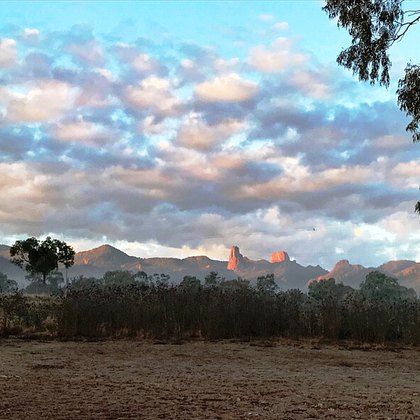
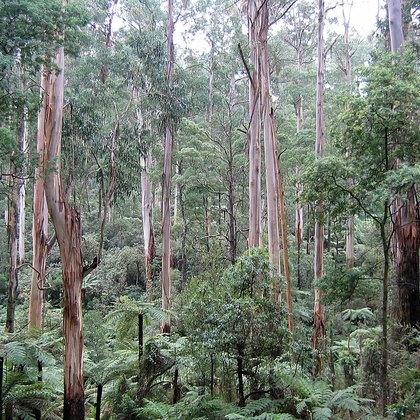
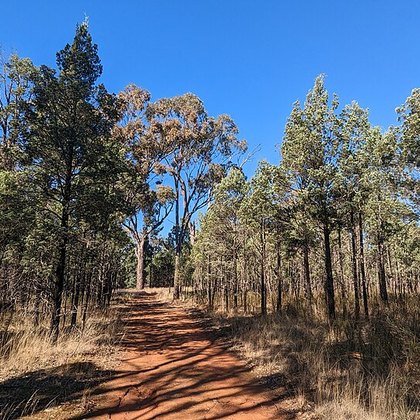
Open eucalypt forest and woodland with an open or sparse understorey — precisely not the dense scrub the Brown Thornbill prefers. It wants fallen branches, dead trees and a litter layer to rummage in. Often in the foothills, but it runs from the coast up into subalpine forest, and it also uses stands of white cypress and casuarina.
Where the bird is most often found, arranged by main group and formation.
Range and movements
Eastern Australia: eastern Queensland south of Cape York, eastern and southern New South Wales, much of Victoria and the southeastern corner of South Australia. Four subspecies are recognised; the form A. r. squamata of northeastern Queensland looks distinctly different. It stays in much the same area all year and is strongly territorial.
- Resident
- dark = core range, pale = thinly spread
Where and when to look
Walk slowly through open forest with plenty of dead wood and listen for the jingling two-note phrase, then follow the sound down to the ground. The party usually works its way from one tree base to the next. When you get a clear view, check two things at once: the pale eye and the dull buff, not yellow, rump. That settles it against the Yellow-rumped Thornbill.
Conservation
Least Concern (LC) and rated secure in every state where it occurs. Locally it does decline where forest gives way to housing, or where dead wood and litter are tidied away; that untidy material is what it lives on. In well-managed reserves with plenty of fallen timber it stays numerous.
Scientific name
Acanthiza reguloides | Vigors & Horsfield, 1827
Vigors and Horsfield introduced the species in 1827; the type locality is Parramatta near Sydney, New South Wales. The epithet reguloides means 'resembling Regulus', the genus of the kinglets, and refers to the small, busy, twig-searching manner. The same authors introduced the genus Acanthiza in the same year, from Greek akantha, 'thorn', and zao, 'to live'.