All species › Passerines › Thornbills, scrubwrens, gerygones and allies › Slaty-backed Thornbill
Slaty-backed Thornbill | Acanthiza robustirostris
Grijsrugdoornsnavel | Acantiza pizarrosa
The Slaty-backed Thornbill is the thornbill of the mulga, and the only member of the genus with a genuinely slate-grey upperside. In a family in which nearly everything is brown that is a gift: where four rufous-rumped species overlap in the dry interior, this is the one you can place on back colour alone.
Voice
A thin, rattling chatter alternating with a clear, reeling trill delivered from a low branch. The sound does not carry far and is easily lost in mulga scrub on a windy day. As with so many inland species, silence outside the breeding season is the real obstacle: a pair can work through the branches for half an hour without a note.
No freely licensed recording has been found for this species yet; what to listen for is described below.
Identification
Nine to ten centimetres, with a slate-grey crown, nape and back — the character everything turns on — and darker grey wings and tail with a narrow pale terminal band. The forehead carries black-on-grey striations, the cheek is whitish with grey specks, the rump is cinnamon to chestnut. The iris is reddish brown. The underparts are plain creamy white from throat to undertail coverts, without any streaking, and that absence of streaking is, with the grey back, the second key character. The bill is proportionally heavy; the epithet refers to it.
Confusion species
This is one of four inland thornbills with a rufous rump and each must be ruled out in turn. Inland Thornbill (Acanthiza apicalis) has the same reddish-brown iris and a rufous rump, but brown-grey rather than slate-grey upperparts, clear dark streaking on throat and breast, and a longer, often cocked tail. Chestnut-rumped Thornbill (Acanthiza uropygialis) has a white to cream iris and a brighter chestnut rump on a pale grey-brown back. Slender-billed Thornbill (Acanthiza iredalei) has a pale yellow iris, no more than an olive-yellow wash at the tail base, and lives in treeless samphire and chenopod flats rather than mulga. Brown Thornbill (Acanthiza pusilla) does not occur in this habitat. Anyone who sees a grey-backed, unstreaked-breasted thornbill in mulga need look no further.
Habitat
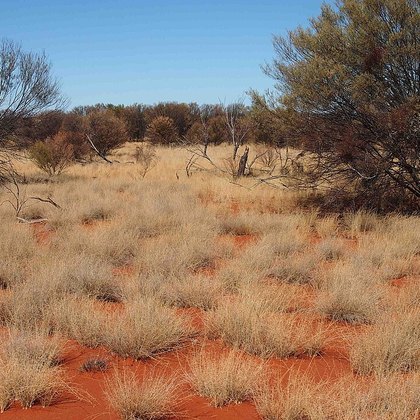
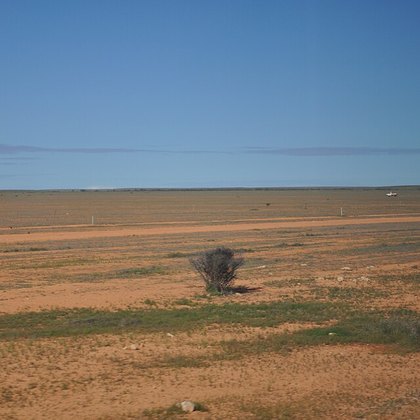
Semi-arid to arid inland country, almost always tied to mulga and other acacia scrub, locally also to the saltbush and bluebush flats adjoining it. The bird forages low in the branches and foliage of the shrubs, rarely on the ground, taking small insects and spiders. It is usually met singly or in pairs, far less often in parties than most of its relatives.
Where the bird is most often found, arranged by main group and formation.
Range and movements
Endemic to the dry heart of Australia: from the central inland of Western Australia east through the southern Northern Territory and South Australia to the western side of Lake Eyre, with extensions north into western Queensland. The range follows the distribution of mulga fairly closely. The species is sedentary, but can shift locally when drought strips the scrub.
- Resident
- Winter
- dark = core range, pale = thinly spread
Where and when to look
Work the edges of mulga scrub and the swales where the wattles stand thickest, and work them slowly. Once a thornbill is in view, check the breast first: streaked means Inland Thornbill, plain cream means this species or Chestnut-rumped. Only then check the eye: reddish brown here, white in Chestnut-rumped. The grey back confirms it, but in harsh desert light it reads deceptively pale.
Conservation
Least Concern (LC). The species is nowhere numerous but is spread over a very large area, and its habitat lies largely outside the intensively farmed zones. Where mulga has been cleared on any scale, or no longer regenerates because of overgrazing and too-frequent fire, the bird goes with it; camels, goats and rabbits contribute locally to that decline. Because the species is little studied, trends within the range are known with little certainty.
Scientific name
Acanthiza robustirostris | Milligan, 1903
Alexander William Milligan described the species in 1903. The epithet robustirostris compounds Latin robustus ('stout') and rostrum ('bill') and points to the notably heavy bill for a thornbill; older literature accordingly places the species in the subgenus Milligania, after its describer. The English Slaty-backed Thornbill and the Dutch grijsrugdoornsnavel take the slate-grey back, as does the Spanish acantiza pizarrosa.