All species › Passerines › Thornbills, scrubwrens, gerygones and allies › Chestnut-rumped Thornbill
Chestnut-rumped Thornbill | Acanthiza uropygialis
Roodstaartdoornsnavel | Acantiza culirroja
The Chestnut-rumped Thornbill is the palest of the four inland thornbills with a rufous rump, and the only one with a white eye — one look at that iris settles the identification. It is also the only thornbill that nests in tree hollows rather than in a self-built dome in a shrub, which ties it to old trees with hollows.

Voice
A long, penetrating chirping from the treetops, and while feeding a soft, repeated chirp by which a party keeps contact. The species mimics other birds fairly often. The voice is less musical than the tinkling song of Yellow-rumped Thornbill and reads as monotonous rather than tuneful.
No freely licensed recording has been found for this species yet; what to listen for is described below.
Identification
Nine to eleven centimetres, pale and plain greyish brown above, with a rich chestnut rump standing out sharply against that pale back, and a mostly black tail with pale tips. The iris is white to cream and is the decisive character. The face is speckled grey with white scalloping, the crown carries a rufous wash, and the bill is sharp and grey-black, as are the legs. The underparts are pale and unstreaked.
Confusion species
Three other thornbills carry a rufous rump and all three have a red to reddish-brown iris rather than a white one: Inland Thornbill (Acanthiza apicalis), which also has a clearly streaked throat and breast and cocks its longer tail almost continually; Slaty-backed Thornbill (Acanthiza robustirostris), with slate-grey rather than pale grey-brown upperparts and a heavier bill; and Brown Thornbill (Acanthiza pusilla), which is warmer brown and avoids the dry inland woodlands. Slender-billed Thornbill (Acanthiza iredalei) is also pale-eyed but has no more than an olive-yellow wash at the tail base and sits in treeless samphire. Buff-rumped Thornbill (Acanthiza reguloides) is pale-eyed too, but has a buff-yellow rump and an eastern range that overlaps this species' only marginally.
Habitat
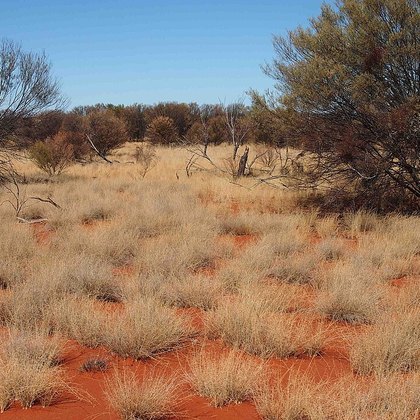
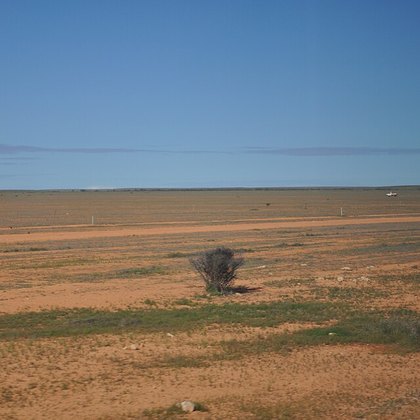
Dry inland woodland and timbered grassland, especially where mulga and mallee eucalypts set the tone, and beyond that open pastoral country and plains of saltbush and bluebush. It forages versatilely: in foliage, along branches, under loose bark, in fallen timber and on the ground as well. Food is mostly insects, with seed occasionally. It breeds cooperatively, with helpers at the nest, laying two to four eggs in a hollow in a tree or stump lined with dry grass, bark, moss, lichen and feathers; incubation runs about nineteen days and the young stay in the nest for fourteen to twenty-one.
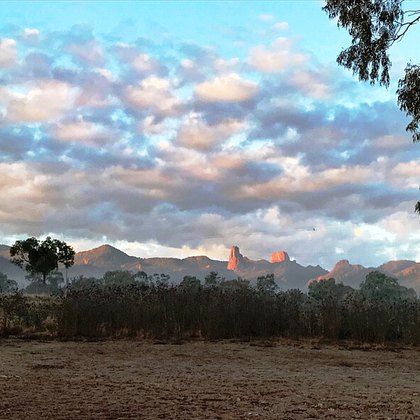
Where the bird is most often found, arranged by main group and formation.

Range and movements
Endemic to mainland Australia west of the Great Dividing Range: from southern Queensland and western New South Wales through Victoria — the Mallee in particular — and South Australia west of Yorke Peninsula into southern Western Australia, where it avoids the coastal districts and the humid south-west. It is absent from the far north. The species is largely sedentary and stays in the same country all year, although individuals sometimes travel long distances. It is usually seen in small parties or in twos and threes.
- Resident
- dark = core range, pale = thinly spread
Where and when to look
Work mulga and mallee woodland with old trees, and watch the eye. It is worth waiting for a bird to sit still in good light: white eye is this species, red eye is Inland or Slaty-backed. A second clue is behaviour at the nest: a thornbill shooting in or out of a hollow in a dead limb can only be this species in this company, because all the others build a domed nest in a shrub.
Conservation
Least Concern (LC), but it appears on the lists of declining inland woodland birds. Clearing of woodland, overgrazing and the loss of old hollow-bearing trees reduce both the food supply and the number of nest sites; the dependence on hollows makes it more exposed than its relatives, which can build a nest anywhere. In large, continuous mulga and mallee country it remains common.
Scientific name
Acanthiza uropygialis | Gould, 1838
John Gould described the species in 1838. The epithet uropygialis comes from mediaeval Latin uropygium, 'the rump', and points to the chestnut rump — the same character taken by the English Chestnut-rumped Thornbill and the Spanish acantiza culirroja. The Dutch name roodstaartdoornsnavel points to the tail, whereas it is the rump that is rufous: the tail is largely black with pale tips. The name is therefore misleading, but it is the guide's established form and is not altered here.