All species › Passerines › Thornbills, scrubwrens, gerygones and allies › Brown Thornbill
Brown Thornbill | Acanthiza pusilla
Bruine doornsnavel | Acantiza parda
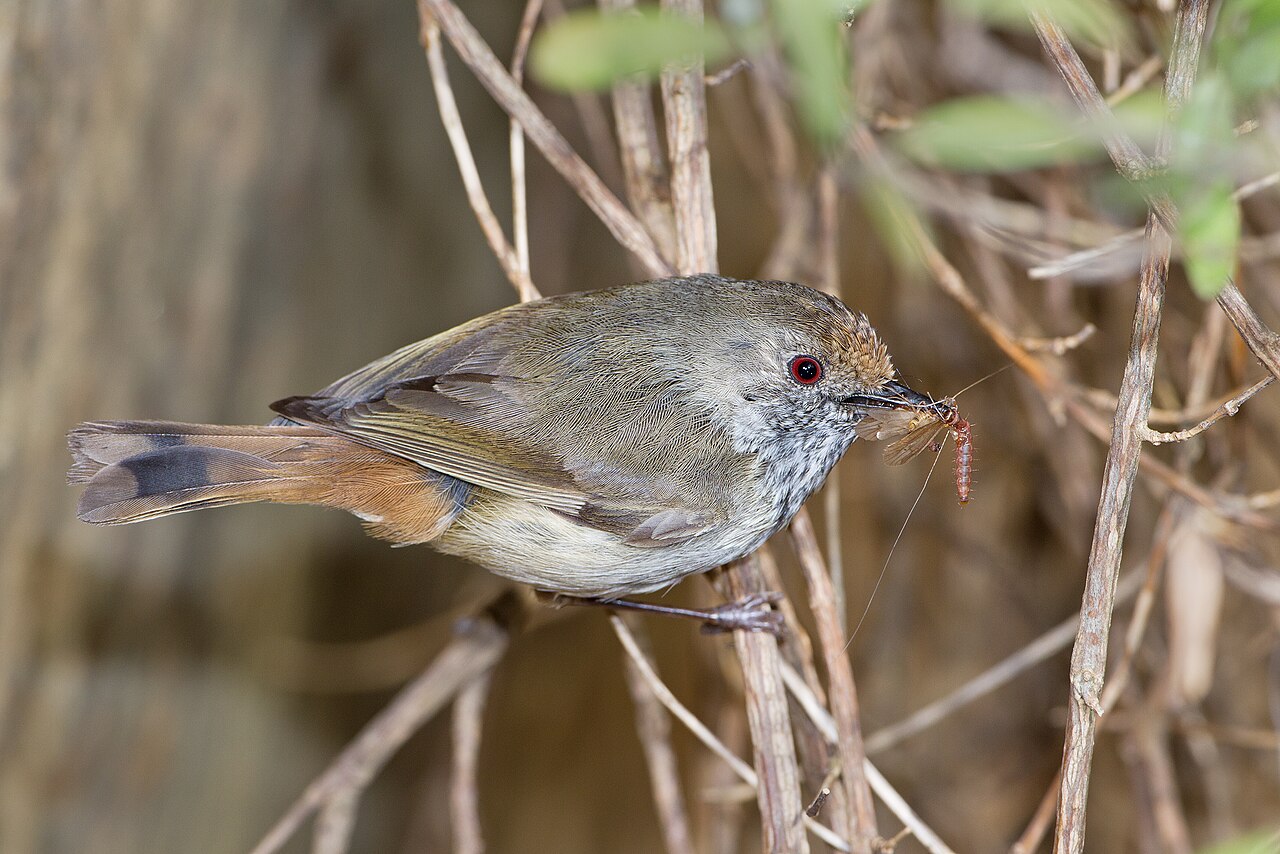
The Brown Thornbill is the plain brown bird of the dense understorey: ten centimetres, seven grams, with a dark red eye that at close range makes it unexpectedly alive. It is one of Australia's best mimics, and it uses the gift not for song but as a weapon — it copies the alarm calls of other species to pull a predator away from the nest.
Voice
The song is a rich musical warble with a mellow descending pee-orr in it, alternating with high whistles and fast cascading trills, and sharp rattling scolds in between. In danger the bird imitates the aerial alarm of other forest species, as though a hawk were passing; an approaching currawong looks up instead of at the nest. It answers at once when a person whistles its call back.
Recording: James Ray — CC BY-SA 4.0 · Faulconbridge, Blue Mountains City Council, New South Wales, Australia · xeno-canto
Identification
A bird of 9 to 10 centimetres, olive-brown to grey above, with a warm rufous forehead finely scalloped paler. Throat and breast are off-white with black streaking, the flanks olive-yellow, the rump rufous. The tail carries a black band and a pale tip and is often held cocked. The eye is dark red and shows plainly in good light. Sexes are alike; young birds have a dull forehead and a brown eye.
Confusion species
Inland Thornbill (Acanthiza apicalis) overlaps along the Great Dividing Range: shorter tail held cocked more often, less breast streaking, drier cover. Tasmanian Thornbill (A. ewingii) has white rather than yellow flanks and holds the wetter forest in Tasmania. Striated Thornbill (A. lineata) feeds high in the canopy and is streaked on the crown. White-browed Scrubwren (Sericornis frontalis) shows a white brow and a white mark below the eye.
Habitat
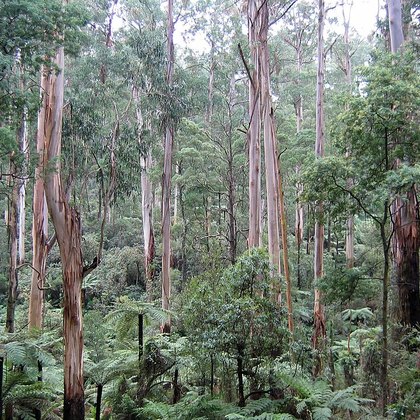
Dense shrubby understorey: wet montane forest with tree ferns, dry eucalypt forest with a thick ground layer, heath, shrubland and rainforest edge, and everywhere along creeks and gullies. It runs from the coast to twelve hundred metres and takes to gardens and parks as soon as there is an untidy prickly corner of native shrubs. Where the understorey is cleared out, it goes.
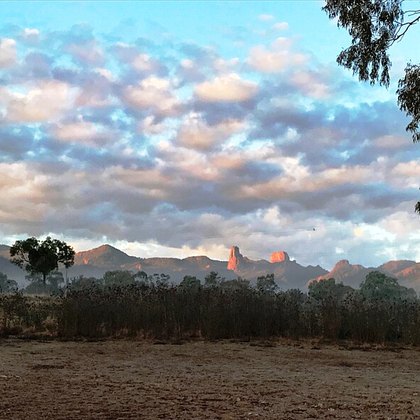
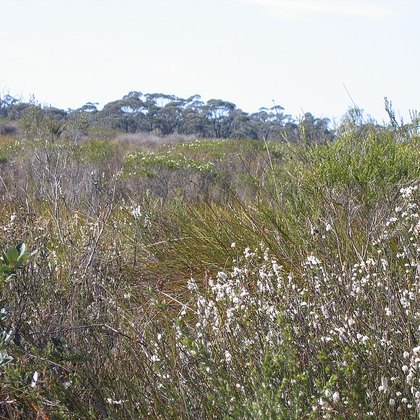
Where the bird is most often found, arranged by main group and formation.

Range and movements
Eastern and southeastern Australia, from southeastern Queensland through New South Wales, Victoria and Tasmania to the Mount Lofty Ranges in South Australia, and nowhere else. It does not migrate: a pair holds the same small territory the year round, often for years on end. Five subspecies are recognised, among them a distinct form on King Island.
- Resident
- dark = core range, pale = thinly spread
Where and when to look
Stand by a dense prickly bush and whistle its call back, or make a soft hissing noise; of all Australian bush birds this is the quickest to come and look. Then check the dark red eye and the black tail band — the best marks in the gloom of the understorey. In winter it travels in mixed flocks with scrubwrens and White-naped Honeyeaters.
Conservation
Least Concern (LC), and still one of the commonest small birds of southeastern Australian forest. It does drop out of woodland where the understorey has been cleared by stock, fire or gardening, and out of suburbs taken over by Noisy Miners. The King Island subspecies is in trouble: recent surveys put it at twenty to fifty birds.
Scientific name
Acanthiza pusilla | (Shaw, 1790)
Shaw described the species in 1790 as Motacilla pusilla, among the wagtails; the move to another genus puts author and year in parentheses. The genus Acanthiza was introduced by Vigors and Horsfield in 1827, from Greek akantha, 'thorn', and zao, 'to live': the bird of the thorn-brake. pusillus is Latin for 'very small'. The type locality is near Sydney, New South Wales.