All species › Passerines › Australasian robins › Buff-sided Robin
Buff-sided Robin | Poecilodryas cerviniventris
Bruinoorvliegenvanger | Petroica ventricanela
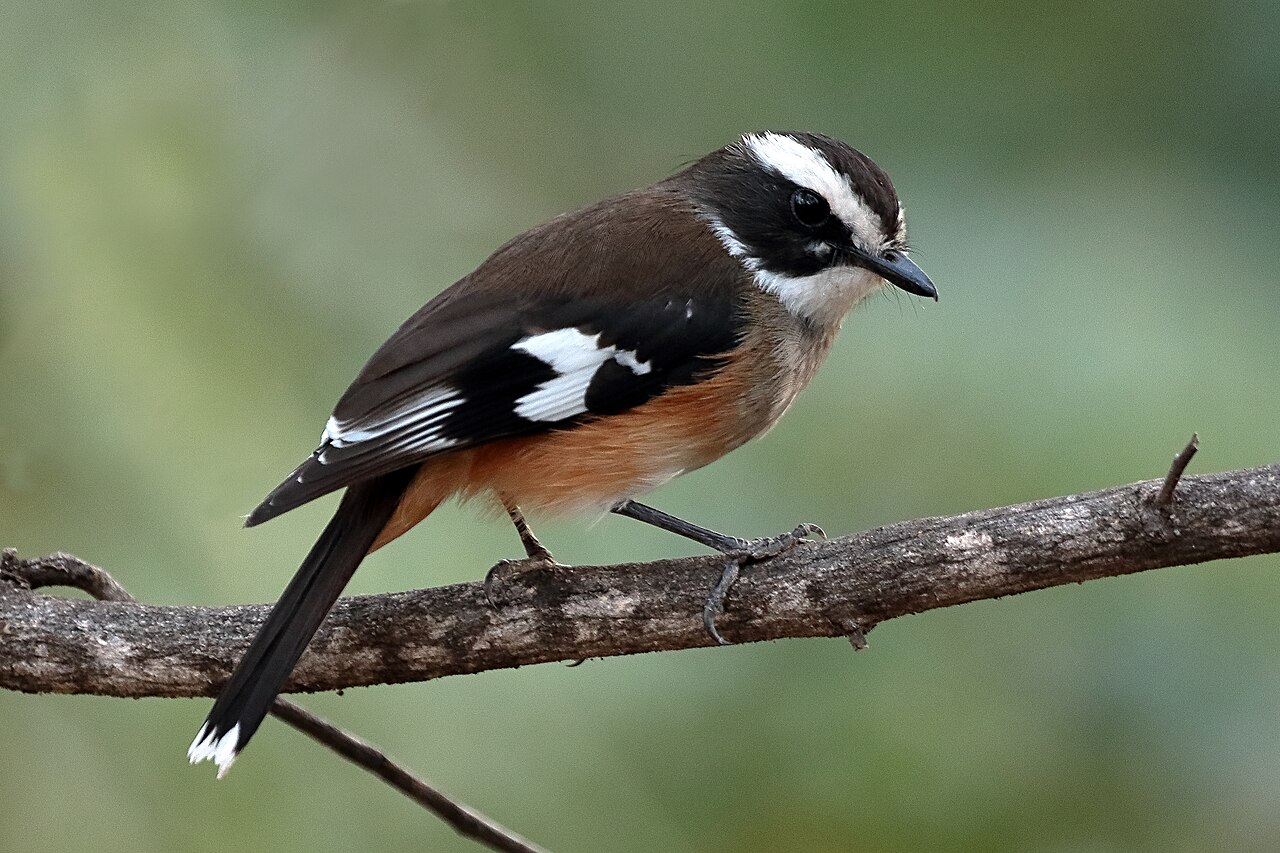
The Buff-sided Robin is a bird of a single line in the landscape: the green band of forest along the rivers of tropical northern Australia. Outside it, it hardly occurs at all. Seventeen centimetres, a dark hood with a long white eyebrow stripe, white from throat to belly, and warm buff to rufous flanks below the wing — in the dense pandanus and bamboo along a creek that is a surprisingly striking bird.
Voice
It calls infrequently, and then mainly early in the morning and late in the afternoon. The usual call is a run of two or three short, loud, clear whistled notes with the last one higher, or a series of three to five loud whistles of varying pitch. Both sexes call alike. There is also a chattering note used with other individuals and with young, and to coax a fledgling from the nest.
No freely licensed recording has been found for this species yet; what to listen for is described below.
Identification
A fairly large robin of sixteen to eighteen centimetres with a notably long tail. Head and neck dark with a broad, long white eyebrow stripe, black lores and ear-coverts, a white malar stripe and white throat; mantle and nape dark olive-brown to black. The breast has a distinct grey wash, the flanks and sides are deep fawn, fading to almost white on the belly. The wing is dark brown to black with a broad white wing bar, and all tail feathers are tipped white. Bill black, iris dark brown. The sexes cannot be told by plumage; males average larger. Juveniles are rusty brown with faint cream barring.
Confusion species
The only real counterpart is Poecilodryas superciliosa, with which this species was treated as conspecific between 1958 and 1994. They are geographically separated by the southern Gulf of Carpentaria: cerviniventris to the west, superciliosa in north-eastern Queensland. Where they come closest, the differences are sharpest. cerviniventris is larger, has a thicker and longer white supercilium, a duskier upper back, a broad black face band, a grey breast, a broader white wing bar and — the quickest field mark — deep fawn to rufous flanks where superciliosa is white to very pale grey. The white tips on all tail feathers likewise belong to cerviniventris. The third relative, the New Guinean Poecilodryas hypoleuca, does not occur in Australia.
Habitat
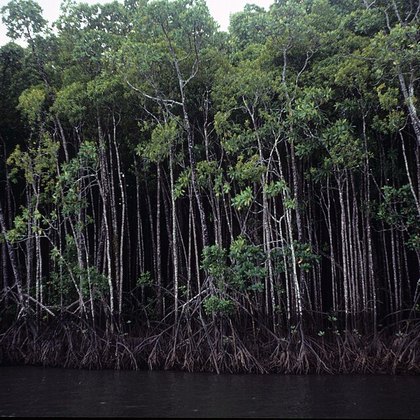
Dense riparian vegetation along creeks and rivers, under a canopy of paperbark, Nauclea, fig, Terminalia, pandanus and freshwater mangrove (Barringtonia acutangula). Within that band it seeks out the densest part: pandanus thickets, bamboo and freshwater mangrove scrub. It is also found in monsoon forests and vine thickets at the foot of sandstone escarpments, and occasionally in true tidal mangrove near the coast. It hardly ever enters the drier, more open forest next door. It hunts low: eighty-five per cent of all observed foraging takes place within three metres of the ground, and ninety-five per cent consists of a sally from a perch to the ground.
Where the bird is most often found, arranged by main group and formation.


Range and movements
The northern drainage basins of Australia, from the Kimberley in Western Australia through the Top End of the Northern Territory to the north-western Gulf of Carpentaria in Queensland. In the Northern Territory it ranges from the Western Australian border to Kakadu and east to the Roper, the McArthur and Settlement Creek; it skips eastern Arnhem Land. In Queensland it is confined to the Gregory and Nicholson Rivers, with Boodjamulla (Lawn Hill) National Park as the best-known site. It is sedentary in the strictest sense: banded birds move on average one kilometre and at most three, and a male on the McArthur River was resighted at the same place nine years and three months after banding.
- Resident
- Winter
- dark = core range, pale = thinly spread
Where and when to look
Do not walk into the forest, walk along the water, and look for the densest spot: where pandanus or bamboo stands right down to the waterline. Sit and wait for the sound — two or three clear whistles with the last one rising — and then search low, because the bird is seldom above three metres. Finally check the flank below the wing: if it is warm buff, this is the species; if it is white, then at the Gulf of Carpentaria you are on the wrong side of the divide.
Conservation
Least Concern (LC) on the strength of range size, but with a declining trend, and listed as Near Threatened within the Northern Territory. The cause lies in the habitat itself: riparian and monsoon forest are the most vulnerable formations in northern Australia. Cattle and water buffalo trample the banks, feral pigs root them up, and altered fire regimes eat away the edges of the monsoon forests. Add feral cats, which hit low-nesting and ground-foraging birds hardest, and dingo control, which can indirectly raise cat numbers. In a study of the vulnerability of savanna birds to climate change this species ranked among the ten most vulnerable. It occurs in a considerable number of reserves, from Geikie Gorge and Prince Regent to Kakadu, Limmen and Boodjamulla.
Scientific name
Poecilodryas cerviniventris | (Gould, 1858)
John Gould described the species in 1857 from specimens collected in 1856 by the surgeon and naturalist Joseph Ravenscroft Elsey on the Victoria River, near present-day Timber Creek, during Augustus Gregory's expedition; the name is usually cited as (Gould, 1858). Gould first placed it tentatively in Petroica and himself remarked that a separate genus would probably be needed. That became Poecilodryas, from Greek poikilos, 'spotted', and dryas, 'wood-nymph', after the white spots on wing and tail. cerviniventris is from Latin cervus, 'stag', and venter, 'belly': fawn-coloured underparts. The English name points at the same feature, which is indeed what the identification turns on.