All species › Passerines › Australasian robins › White-browed Robin
White-browed Robin | Poecilodryas superciliosa
Witoorvliegenvanger | Petroica cejuda
The White-browed Robin is the eastern counterpart of the Buff-sided Robin: the same build, the same broad white eyebrow stripe, the same preference for dense thickets beside water, but on the other side of the Gulf of Carpentaria. It keeps to the darkest part of creek-side forest in north-eastern Queensland, often holding its tail cocked upright. Whoever looks for it hears it first: a rapid, almost electric three-note burst from the scrub.
Voice
Two sounds stand out. The first is a rapid, hard and penetrating set of three notes, zap-zap-zap, that comes out of the dense vegetation like a spark and carries far over water. The second is a longer run of clear whistled notes. Both sexes call. Outside those outbursts it is a quiet bird, easily overlooked.
No freely licensed recording has been found for this species yet; what to listen for is described below.
Identification
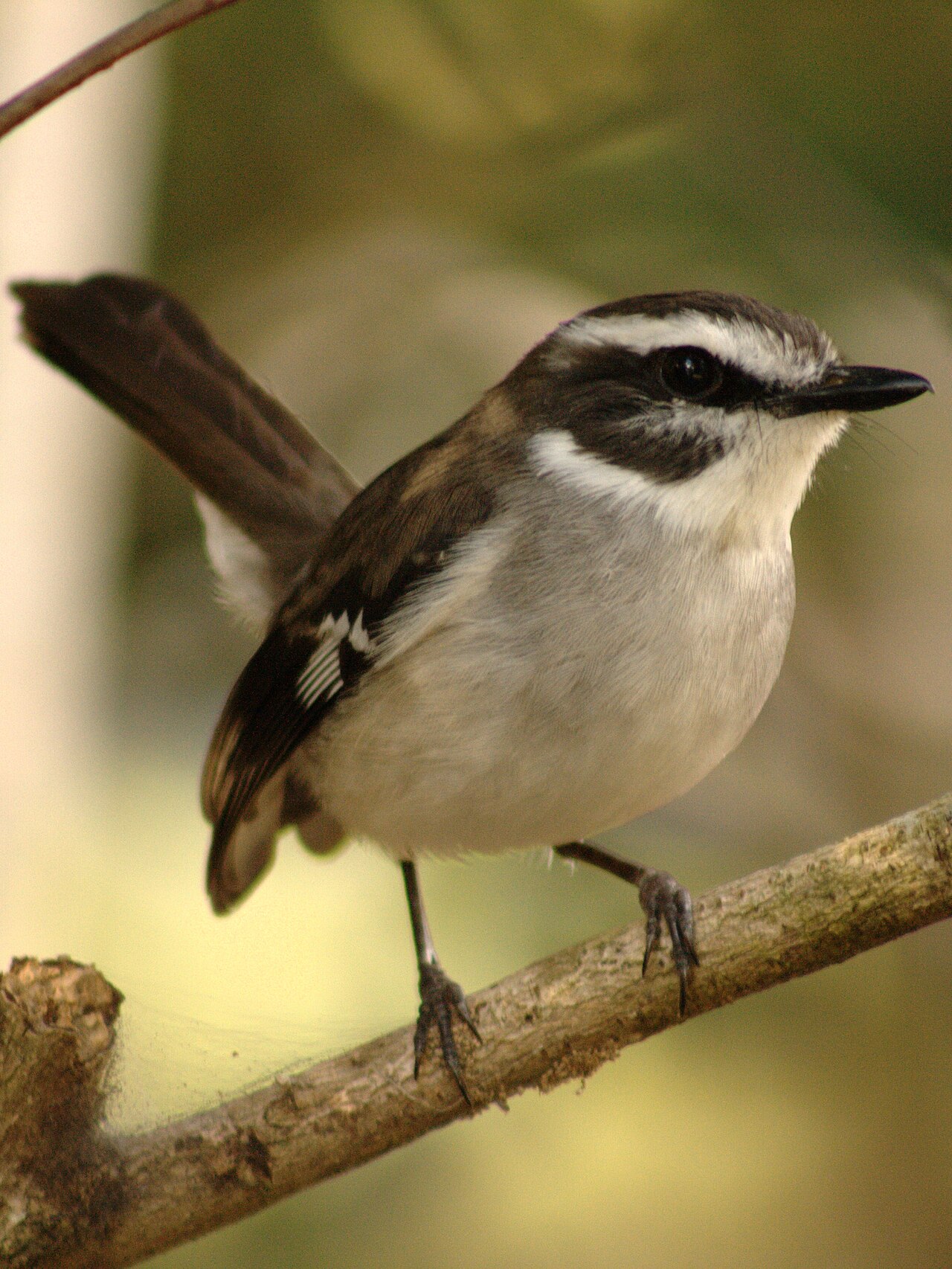
A slim robin with a long tail, olive-brown to greyish brown on back and wing. The most conspicuous mark is the broad white eyebrow stripe above a dark eye-stripe and dark ear-coverts; below it the throat is white and the breast pale grey, passing into a white belly. There is a clear white patch in the wing, and the tip of the tail carries white spots. The bill is black, the eye dark brown. The posture is characteristic: the tail is often held cocked upright. The species is monotypic — no subspecies are recognised.
Confusion species
The only real difficulty is Poecilodryas cerviniventris, with which this species stood as one between 1958 and 1994. The two are close relatives and replace one another geographically on either side of the southern Gulf of Carpentaria; genetic work points to allopatric speciation. The differences are sharpest precisely where the ranges come closest: superciliosa is smaller, has a thinner and shorter white supercilium, a paler upper back, a narrower white wing bar and — the quickest mark — white to very pale grey flanks, where cerviniventris is deep fawn to rufous. The undertail too is orange-toned in cerviniventris and white in superciliosa. Within the range of superciliosa further confusion is unlikely: no other Australian robin combines this eyebrow stripe with a cocked tail.
Habitat
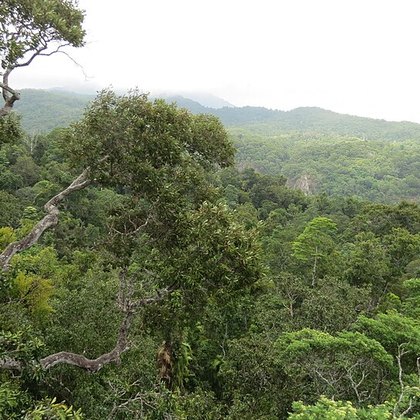
Dense, closed vegetation along creeks and rivers, plus wet, thick forest: riparian forest, monsoon forest and vine thicket, the edges of tropical rainforest and the growth around springs. As with the Buff-sided Robin, water is the common thread; the bird stays in the dense understorey and avoids the drier, open forest next to it.
Where the bird is most often found, arranged by main group and formation.


Range and movements
Endemic to Australia and confined to northern and north-eastern Queensland, from Cape York Peninsula south to the Burdekin. The range is neither continuous nor large: the species is described as common, but with a fragmented distribution that follows the watercourses and the position of the forest remnants. It is sedentary.
- Resident
- dark = core range, pale = thinly spread
Where and when to look
Follow a creek with a closed canopy and stop where the vegetation reaches the water. Do not whistle, but wait for the zap-zap-zap; it gives the bird away almost always before you see it. Then search between one and three metres up for a slim bird holding its tail upright and working through the thicket in short hops. If in doubt, check the flank: white means this species, warm buff means you are further west than you thought.
Conservation
Least Concern (LC). The population size has not been quantified; the species is regarded as common within its range, but with a fragmented distribution. Its vulnerability lies in the same direction as that of its western sister species: it depends entirely on dense riparian vegetation and on closed forest remnants, two formations in northern Queensland that suffer from grazing and trampling by stock, rooting by feral pigs, altered fire regimes and clearing. There is no separate national assessment of this species under Australian EPBC legislation; globally its situation gives no cause for concern for now.
Scientific name
Poecilodryas superciliosa | (Gould, 1847)
John Gould described the species in 1847, from material John Gilbert had collected in the Burdekin region in 1845. superciliosa is from Latin supercilium, 'eyebrow', after the stripe that defines the bird — the same idea as in the English name. The genus Poecilodryas is formed from Greek poikilos, 'spotted', and dryas, 'wood-nymph', after the white spots on wing and tail. Gould saw at once that this species and the Buff-sided Robin represented one another in their respective countries; later authors merged them between 1958 and 1994, after which Schodde and Mason separated them again.