All species › Passerines › Australasian robins › Black Robin
Black Robin | Petroica traversi
Chatham island-vliegenvanger | Petroica de las chatham
The Black Robin is entirely black, fifteen centimetres long, tame enough to approach within arm's reach, and probably New Zealand's most famous bird. In 1980 five were left, with a single fertile female. Every bird hopping about on Rangatira and Mangere today is a descendant of that one female, 'Old Blue'. No other bird species in the world has come back from so narrow a bottleneck.

Voice
The repertoire is small. The song, mostly from the male, consists of four or five clear notes and lacks the richness and melody of the mainland robins. Both sexes give a simple down-scale call, probably territorial, and a single high-pitched note in alarm or aggression. While feeding they use contact calls that resemble the trills of the Tomtit, but quieter.
No freely licensed recording has been found for this species yet; what to listen for is described below.
Identification
A small, rounded bird of fifteen centimetres and twenty-two to twenty-five grams, intermediate in size and form between the Tomtit and the robins of the main islands. Both sexes are completely black at all ages; only juveniles show subtle pale streaking on the crown. Tail, legs and bill are slightly longer and stouter than in the Chatham Island subspecies of the Tomtit. The bird looks short and round because it holds its large head hunched against the body. Male and female cannot be told apart in the field; weight and size ranges overlap too. Its flight capacity is somewhat reduced, and it moves mainly in brief direct flights.
Confusion species
On the Chatham Islands confusion is virtually impossible: this is the only robin and the only entirely black Petroica in the archipelago. It shares its breeding and foraging range with the Chatham Island subspecies of Petroica macrocephala, which is smaller, carries a white spot at the base of the bill and shows white and yellow in the male's plumage. The relatives of the main islands — Petroica australis on the South Island and Petroica longipes on the North — are larger, longer-legged and grey rather than black, and do not occur on the Chathams. The Australian red- and pink-breasted Petroica species, from Petroica goodenovii to Petroica rodinogaster, play no part here geographically. A fledged starling is at distance the most confusing animal on the islands, but it walks, glistens and has a quite different outline.
Habitat
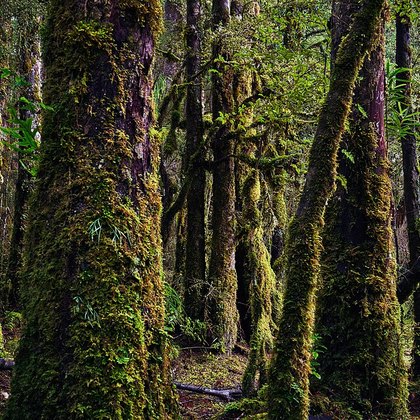
Almost exclusively the interior of closed forest — a habit unique among the temperate-zone Petroica of Australasia. It hardly ventures beyond the forest edge and breeds poorly in scattered or fragmented vegetation. It favours large continuous tracts with a closed canopy, a mixed understorey and edges enclosed by dense sheltering vegetation; forest with trees of mixed height and age classes offers the most nesting and foraging opportunities. Very little of this is left: about eight hectares of suitable forest remain on Mangere and about a hundred and ten on Rangatira. It nests in tree cavities or dense Muehlenbeckia vines, usually within two metres of the ground, and feeds in the understorey and on the forest floor, pouncing from a low branch or flicking the litter over with its bill.
Where the bird is most often found, arranged by main group and formation.
Range and movements
Endemic to the Chatham Islands, and now confined there to the southern extremity of its former range. It once inhabited the five major forested islands of the group: Chatham (90,040 ha), Pitt (6,325 ha), Rangatira or South East Island (218 ha), Mangere (113 ha) and Little Mangere (9 ha). Human activity eliminated all those original populations; on the main island it was gone before 1871. Today it is on Rangatira and Mangere, both protected sanctuaries. Water and open ground are barriers to it: natural exchange between islands does not occur, and the colonising of detached forest is slow. Attempts to establish a third population in a fenced covenant on Pitt Island have so far failed.
- Resident
- dark = core range, pale = thinly spread
Where and when to look
Rangatira and Mangere are closed sanctuaries that cannot simply be visited; this is not a bird you look for with binoculars but one that, if you ever get there, you see walking across your boot. The species is remarkably confiding and is drawn to human presence. Anyone visiting the islands should watch the lowest two metres of the forest: sitting still on a low branch, turning only its head, then a short drop into the litter. The quickest distinction from the Chatham Island Tomtit is not colour but posture and the heavier legs.
Conservation
This is New Zealand's central conservation story, and probably the bird world's. Introduced cats and Pacific rats swept away the original populations swiftly; on the main island of Chatham the species had gone before 1871, and one large population was lost to decline in forest area and quality alone. By 1976 a handful of birds remained on Little Mangere, nine hectares in extent, where the forest was collapsing. That year the seven survivors were moved to Mangere Island. By 1980 five were left, with only one fertile female: 'Old Blue', who lived more than fourteen years, several times the mean life expectancy of just over four. Don Merton and his New Zealand Wildlife Service team raised her annual output by removing the first clutch each year and placing the eggs in the nest of the Chatham Island race of the Tomtit — cross-fostering. The tomtits raised the first brood, and the robin pair, having lost their eggs, laid again and raised a second. At the same time the operation showed how an intervention can overshoot: many females laid their eggs on the rim of the nest, where they could not survive unaided. By pushing those eggs back in, the underlying deleterious gene spread until more than half of all females did it. When people stopped, rim-laying became less frequent again, though nine per cent of birds still did it in 2011. Today there are around three hundred birds; in October 2020 Rangatira held at least 264, stable or slowly increasing, while Mangere stood at 34 and was declining, prompting increased monitoring. The species remains vulnerable in a way that numbers alone cannot fix. All birds descend from Old Blue; degrees of relatedness within the populations are among the highest recorded for any wild bird species, and inbreeding depression shows up as lowered reproductive output. On top of that, its reproductive output is naturally the lowest recorded among known Australasian Petroica: small clutches, a long breeding cycle and a climatically shortened season. Nest predation by introduced starlings is the commonest cause of nest failure on Rangatira, accounting for almost twenty-one per cent of failed nests; mice are a further concern. The IUCN now lists the species as Vulnerable, after earlier standing as Endangered and before that Critically Endangered — one of the few Red List downlistings that rest on genuine recovery. On the New Zealand list it is still Nationally Critical. Management rests on three pillars: keeping the small populations free of predators, new pathogens and further habitat loss; safeguarding genetic health by letting numbers grow; and spreading the risk by translocating birds to new suitable forest within the Chathams.
Scientific name
Petroica traversi | (Buller, 1872)
Walter Buller described the species in 1872. The first scientific mention came a year earlier, when William Travers reported to the Wellington Philosophical Society on the findings of his son Henry H. Travers (1844–1928), who had visited the Chatham Islands; the species name traversi commemorates him. The genus Petroica was introduced by Swainson in 1830, from Greek petros, 'rock', and oikos, 'home'. For a long time the bird stood as Miro traversi. In Moriori it is karure, in Māori kakaruia.