All species › Passerines › Australasian robins › Rose Robin
Rose Robin | Petroica rosea
Grijs-roze vliegenvanger | Petroica rosada
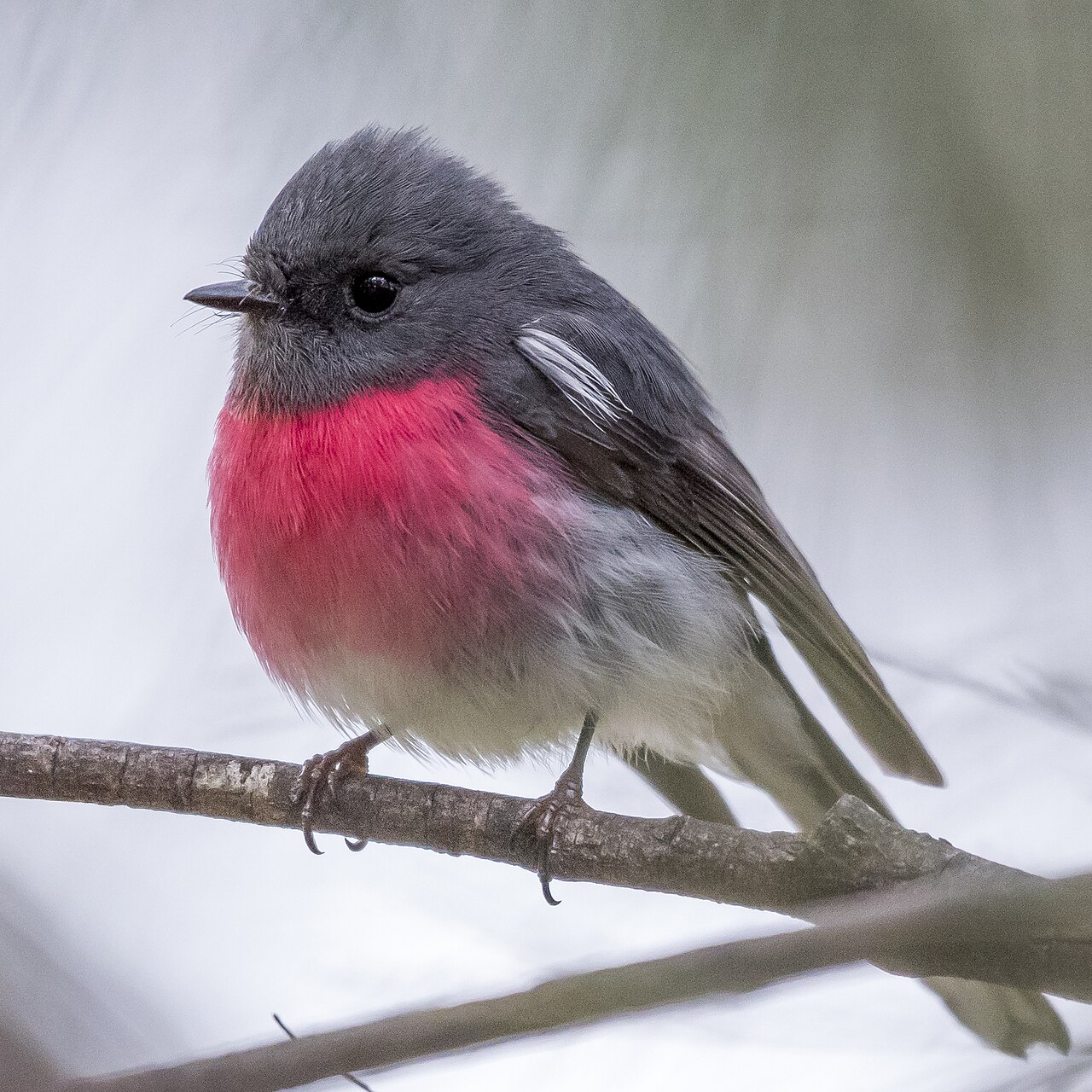
The Rose Robin is the lightest of all Australasian robins: barely eight and a half grams, eleven centimetres long, with a long tail and a tiny bill. The male carries a rose-pink breast over uniformly dark grey upperparts; the female is so plain that most observers pick her out by movement rather than colour. Unlike most of its relatives this species lives high in the canopy of wet forest and gullies, not on or just above the ground.
Voice
A thin, high, insect-like voice that is easily overlooked. The song is a rapid, reedy trill delivered from high in the canopy, and in the forest it sounds more like a cricket than a bird. There is also a hard, short tick as contact and alarm note, often in series of two or three. Because the bird rarely comes low, that tick is in practice the first thing an observer notices; the song has to be deliberately picked out of the background.
No freely licensed recording has been found for this species yet; what to listen for is described below.
Identification
A very small, long-tailed bird with a fine, broad little bill. The male is uniform dark slate-grey above — not black — with a small, sharply defined white forehead spot, a white throat, and a pink breast and upper belly that give way abruptly to white on the lower belly and undertail. The tail is black with white corners. The female is plain dull grey-brown above and greyish white below, with at most a wash of pink on the breast and a couple of small pale wing markings. In the field it is the build that stands out: smaller and slighter than any other robin, and nearly always high in the trees.
Confusion species
The closest relative is Pink Robin (Petroica rodinogaster), the most similar bird in the field but clearly heavier: its male has a sooty black head, throat and upperparts instead of slate grey, lacks the white throat, and the pink runs much further down the belly. The female of P. rodinogaster is warm brown with two clear buff wing bars, where this female is a colder grey-brown and almost unmarked. P. rodinogaster also occupies Tasmania and the wet gullies of Victoria, while this species avoids Tasmania and reaches further north. Scarlet Robin (Petroica boodang), Flame Robin (Petroica phoenicea) and Red-capped Robin (Petroica goodenovii) are all red rather than pink and forage low or on the ground; P. boodang further has a large white forehead patch and a black throat, P. phoenicea has orange-red running up over the throat, and P. goodenovii has a red crown. The most threatened member of the genus, Black Robin (Petroica traversi), is entirely black and confined to the Chatham Islands.
Habitat
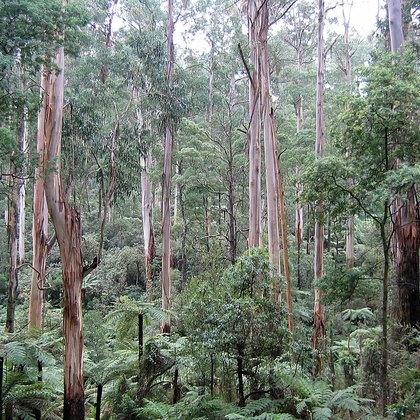
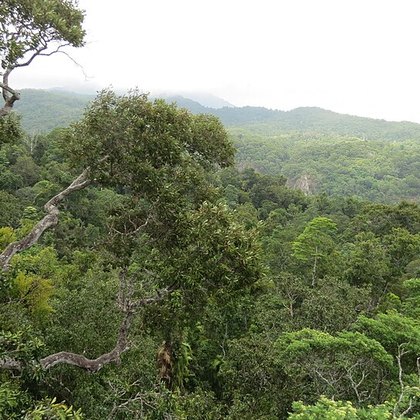
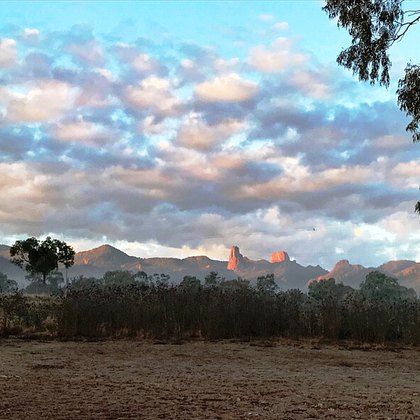
In the breeding season wet eucalypt forest, rainforest gullies and shaded creek valleys of the eastern ranges, where the bird stays almost year-round in the upper half of the trees. It forages on the wing and in fluttering sallies through the canopy, gleaning insects and spiders from leaf and twig, and — unlike most robins — does not return again and again to the same perch. Outside the breeding season it shifts into lower and drier forest, open eucalypt woodland and creekside woodland, and then also comes lower in the vegetation.
Where the bird is most often found, arranged by main group and formation.

Range and movements
Endemic to eastern and south-eastern Australia. AviList gives the breeding range as north-eastern New South Wales to south-western Victoria, with wintering west to the Mount Lofty Ranges and north to the Blackdown Tableland; winter records reach southern Queensland. Tasmania is not reached. The seasonal movement is a genuine migration rather than mere wandering: the high, wet breeding forests largely empty out in winter and the birds then appear in forest where they are absent in summer.
- Resident
- Winter
- dark = core range, pale = thinly spread
Where and when to look
Look up. An observer scanning the ground and lower branches of a damp gully will almost certainly miss this species; the canopy is the place. Watch for a tiny bird working through the leaves in short fluttering sallies and changing perch each time rather than returning. The hard tick is the best way in, and in winter it pays to search lower, drier forest, where the bird may come to eye level and the pink is finally easy to see.
Conservation
Least Concern (LC). The species has a wide range and is nowhere rare, but it is tied to wet forest with a closed canopy, and the loss and fragmentation of exactly that forest type is the main pressure cited for it. Because it is found in winter over a much larger and partly different area than in summer, it also depends on two landscapes at once; management that attends only to the breeding forests therefore does not cover the whole annual cycle.
Scientific name
Petroica rosea | Gould, 1840
John Gould described the species in 1840 from material taken on the Hunter River in New South Wales, under the name it still bears. The genus Petroica combines Ancient Greek petros ('rock') with oikos ('dwelling'), hence 'rock-dweller'. The epithet rosea is Latin roseus, 'rosy', after the male's breast. The English name Rose Robin and the Spanish petroica rosada take that same colour; the Dutch grijs-roze vliegenvanger sets the grey of the upperparts beside it, precisely the character that separates the species from the Pink Robin.