All species › Passerines › Australasian robins › Pink Robin
Pink Robin | Petroica rodinogaster
Zwart-roze vliegenvanger | Petroica encarnada
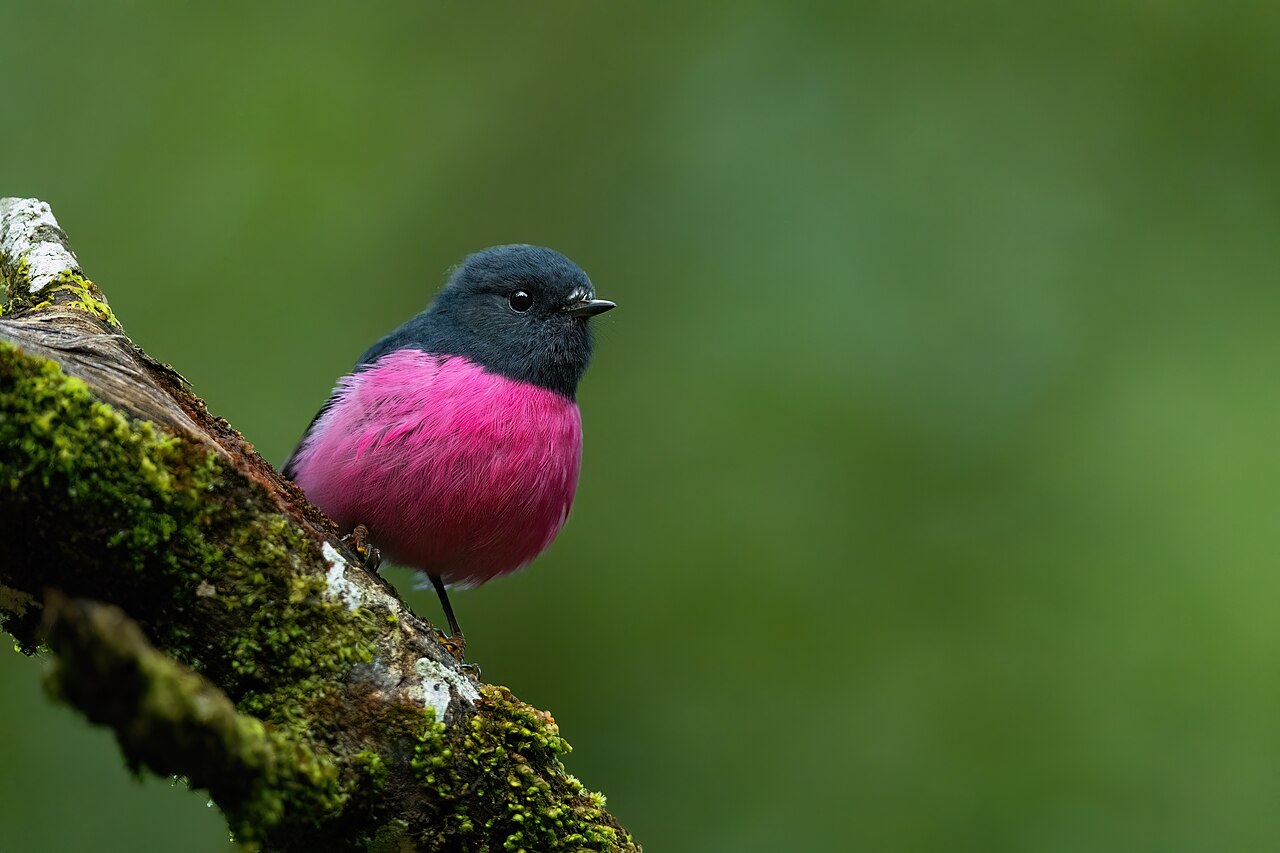
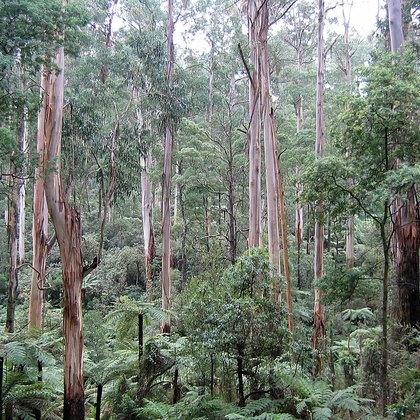
The Pink Robin is the bird of the wet, dark gullies of Tasmania and the south-eastern corner of the mainland: tree ferns, moss, dripping myrtle beech and eucalypt, and in among them a small bird that is sooty black with a bright pink breast and belly. It is the dimmest light in which any Australian robin lives, and for exactly that reason the pink flares surprisingly brightly in a patch of sun. The female is warm brown and so inconspicuous that she is often noticed only once the male turns out to be nearby.
Voice
A soft, short song that rarely carries far: a series of clear, slightly plaintive whistled notes, often with a faintly descending close, interspersed with a sharp tick-tick contact call. In the dense, damp forest much of the sound is lost among dripping leaves and the noise of the creek, and it is then mainly the hard tick that draws attention. The bird sings most in the early morning and at the start of the breeding season.
No freely licensed recording has been found for this species yet; what to listen for is described below.
Identification
A small, compact bird with a rounded head and a short, broad bill. The male is sooty black on head, throat, breast sides and the whole of the upperparts, with a small dull white forehead spot, and carries a pink breast that runs on without a sharp border across the belly, turning white only on the undertail coverts. There is no white throat. The female is warm olive-brown to grey-brown, with two clear buff wing bars, a faint pale forehead spot and sometimes a weak pink wash on the belly. Both sexes like to sit low, on a low branch or a trunk, flicking the tail as they do so.
Confusion species
Rose Robin (Petroica rosea) is the only other pink robin and the real risk of confusion. That species is smaller and slighter, its male slate-grey rather than sooty black, with a white throat and a sharply bordered white lower belly, and its pink confined to the breast; moreover P. rosea forages almost entirely high in the canopy, while this species stays low in the understorey. The females separate on tone: warm brown with clear buff wing bars in P. rodinogaster, cold dull grey-brown and almost unmarked in P. rosea. P. rosea also avoids Tasmania altogether. The red robins — Scarlet Robin (Petroica boodang) with its large white forehead patch and black throat, Flame Robin (Petroica phoenicea) with orange-red running up over the throat, and Red-capped Robin (Petroica goodenovii) with its red crown — are all distinctly red rather than pink below and choose open, drier woodland. The most threatened member of the genus, Black Robin (Petroica traversi), is entirely black without any red or pink and lives only on the Chatham Islands.
Habitat
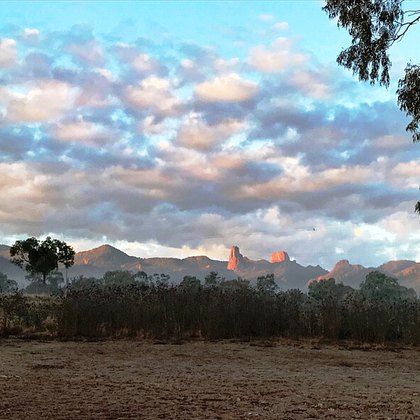
Wet eucalypt forest and temperate rainforest with a dense understorey of tree ferns, and in Tasmania and southern Victoria also the southern beech forest of Nothofagus cunninghamii. The bird keeps to the lower strata, watching from a low branch or a fallen trunk and dropping onto prey on the ground or among the moss. Outside the breeding season young birds and females in particular disperse into drier and more open forest, out into eucalypt woodland and sometimes into gardens along the forest edge.
Where the bird is most often found, arranged by main group and formation.

Range and movements
Tasmania and the Bass Strait islands, and on the mainland a small, fragmented range in southern Victoria — the Otway Ranges, the Strzelecki Ranges and the Central Highlands — with an outlier into far south-eastern New South Wales. The type specimen comes from Maria Island off Tasmania. In winter some birds leave the wet gullies and then appear further north and in lower, drier forest; some Tasmanian birds cross Bass Strait to the mainland.
- Resident
- dark = core range, pale = thinly spread
Where and when to look
Search a wet gully with tree ferns, at eye level and below, and stand still for a few minutes: this species often comes closer of its own accord. Watch for a dark, compact bird sitting motionless on a low branch and flicking its tail. In shade the pink reads as almost black and gives itself away only in a shaft of sun, so work from posture and from the hard tick rather than from colour. In winter it is worth searching drier, more open forest, where brown birds in particular turn up.
Conservation
Least Concern (LC). The Tasmanian core is large and continuous, but the mainland portion is small and fragmented and depends on the survival of wet gully forest with tree ferns — a forest type vulnerable to logging and above all to severe bushfire, which can remove the moist understorey in a single season and from which recovery takes decades. For the mainland populations that is the pressure management points to; for the species as a whole there is no evidence of a national decline.
Scientific name
Petroica rodinogaster | (Drapiez, 1819)
Pierre Auguste Joseph Drapiez described the species in 1819 as Saxicola rodinogaster, from material taken on Maria Island off Tasmania. The genus Petroica combines Ancient Greek petros ('rock') with oikos ('dwelling'). The epithet is built from Greek rhodinos ('rosy') and gaster ('belly'), hence 'rosy-bellied' — an apt name, since it is precisely the continuous pink belly that separates the species from Rose Robin. The English name Pink Robin and the Spanish petroica encarnada name only the colour; the Dutch zwart-roze vliegenvanger sets the black of the upperparts beside it.