All species › Passerines › Australasian robins › Flame Robin
Flame Robin | Petroica phoenicea
Vuurbuikvliegenvanger | Petroica flamígera
The Flame Robin is the largest and longest-winged of the Australian red robins and the only one that truly migrates. The male carries an orange-red glow that does not stop at the breast but runs up over the throat and chin, as though the bird were alight from below — hence the name. In winter the birds gather in loose parties on bare paddocks and along fence wires in the lowlands, far from the subalpine forests in which they breed.

Voice
One of the pleasantest sounds of the south-eastern forest: a high, clear, slightly rolling phrase of a few notes, often rendered as a quick musical ditty delivered from a high dead branch and carrying further than that of Scarlet Robin. The male sings persistently from a prominent song post in the breeding season. The contact call is a soft, high tsip; outside the breeding season that is usually all a winter party gives away.
No freely licensed recording has been found for this species yet; what to listen for is described below.
Identification
The male is dark slate-grey to black above, with a small and inconspicuous white forehead spot, a white wing bar and white outer tail feathers. The underparts are orange-red from chin and throat across the breast and far onto the belly, turning white only low down — there is no black throat. The female is plain dull grey-brown with two buff wing bars and a small pale forehead spot; she lacks the red almost entirely and is thus the plainest of the Australian robin females. The build is slighter and longer-winged than in the relatives.
Confusion species
Scarlet Robin (Petroica boodang) is the species most often confused with this one: it has a black throat and chin below a deep scarlet breast, and a large, pure white forehead patch — in this species, by contrast, the orange-red runs up over the throat and the forehead spot is small. Red-capped Robin (Petroica goodenovii) is much smaller, has a red crown and black throat and is a bird of the dry inland. Rose Robin (Petroica rosea) and Pink Robin (Petroica rodinogaster) are pink rather than orange-red and keep to closed, damp forest. The females are the hardest: this one is the plainest and largest, with two clear buff wing bars and virtually no red, while the female of P. boodang usually still shows an orange-red wash on the breast and that of P. goodenovii has a reddish forehead. The most threatened member of the genus, Black Robin (Petroica traversi), is entirely black and lives only on the Chatham Islands.
Habitat
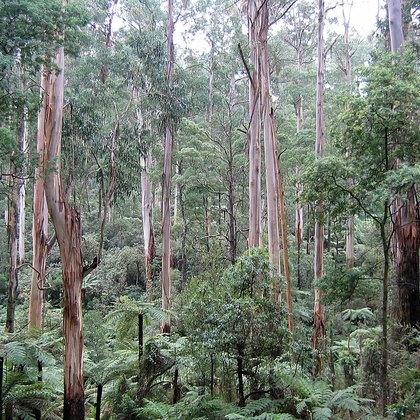
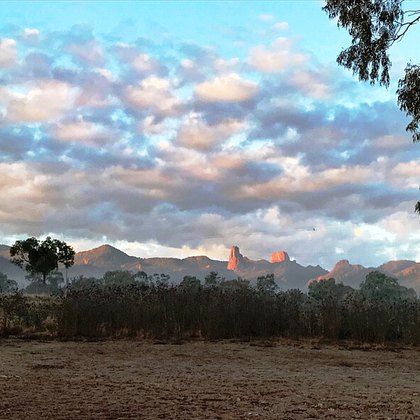
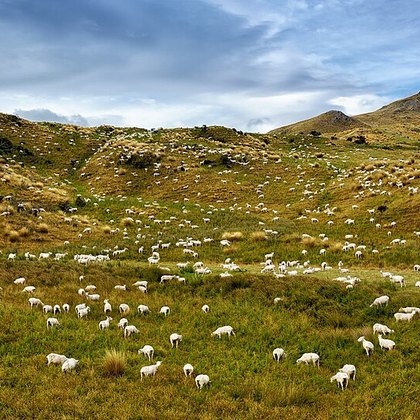
In the breeding season wet and dry eucalypt forest in the higher parts of the south-eastern ranges and in Tasmania, with a preference for forest opened up by fire or logging, where standing dead trees serve as song posts and lookouts. In winter the species leaves that forest and appears in open lowland country: pasture and grazing land, stubble, roadsides and bare ridges, where the birds watch for ground insects from fence posts and thistles and keep together in loose parties.
Where the bird is most often found, arranged by main group and formation.

Range and movements
South-eastern Australia and Tasmania. AviList gives the breeding range as north-eastern New South Wales to the Grampians in western Victoria and Tasmania — the Mount Lofty Ranges have been abandoned as a breeding area — with wintering west to those same Mount Lofty Ranges and north into south-eastern Queensland. Many Tasmanian birds cross Bass Strait to the mainland in winter. That makes this the only species in the genus with a true migration measurable over hundreds of kilometres.
- Resident
- Winter
- dark = core range, pale = thinly spread
Where and when to look
In winter this is the easiest red robin in Australia: search open, bare farmland for small birds on fence posts and wires, often several together, and check for orange running right up to the chin. In the breeding season go higher into the forest instead, to open burnt or logged patches with standing dead trees, and then the clear song from a high branch is the quickest way in. On every red male, check the throat first.
Conservation
Least Concern (LC), but there is continuing concern about numbers in south-eastern Australia and the species is on regional lists in several states there. The pressures named are the loss of standing dead timber in the breeding forests, altered fire regimes, and the decline of open, insect-rich grassland in the wintering areas. Because breeding and wintering grounds lie hundreds of kilometres apart and have nothing ecologically in common, the species is a prime example of a bird that cannot be secured by managing one landscape alone.
Scientific name
Petroica phoenicea | Gould, 1837
John Gould described the species in 1837 from New Holland material later attributed to Sydney. The genus Petroica combines Ancient Greek petros ('rock') with oikos ('dwelling'). The epithet phoenicea goes back to Latin phoeniceus, 'purple-red, crimson', by way of Greek and ultimately of the purple dye of Phoenicia. The English name Flame Robin and the Spanish petroica flamígera take the image of the flame; the Dutch vuurbuikvliegenvanger stresses exactly what separates the species from Scarlet Robin, namely that the fire runs far onto the belly and up over the throat.