All species › Passerines › Australasian robins › Norfolk Robin
Norfolk Robin | Petroica multicolor
Norfolkvliegenvanger | Petroica multicolor
The Norfolk Robin lives only on Norfolk Island, an island of barely thirty-five square kilometres in the Tasman Sea, and nowhere else on earth. At first glance the male closely resembles the Scarlet Robin of mainland Australia — black, with a white forehead patch and a red breast — and until 1999 the two were treated as one species. Today it is a separate, endemic species with a population of a few hundred pairs, and it stands as Endangered on the red list.

Voice
A soft, clear song of a few whistled notes, close in character to that of Scarlet Robin, together with a short hard tick as contact call. Because the species lives in dense, damp forest and no other robin occurs on Norfolk Island, any robin-like song on the island is this bird. That makes the voice a reliable way in, even where the bird itself stays hidden in the understorey.
No freely licensed recording has been found for this species yet; what to listen for is described below.
Identification
The male is black on head and upperparts, with a conspicuous white forehead spot, white wing bars and only a trace of white in the tail tips. Breast and upper belly are bright red, passing to white on the lower belly. The female is mainly brown, with a pinkish red wash on the breast; immatures resemble the female. Within the Pacific robin group this is the largest form, with a notably long tarsus — the bird forages much on and just above the forest floor, searching damp leaf litter for invertebrates.
Confusion species
On Norfolk Island itself confusion is impossible: there is no other robin. The identification problem is one of the literature and the museum drawer. Scarlet Robin (Petroica boodang) of mainland Australia closely resembles this species and was long treated as the same; that bird is slightly larger and heavier, has less white in the wing but distinctly white outer tail feathers, where this species has at most a trace. Flame Robin (Petroica phoenicea) has no black throat and a much smaller forehead spot, and Red-capped Robin (Petroica goodenovii) a red crown; neither occurs on Norfolk. The pink species, Rose Robin (Petroica rosea) and Pink Robin (Petroica rodinogaster), are pink rather than red. The most threatened member of the genus, Black Robin (Petroica traversi), is entirely black and confined to the Chatham Islands — like this species, an island endemic with a very small population.
Habitat
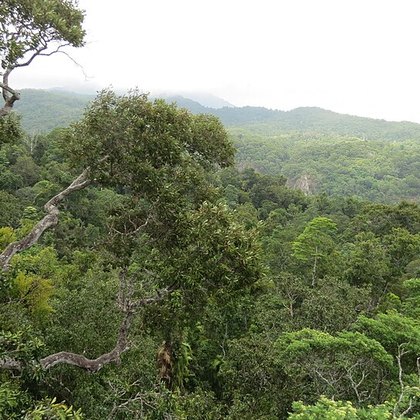
Subtropical rainforest with a dense shrub layer and an open, moist ground layer of leaf litter, in which the bird finds most of its food. According to the available sources the species is largely confined to the Mount Pitt section of Norfolk Island National Park and to a few remaining forest patches nearby. It is therefore not merely an island species but a species of one forest remnant on that island, and that is exactly why it is so vulnerable.
Where the bird is most often found, arranged by main group and formation.
Range and movements
Endemic to Norfolk Island, an Australian external territory in the Tasman Sea between Australia and New Zealand. The type material comes from the island itself. There is no migration and no exchange with other populations; the nearest relatives within the Pacific robin group live on other island groups in the south-western Pacific. Reintroduction has been proposed for nearby Phillip Island, where the forest is recovering since the removal of rabbits.
Where and when to look
Walk the national park tracks around Mount Pitt and search low: this robin sits on low branches and on the forest floor, not in the canopy. Stand still in a damp, shaded spot with deep leaf litter and wait; like other robins the bird often comes closer of its own accord. A bright red breast low in the understorey on Norfolk Island is always this species, and the tick betrays the bird even where the forest is dense.
Conservation
Endangered (EN on the IUCN Red List, as AviList v2025b also records). The population was estimated in 1988 at four to five hundred pairs; no more recent figure was found in this round, and for a species with this range one is urgently needed. The main threats are degradation and fragmentation of the forest and above all predation by black rats and feral cats — the familiar pattern in which an island bird with no evolutionary experience of mammalian predators faces two at once. Management focuses on control of those predators and on pushing back invasive plants that crowd out the understorey; reintroduction to Phillip Island has also been proposed, to give the species a second and safer population.
Scientific name
Petroica multicolor | (Gmelin, 1789)
Johann Friedrich Gmelin described the species in 1789 as Muscicapa multicolor, from Norfolk Island material; in 1829 it was moved to Petroica. The genus combines Ancient Greek petros ('rock') with oikos ('dwelling'). The epithet multicolor is Latin for 'many-coloured', after the black, white and red of the male. The bird was long treated as one species with Scarlet Robin; in 1999 it was split off as part of the Pacific robin assemblage, and genetic work confirmed its species status in 2015. The English name Norfolk Robin, the Dutch norfolkvliegenvanger and the Spanish petroica multicolor follow the island and the scientific name respectively.