All species › Passerines › Australasian robins › Tomtit
Tomtit | Petroica macrocephala
Maorivliegenvanger | Petroica carbonera
The Tomtit is the smallest black-and-white bird of the New Zealand forest: thirteen centimetres, eleven grams, with a head that looks far too large for the body under it. It sits still on a low branch, turns only its head, and then drops onto prey in the litter. From Northland to Stewart Island it is in almost every patch of forest, and it often comes closer than binoculars will focus.

Voice
The male sings all year except while moulting: a thin, high, fast swee-swee-swee-swee of two to three seconds that cuts through the forest understorey. He also gives a run of chuck notes that speeds up and then slows away again, often in answer to a neighbour. Both sexes keep contact year-round with short sharp peeps, and those are usually heard well before the bird itself is seen.
Recording: craig wilson — CC BY 4.0 · Millerton, Buller District, West Coast Region, New Zealand · xeno-canto
Identification
A rounded bird of thirteen centimetres with a big round head, a small bill and a short black tail. The North Island male is black on head, back and wing, with a white wingbar and clean white underparts; on the South Island, the Chathams and the Aucklands he carries a yellow to orange breast band between the black and the white. Both sexes show a white spot at the base of the bill, the quickest mark in dark forest. In the female all the black is replaced by brown. The Snares form is wholly black and, at twenty grams, nearly twice as heavy.
Confusion species
The larger Petroica relatives of the main islands — P. longipes on the North Island and P. australis on the South — are longer-legged and greyer, lack the white wingbar and hop about on the forest floor rather than watching from a perch. Grey Warbler (Gerygone igata) is smaller, plain grey-green and never still. A female against the light can suggest a white-eye, but it lacks the white eyering of the Silvereye.
Habitat
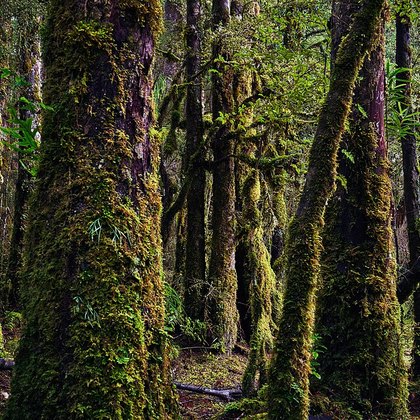
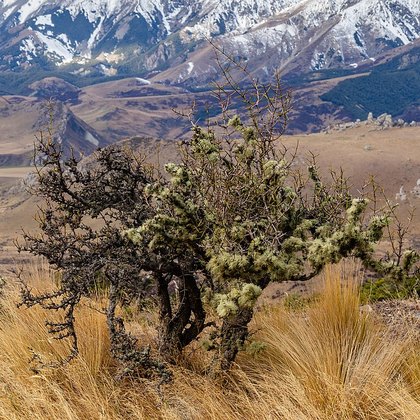
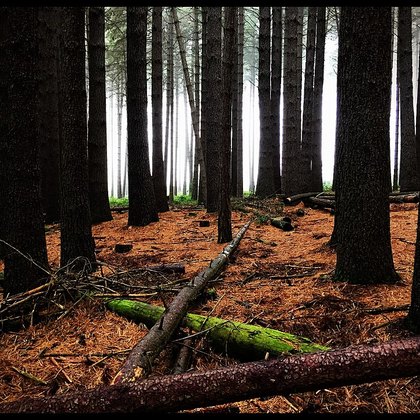
Almost any closed forest: podocarp-broadleaf on the North Island, southern beech in the mountains of the South Island, kauri forest in Northland. It also uses planted Pinus radiata, manuka and kanuka scrub, and well-treed farm shelterbelts. From sea level to the treeline; in June and July mountain birds drop a few hundred metres down the slope.
Where the bird is most often found, arranged by main group and formation.


Range and movements
Both main islands and Stewart Island, plus a string of offshore islands each with its own subspecies: Little Barrier, Kapiti, the Chathams, the Snares and the Aucklands. It has not been lost from any forest district and, unlike many other native songbirds, has held on well away from predator-free islands. It does not migrate and generally spends its life in one block of forest.
- Resident
- dark = core range, pale = thinly spread
Where and when to look
Stand still on a forest track and wait: the Tomtit comes to look at you, often to within two or three metres. A soft pssht or a tap on a trunk brings it in within seconds. Check the white spot above the bill on every bird; it stays visible in the darkest understorey and saves you the question of female or juvenile.
Conservation
Least Concern (LC), and 'Not Threatened' on the New Zealand list. It is one of the few native songbirds doing well away from predator-free islands: it nests high and hidden enough to keep part of its nests out of reach of rats and stoats, and it accepts planted forest. The Chatham Island subspecies is another matter — Nationally Endangered, and confined to a handful of small islands.
Scientific name
Petroica macrocephala | (Gmelin, 1789)
Gmelin described the bird in 1789 as Parus macrocephalus, among the tits; because it was later moved to another genus, author and year stand in parentheses. The genus Petroica was introduced by Swainson in 1830, from Greek petros, 'rock', and oikos, 'home'. macrocephala is Greek for 'great-headed', from makros, 'large', and kephale, 'head'. The type came from Queen Charlotte Sound in the South Island; the Maori name is miromiro.