All species › Passerines › Australasian robins › North Island Robin
North Island Robin | Petroica longipes
Noordereilandvliegenvanger | Petroica de isla Norte
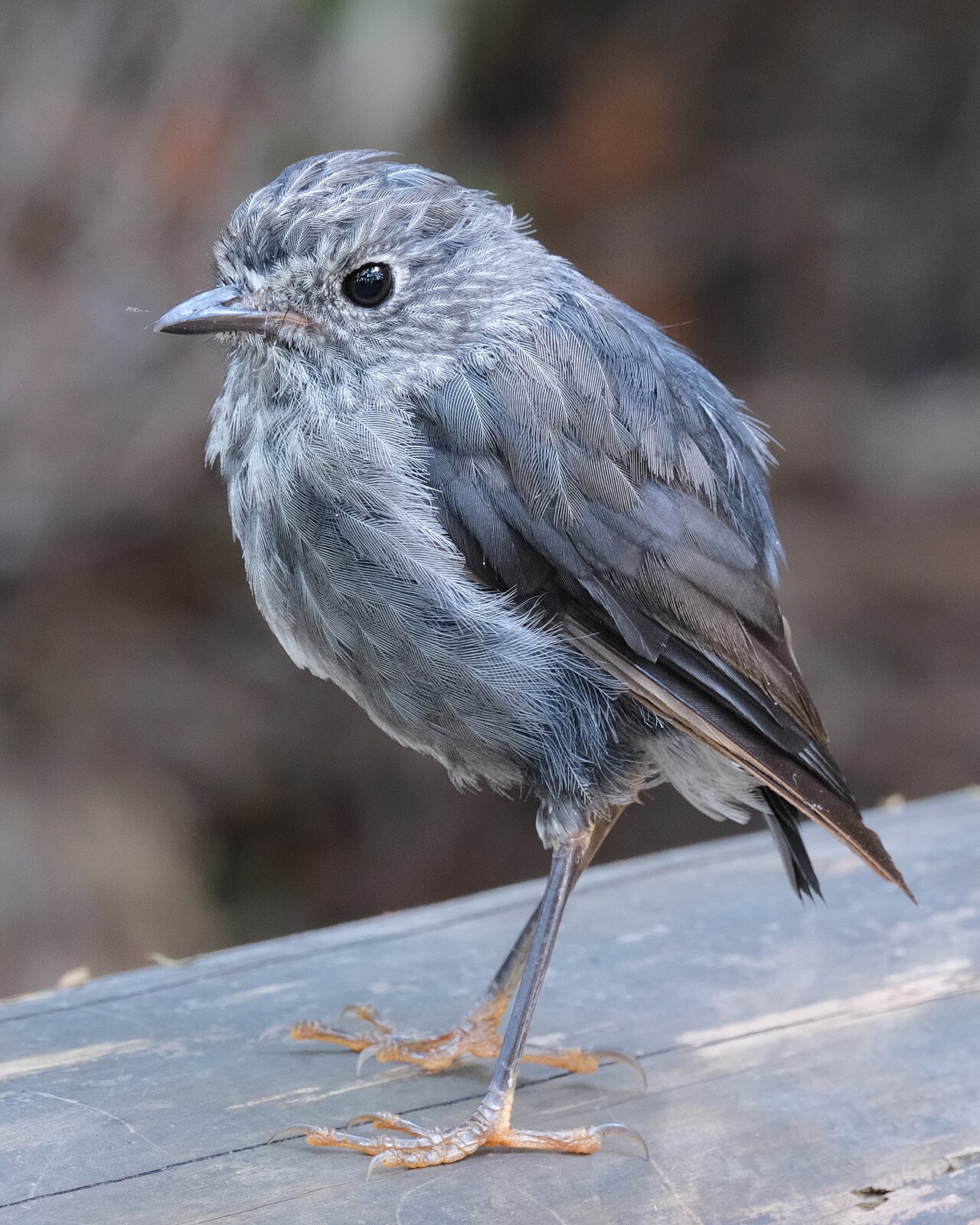
The North Island robin, toutouwai in Māori, is the North Island counterpart of the bird every South Island visitor knows: small, dark grey, on strikingly long legs, sitting bolt upright on a low branch. It is also one of the few forest birds in the world that comes to you — scuff the leaf litter and within a minute it will be standing between your boots. Molecular work showed the northern and southern birds diverged before the Pleistocene, and AviList now treats it as a full species.
Voice
The male delivers his fullsong from a high perch: loud, clear, far-carrying phrases, mostly in the early morning, serving both territory and mate attraction. Both sexes also give a quiet, muttered subsong, heard most often during moult. The best-known signal is the downscale, a three- to four-second series of loud, descending 'chuck' notes given mainly outside the breeding season. Single 'chuck' notes serve as contact calls, and the same note repeated rapidly is the alarm at a rat or cat.
No freely licensed recording has been found for this species yet; what to listen for is described below.
Identification
A bird of 18 cm and about 35 g, upright in posture and with long, slender legs for its size — that silhouette on a low branch or on the ground is the quickest mark. The male is dark grey to almost black on head and upperparts, with brown-black flight feathers and tail; many body feathers have pale shafts, giving a faint fine streaking at close range. Below there is a pale grey-white belly patch, not sharply demarcated above. The female is paler, duller grey, with a smaller and vaguer patch. Both sexes can raise a small white spot of feathers above the bill base when excited. Males darken slowly and only reach full adult plumage at nineteen to twenty-two months, so a pale bird is by no means necessarily a female.
Confusion species
The nearest relative is the South Island robin (Petroica australis), from which this species was until recently not distinguished. On average the northern bird is a little blacker and shows a smaller, cooler grey-white belly patch, while the southern one often shows a larger, more sharply cut white to yellowish-white belly — but these differences overlap heavily, vary with age and sex, and are not reliable in the field. As the South Island robin's own page in this guide puts it: the island decides. The two ranges nowhere meet, so a robin on the North Island and its offshore islands is this species, one on the South Island or Stewart Island the other. Confusion with any other forest bird is slight: Petroica macrocephala (miromiro, the tomtit) is clearly smaller and shorter-legged, with a thick round head and, in the male, a crisp white wingbar and a sharply cut white breast — all three marks the robin lacks. The Chatham Island black robin (Petroica traversi) does not occur on the mainland.
Habitat
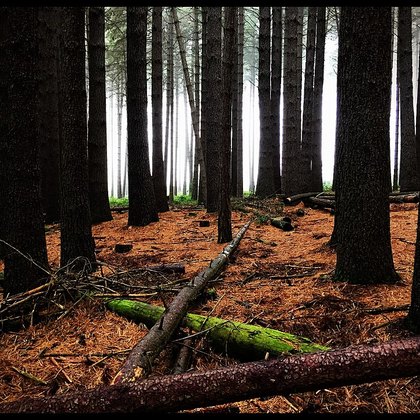
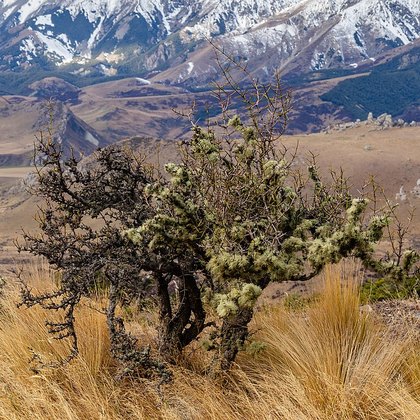
Mature native forest is the core: podocarp-broadleaf forest and, higher and more centrally, southern beech forest, from sea level to the treeline. What it really needs is a closed canopy above an open, moist forest floor, because it hunts by perching low and dropping onto ground prey. That also makes old dense scrub suitable and — unusually for an endemic — mature exotic conifer plantations, where it does well under pines with an open floor layer.
Where the bird is most often found, arranged by main group and formation.


Range and movements
Resident on the North Island of New Zealand; measurements for this guide give ten qualifying years out of ten and 21,201 regional records, with eight resident units and one breeding unit. The distribution is strikingly patchy: the core lies centrally, roughly from Taranaki to the Bay of Plenty, with island populations on Little Barrier (Hauturu), Kapiti and Moturua, and reintroductions into fenced sanctuaries such as Zealandia near Wellington, Bushy Park near Whanganui and Moehau on the Coromandel. Large tracts of apparently suitable forest stay empty — predation, not habitat, draws this map. Note that this is a recent AviList split that GBIF's own backbone taxonomy has not yet caught up with; the figures above were therefore measured separately at subspecies level.
- Resident
- Breeding (summer)
- dark = core range, pale = thinly spread
Where and when to look
Stand still and scrape the leaves and humus open with your shoe. Keep it up for half a minute and you will first hear a single 'chuck', then see the bird hopping in, often to within a metre. Whoever looks for it by walking and peering usually fails; whoever stands still and rummages in the litter is almost always found.
Conservation
The IUCN lists the species as Least Concern and puts the population at more than ten thousand birds, but the New Zealand national list is stricter and calls it Declining. The problem is familiar and one-sided: introduced mammals. Ship rats, stoats, feral cats and possums take eggs and nestlings and kill incubating females in particular, so that unmanaged populations skew towards a surplus of males and slowly bleed away. Where trapping and toxins are applied intensively, or on predator-free islands, the species recovers fast, which has made it a favourite candidate for reintroduction into fenced sanctuaries.
Scientific name
Petroica longipes | (Lesson & Garnot, 1827)
The Dutch name follows the guide's pattern and simply names the island the bird lives on, against the South Island robin. The specific name longipes means 'long-footed' and points at the most useful field mark the bird has. The Māori name toutouwai covers both island species. Despite the English name this is no relative of the European robin but an Australasian Petroicidae, a family related to neither robins nor flycatchers.