All species › Waterfowl › Ducks, swans and geese › Cape Barren Goose
Cape Barren Goose | Cereopsis novaehollandiae
Hoendergans | Ganso ceniciento
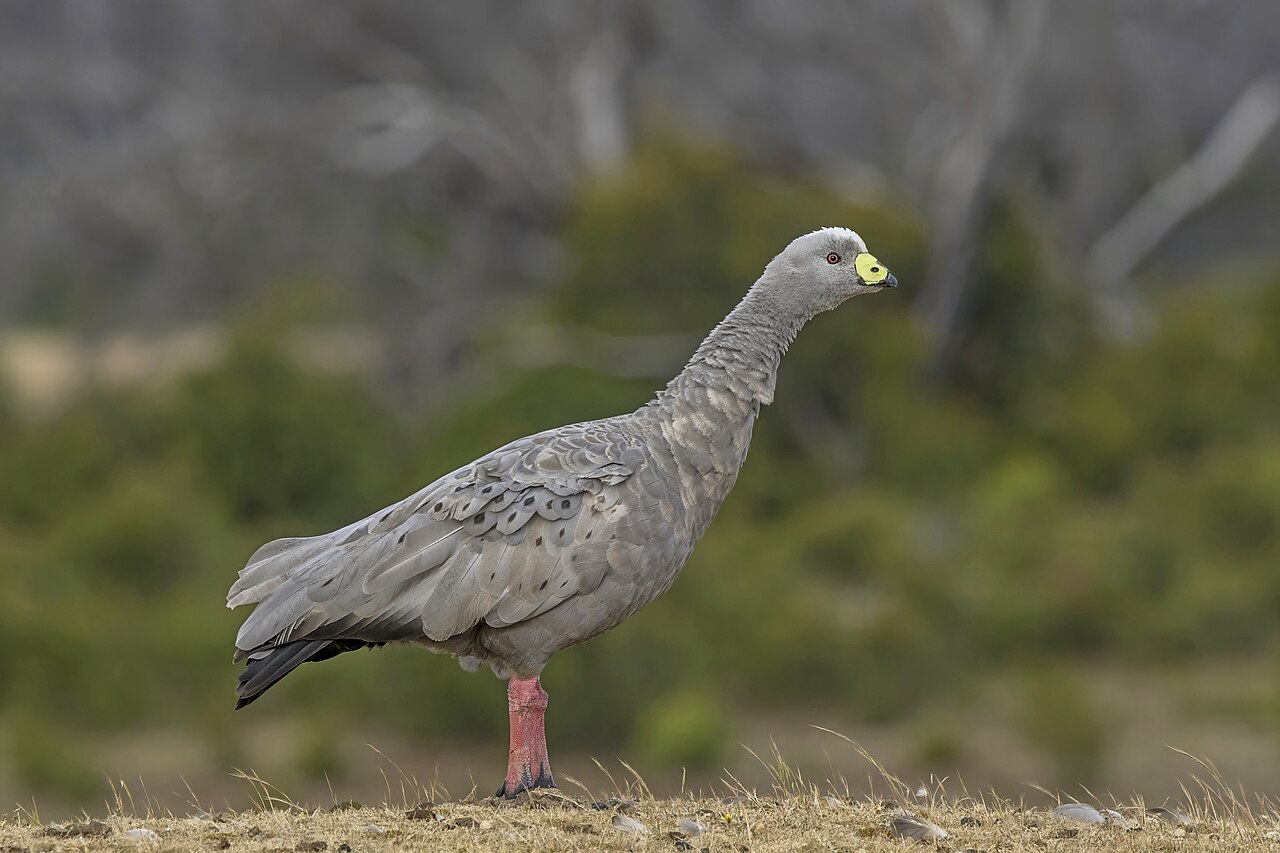
The Cape Barren Goose is the large, pale grey goose of the granite islands off Australia's southern coast: a bird that stands on land almost all the time, crops grass and seldom swims. The unmistakable mark is on the bill — a swollen, lime-green to yellow-green cere that all but covers the short black bill.
Voice
Usually quiet on the ground, but loud in alarm and in display. The female gives a low, grunting, pig-like gronk, which earned the species its Australian nickname of Pig Goose; the male answers with a much higher, harsh trumpeted ark, ark-ark, above all in flight. A pair defending its ground runs through a triumph ceremony loudly and in unison, necks stretched and calls following fast on each other.
No freely licensed recording has been found for this species yet; what to listen for is described below.
Identification
A heavy goose of 75 to 100 cm and three and a half to over five kilos, evenly ash-grey overall, with a strikingly small head on a thick neck. The short triangular black bill hides under a bulging lime-green cere that shows at distance as a yellow blaze in the face. Rows of round dark spots run across the shoulder and wing coverts. The legs are pink to deep red with black feet — a combination no other waterbird of the area has. In flight the black primaries and the dark trailing edge stand out against the pale grey.
Confusion species
Nothing else in the area looks like it. Maned Duck (Chenonetta jubata) grazes the same pasture, but is barely half the size, with a brown head and black stripes down the back. In New Zealand a feral Cape Barren Goose may stand among Greylag Geese (Anser anser) or Canada Geese (Branta canadensis): those are brown-patterned, with a long bill and no green cere, and dark rather than pink legs. At long range a grazing flock looks pale and shapeless; look then for the red legs and the small head.
Habitat
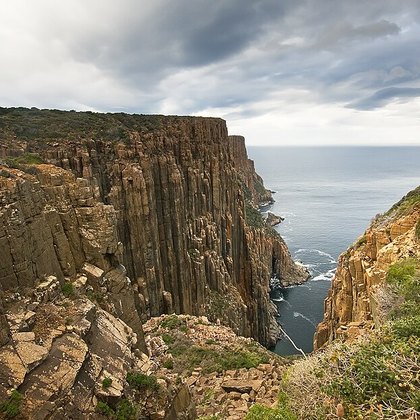
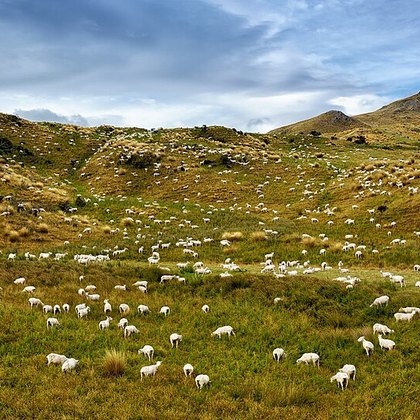
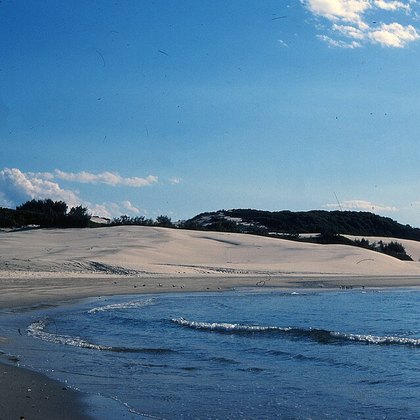
Granite islands off the coast, clothed in tussock grass — above all Poa poiformis — spear grass, succulents and low heathy scrub. Beyond that it grazes on the mainland in stock pasture, on grain crops and on clover and legumes, often alongside cattle. Because it can drink salt and brackish water it can stay year-round on islands with no fresh water; it does swim, but seldom and briefly.
Where the bird is most often found, arranged by main group and formation.
Range and movements
The coast of south-eastern Australia and southern Western Australia. The centre of gravity is the Bass Strait islands, with the Furneaux Group and the name-giving Cape Barren Island at its core, and beyond that the islets off South Australia and Victoria; on Kangaroo Island an introduced population is established. In the west the separate subspecies grisea holds the Recherche Archipelago, with about a thousand birds. In New Zealand it is an introduction: at least three releases failed between 1869 and 1874, but six birds freed at Lakes Hawea and Wanaka in 1914-15 held on there until 1946, and feral birds now sit mainly in North Canterbury, where up to eighteen together have been counted at St Anne's Lagoon since 1988, and scattered around Christchurch, at Helensville on the South Kaipara and near Hokitika.
- Resident
- Breeding (summer)
- dark = core range, pale = thinly spread
Where and when to look
Take the ferry or a boat trip to the Bass Strait islands, or drive the coastal pasture of South Australia and Victoria in winter, when the birds move onto the mainland to graze. Keep clear of a breeding pair: from autumn on they defend their patch of island loudly and stubbornly, and the male will walk straight at a person without hesitating.
Conservation
Least Concern (LC) on the IUCN list, with a population of around eighteen thousand birds — which still leaves it one of the rarest geese in the world. In the 1950s it stood at the edge of extinction through shooting and egg collecting; protection of the breeding islands and the spread of grazed grassland on the mainland have let it recover since. Federally and in New South Wales and Victoria it is still rated vulnerable, in South Australia rare, and the western subspecies grisea is listed as vulnerable under the EPBC Act. Disturbance of the breeding islands by visitors and by introduced predators remains the pinch point.
Scientific name
Cereopsis novaehollandiae | Latham, 1801
Latham described the bird in 1801, in his Supplementum Indicis Ornithologici, and erected the genus in the same breath; author and year therefore carry no parentheses. Cereopsis combines Latin cera, 'wax', with Greek opsis, 'appearance', for the waxy skin over the bill. novaehollandiae means 'of New Holland', the old European name for Australia. The type locality lies in Bass Strait, where the bird was found on the first surveys; Cape Barren Island in the Furneaux Group supplied the English name, while the Dutch name points at the bird's hen-like, grazing gait.