All species › Waterfowl › Ducks, swans and geese › Muscovy Duck
Muscovy Duck | Cairina moschata
Barbarie-eend | Bragado
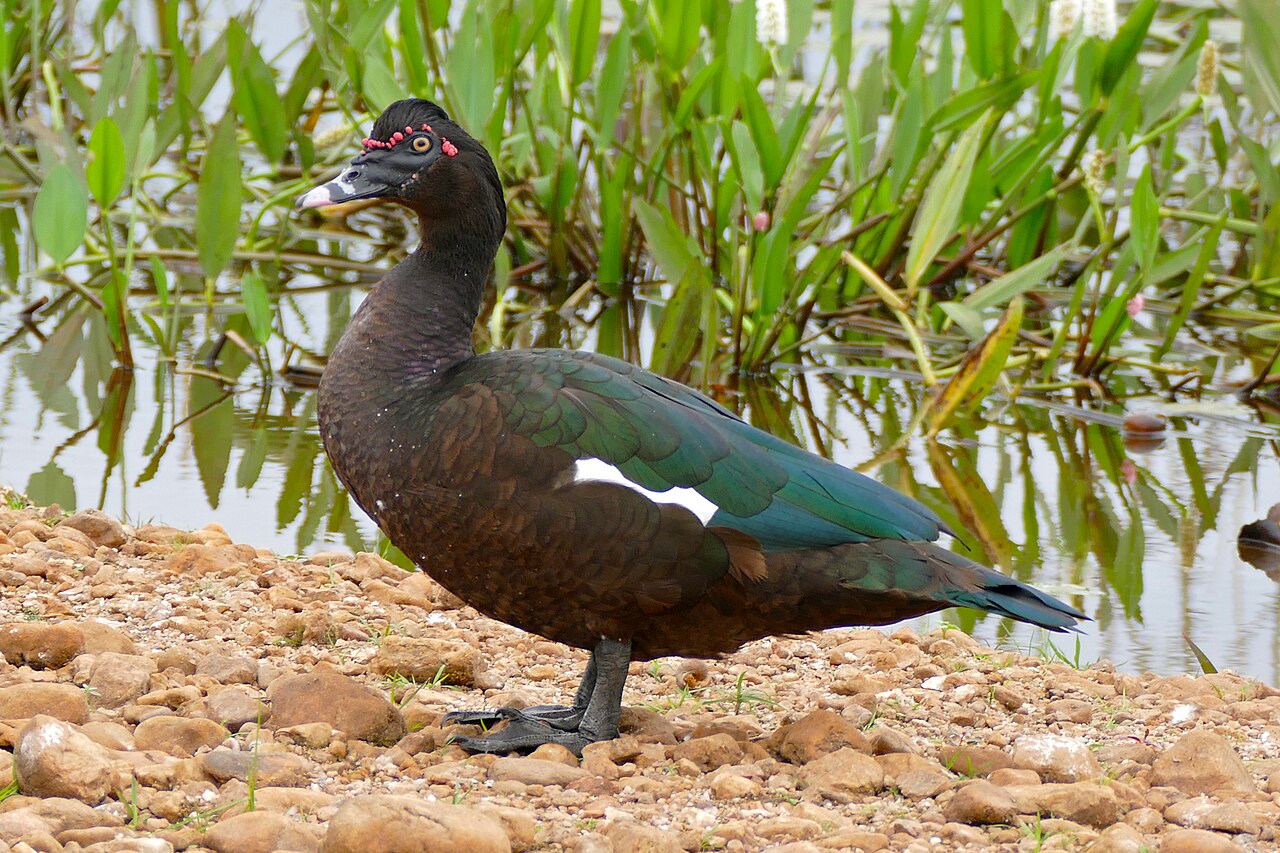
In this region the Muscovy Duck is not a wild bird but a farmyard and park duck: a heavy, low-slung bird with a bare red face covered in warty caruncles, at home in tropical America and present here only as escaped and released domestic stock. In those tame birds the plumage has been bred every which way — white, pied, sooty black or grey-brown — so the red face and the heavy, horizontal build are the features to trust.
Voice
It does not quack, which in a duck this size is striking at once. The male gives a low, breathy puffing and hissing, shhh-shhh, usually with the crest raised and the neck thrust forward; the female has a soft trilling coo and a muffled kwoo-kwoo to her ducklings. Beyond that the sounds are mechanical: the heavy clattering of wings as it comes down out of a tree or off a roof.
No freely licensed recording has been found for this species yet; what to listen for is described below.
Identification
A very large, broadly built duck of 64 to 86 cm, with a long tail, a body carried low and horizontal, and heavy legs with sharp claws that let it climb into trees. The male is bulky, up to twice the weight of the female, and carries a bare field of bright red warty caruncles around the bill base and eye; on the female that field is smaller and the head more feathered. The wild form is glossy black with a large white wing patch, but the birds here are of domestic descent and run from pure white through pied to sooty black. When excited a small crest on the nape goes up and the bare face flushes a deeper red.
Confusion species
Domestic Mallards (Anas platyrhynchos) share the park pond and are bred just as pied, but they are clearly smaller, shorter-tailed, quack loudly and entirely lack the red warty face. Australian Shelduck (Tadorna tadornoides) also has a dark head, but it stands upright, is slimmer, carries a white neck ring and has a small, uniformly dark bill. A large white individual can suggest a domestic goose at range; the bare red face and the low, stretched carriage rule that out at once.
Habitat
Town parks with ponds, village pools, farm drains and stock dams, always close to people and usually with a shed, pen or farmyard nearby. It grazes lawn and pasture, works shallow water for water plants, insects and snails, and prefers to roost high in a tree or on a roof — a duck you may meet above your head. The nest goes in a tree cavity or under dense ground cover.
Where the bird is most often found, arranged by main group and formation.


Range and movements
Within this map window it is not a wild species. In Australia it means feral and escaped farmyard birds around towns, urban parks and farmyards, chiefly in the wetter east and in the south-west; there is no self-supporting wild population and the species does not count on the list of wild Australian birds. New Zealand shows the same picture: New Zealand Birds Online records it as 'introduced, not established', with scattered birds on ponds, pools and slow streams on both main islands, found in just over one percent of atlas squares in 1999–2004. Its actual wild range lies far outside this guide: from the Rio Grande in Texas and Mexico south to Argentina and Uruguay.
- Resident
- dark = core range, pale = thinly spread
Where and when to look
Do not look for it in a swamp but at the duck pond of a village park, on a farmyard or along a stock dam, among the domestic ducks and tame geese. In any doubt go to the face first: red caruncles around bill and eye mean this species, whatever the rest of the plumage is doing. Scan the waterside trees in the morning — it roosts high and drops down with a heavy clatter of wings.
Conservation
Not threatened globally (LC), but that assessment covers the wild American birds and not the animals here. In Australia and New Zealand this is a domesticated duck that people brought with them: it was tamed by indigenous peoples in tropical America before Europeans arrived and then carried around the world as a meat bird. An 1865 attempt to establish it on Adams Island in the subantarctic, as food for shipwreck survivors, failed. Where feral groups do build up the issues are nuisance and water fouling at town ponds and interbreeding with other domestic ducks; there is no displacement of native ducks here, and numbers depend entirely on what people let loose.
Scientific name
Cairina moschata | (Linnaeus, 1758)
Linnaeus described the species in 1758 as Anas moschata, in the tenth edition of the Systema Naturae; because it later moved to Cairina, author and year stand in parentheses. moschata means 'musky', after the scent the bird gives off. The genus name Cairina means 'from Cairo' and rests on a mistake by Aldrovandi, who believed the bird came from Egypt; Linnaeus gave the vague 'in Indiis' as its origin, but it belongs to tropical America. The English name Muscovy is a puzzle too: it probably points not at Moscow but at the Muscovy Company, which traded the bird, or simply at that same musky smell. The Dutch name refers to Barbary, the North African coast — one more region the bird never came from.