All species › Passerines › Quail-thrushes and jewel-babblers › Chestnut-breasted Quail-thrush
Chestnut-breasted Quail-thrush | Cinclosoma castaneothorax
Bruinborstkwartellijster | Zordala pechicastaña
The Chestnut-breasted Quail-thrush walks the stony flats and crumbling edges of the north-eastern interior, where the gravel is the colour of its back. It is one of six quail-thrushes of arid Australia that resemble one another so closely that birders in practice identify them on the map rather than on the bird. This is the species of southern Queensland and north-western New South Wales.
Voice
An extremely high, thin, sustained whistle, tseeee, often held on one pitch for seconds and impossible to place in direction; many ears lose it altogether with the years. There is also a short, low chup as a contact note between the birds of a pair, which is easier to locate. The male calls mainly in the first two hours after sunrise, usually from the ground or a low stone, hardly opening the bill. At any disturbance everything falls silent.
No freely licensed recording has been found for this species yet; what to listen for is described below.
Identification
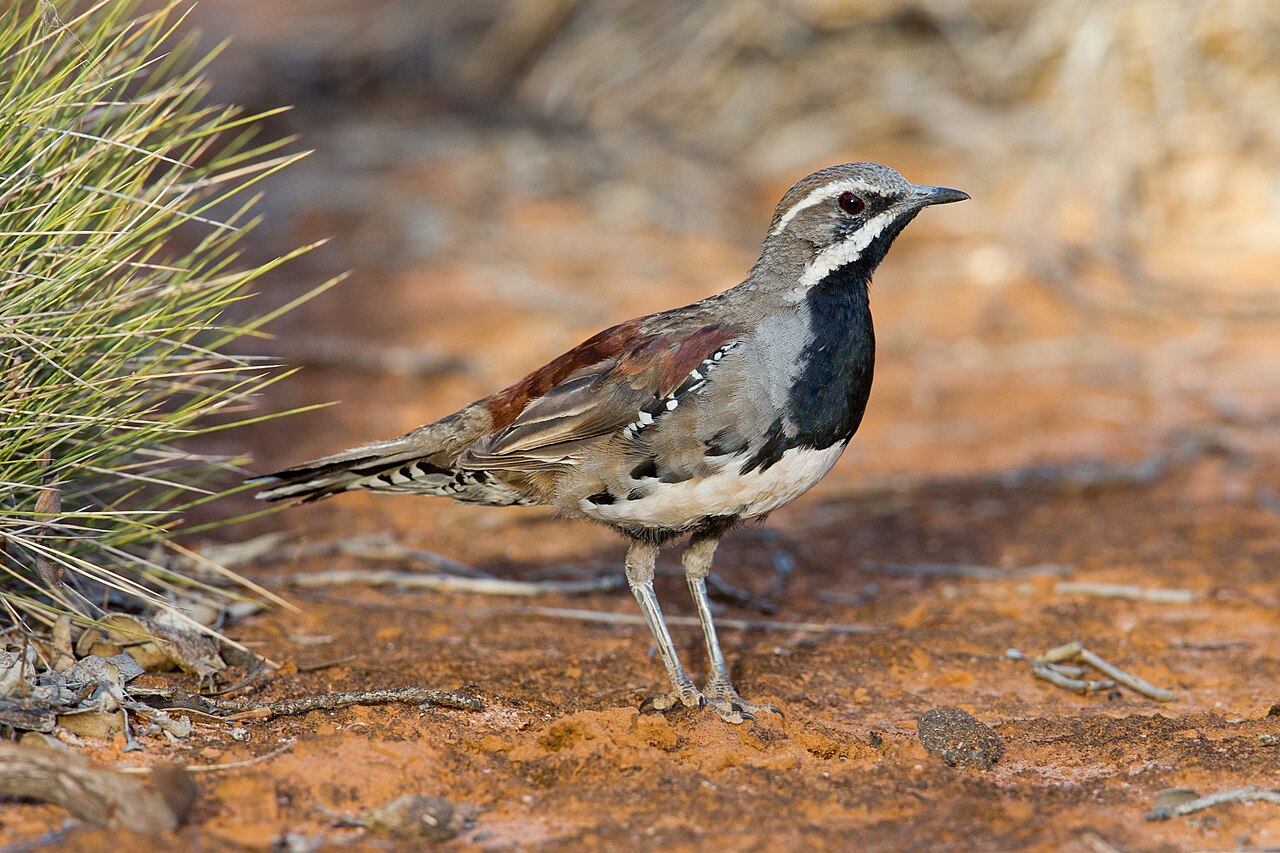
Eighteen to twenty-one centimetres, with a heavy head, short rounded wings, sturdy legs and a medium tail tipped with white. The male has a grey-brown crown and back, a sharp white eyebrow, a black throat with a white malar patch below it, and a broad chestnut breast band separated from the white belly by a black band. The flanks are black streaked with white, the scapulars brown with white shafts. The female is much duller: the throat is grey instead of black, the eyebrow buff and the chestnut breast band faint or absent. Young birds resemble the female. It flushes late and low, with a flash of white in the tail corners, and lands again within fifty metres.
Confusion species
Here, honestly, field identification is often not possible without knowing the range. The five other quail-thrushes of the dry interior all closely resemble this one, and the complex has moreover been revised recently, so that older guides no longer hold. Cinclosoma marginatum, the Western Quail-thrush, was until recently a subspecies of this bird and is barely separable from it; it lives thousands of kilometres to the west, from the Pilbara to Southern Cross, and has paler-edged back and scapular feathers and a narrower, duller breast band. Cinclosoma cinnamomeum, the Cinnamon Quail-thrush, is smaller, more cinnamon above and has a black rather than a chestnut breast band; it lives further west, in the Lake Eyre basin. Cinclosoma alisteri of the Nullarbor is smaller still and sandy grey. Cinclosoma castanotum and Cinclosoma clarum are both clearly larger, with a deep chestnut and a coppery back respectively instead of a chestnut breast band. The Spotted Quail-thrush (Cinclosoma punctatum) is the only one that is really different: larger, spotted black and white on scapulars and flanks, and a bird of moister forest in the south-east. Anyone who sees a quail-thrush and does not know where they are standing cannot name the species; anyone who does know has usually settled it already.
Habitat
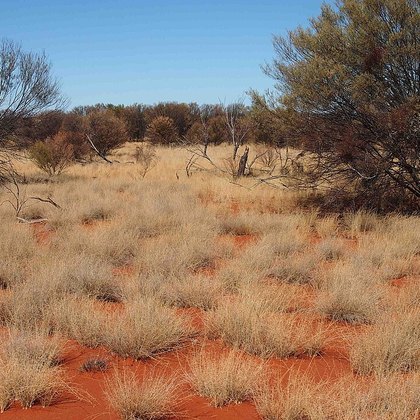
Stony, open, low-vegetated dry country: gibber plains with scattered low shrubs, the crumbling edges and small mesas known in Australia as jump-ups and breakaways, and strips of mulga and other acacia scrub on gravel. Also spinifex hummocks on stony slopes. The bird must be able to walk and at the same time have cover within a few paces; dense shrub layer without open ground between is not used, and neither is sand without stone.
Where the bird is most often found, arranged by main group and formation.



Range and movements
The interior of eastern Australia: southern and south-western Queensland, centred on the Grey Range and the Bulloo basin, and from there south into north-western New South Wales. Resident on a small, fixed territory, though in drought years pairs shift tens of kilometres to places where herbage still stands. The range is small compared with those of the other quail-thrushes and hardly overlaps with any of the five relatives — that near-absence of overlap is exactly what makes identification by map possible. Records are sparse, which reflects the remoteness of the country rather than the numbers.
- Resident
- Winter
- dark = core range, pale = thinly spread
Where and when to look
In the first two hours after sunrise, drive slowly along a gravel road through stony country and stop at every breakaway. Walk a stretch, stand still every hundred metres and listen for something very high and sustained that seems to come from nowhere. If you see nothing, look for movement on the ground between the stones rather than for a bird's outline: a motionless quail-thrush is all but invisible. Always note exactly where you stood — with these six species the place is the most important character you record.
Conservation
Not threatened. The species lives in thinly settled country unsuited to agriculture, so direct loss of habitat is limited. The real concerns are grazing by cattle, sheep and above all goats, which removes the low herb layer between the stones where the bird finds cover and food, and foxes and feral cats, dangerous to any ground-nester. Because the complex was split only recently, most older counts cannot be assigned to the present species limits; the evidence is thus thinner than the quiet status suggests.
Scientific name
Cinclosoma castaneothorax | Gould, 1849
John Gould described the bird in 1849 as Cinclosoma castaneothorax, and it still stands in that genus, so author and year remain without parentheses. Vigors and Horsfield introduced the genus Cinclosoma in 1827, from Greek kinklos (an unspecified waterside bird) and soma (body). The epithet combines Latin castaneus (chestnut) and Greek thōrax (breast) and so means 'chestnut-breasted', after the male's breast band. The type locality is the Darling Downs in Queensland, read in later literature as the upper Dawson River. The western form marginatum was long kept as a subspecies of this bird and has ranked as a species of its own since the recent revision.