All species › Passerines › Quail-thrushes and jewel-babblers › Nullarbor Quail-thrush
Nullarbor Quail-thrush | Cinclosoma alisteri
Nullarborkwartellijster | Zordala de Nullarbor
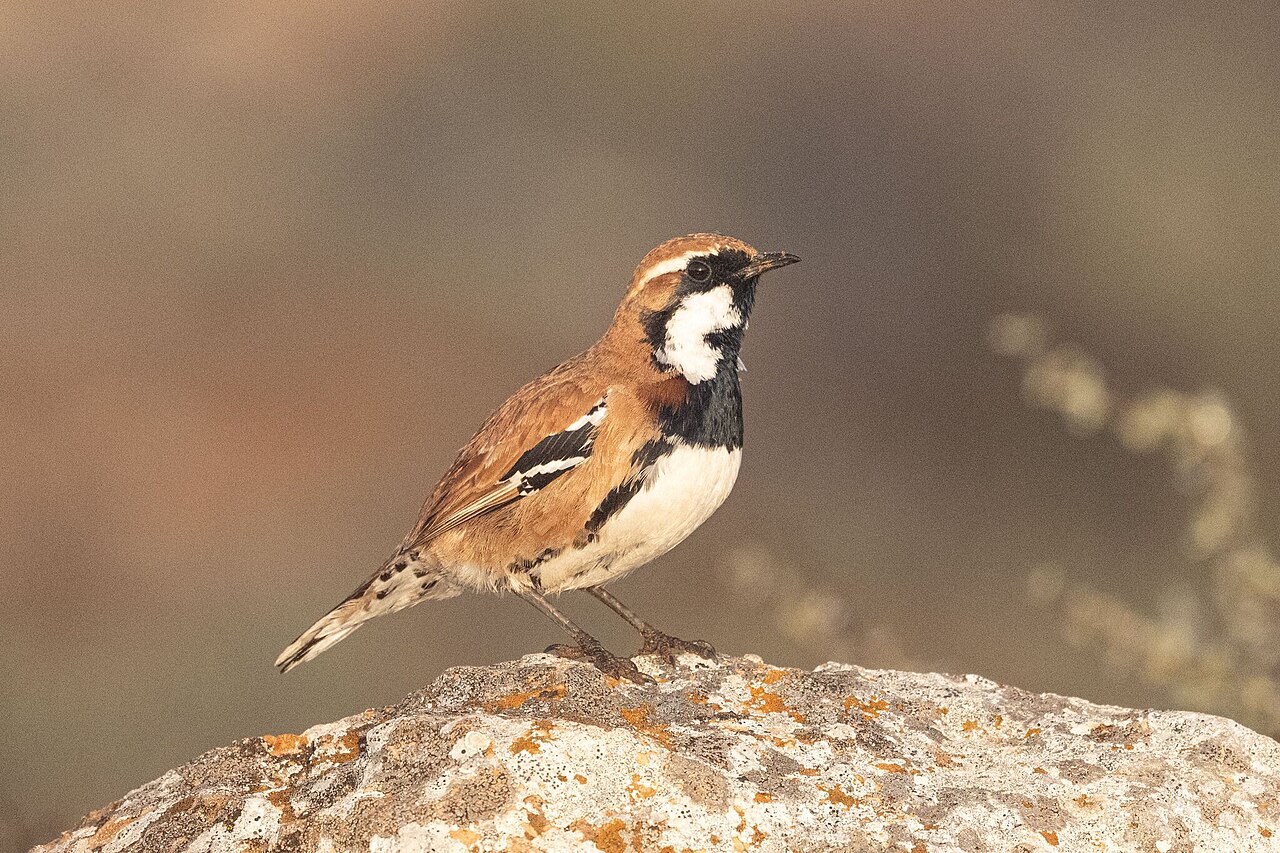
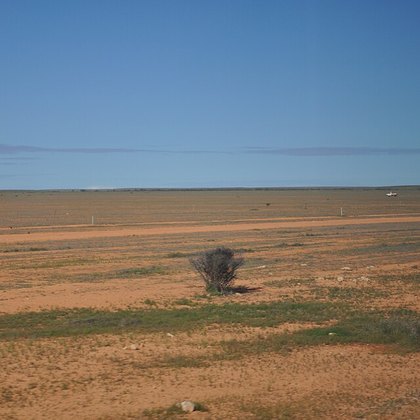
The Nullarbor Quail-thrush lives on the Nullarbor Plain and virtually nowhere else: a treeless limestone plain the size of a country, covered with nothing but grey saltbush and bluebush. It is the smallest and the palest of the six quail-thrushes of the dry interior, and the only one that can be named simply by knowing where one is. Off the Nullarbor it does not exist.
Voice
A thin, high whistle of one or two seconds that carries across the plain but cannot be placed, and a short, sharp tchik as a contact note. Because nothing stands on the Nullarbor to reflect sound, the call seems strikingly bare and close, even when the bird sits a hundred metres off. The male calls in the first hour after sunrise and on cloudy days sometimes all morning. Differences from the voice of the Cinnamon Quail-thrush have not been reliably described.
No freely licensed recording has been found for this species yet; what to listen for is described below.
Identification
Seventeen to nineteen centimetres: small, short-tailed, with rounded wings and proportionally long legs. The male is sandy grey to pale brown on crown, mantle and back, much paler than the cinnamon-coloured Cinnamon Quail-thrush, with a broad white eyebrow, a black throat with a white patch on either side and a narrow black breast band above extensive white underparts; the flanks are black with round white spots. The female is paler still: the throat is greyish buff, the eyebrow off-white and the breast band faint or absent. The bird walks in short steps with a straight back, freezes at any alarm and flushes only at close quarters, low and over a short distance.
Confusion species
Without a known range, field identification in this complex is often impossible; in this species, however, the range is itself the strongest character, because it is confined to the Nullarbor Plain. Cinclosoma cinnamomeum, the Cinnamon Quail-thrush, is the nearest relative and was treated as one species with this bird until the recent revision; it is slightly larger and distinctly warmer cinnamon above, and lives further north, in the Lake Eyre basin. Cinclosoma clarum, the Copperback Quail-thrush, is much larger and heavier with a coppery back and lives in mallee west and north of the plain — the two may meet at the edge of the Nullarbor, but with that difference in size confusion is barely possible. Cinclosoma castanotum lies east of the Eyrean Barrier and is likewise much larger. Cinclosoma castaneothorax and Cinclosoma marginatum are larger, have a chestnut breast band and live in Queensland and in west-central Western Australia respectively. The Spotted Quail-thrush (Cinclosoma punctatum) is the one clearly different species: large, spotted black and white and tied to forest in the south-east.
Habitat
The open, treeless saltbush and bluebush plain on limestone that is the Nullarbor, with gravel and loose limestone rubble at the surface in places. The vegetation does not rise above knee height and the bird walks under and between it. Where the plain gives way to mallee or acacia scrub the species stops; trees mean the end of its ground. It is thus the bird of this whole complex most tightly bound to a single landscape type.
Where the bird is most often found, arranged by main group and formation.


Range and movements
The Nullarbor Plain, that is, south-eastern Western Australia and south-western South Australia, roughly between the Great Australian Bight in the south and the edge of the Great Victoria Desert in the north. The type locality, Waddilinia on the Nullarbor, lies in the middle of that area. This is one of the smallest ranges of any Australian songbird outside the island species. Resident; there is no evidence of migration or of regular wandering off the plain. The trans-Australian railway and the Eyre Highway cut through the range, which makes the species unusually accessible to birders for a bird with so small a distribution.
- Resident
- dark = core range, pale = thinly spread
Where and when to look
Drive the Eyre Highway or one of the side tracks to the railway in the first hour after sunrise and watch the verges. Stop at any movement and get out; the bird walks off rather than flies off, so it must be followed on the ground with binoculars. Cloudy, cool mornings are far better than clear hot ones. It is worth remembering that this is the only place on earth where this bird can be seen — so take the time, and stand an hour in one place rather than driving on.
Conservation
Not threatened according to the world lists, and the habitat is largely intact because the Nullarbor is unsuited to agriculture and lies mostly in reserves and parks. Even so, the very small range makes this a species to watch: anything that changes the saltbush plain over a large area affects virtually the whole world population at once. The concrete concerns are grazing by feral goats, camels and rabbits, which thins the low shrub layer, and the feral cat, which on a treeless plain is extraordinarily dangerous to a ground-nester. Reliable numbers do not exist.
Scientific name
Cinclosoma alisteri | Mathews, 1910
Gregory Macalister Mathews described the bird in 1910 as Cinclosoma alisteri in the Bulletin of the British Ornithologists' Club, and it still stands in that genus, so author and year remain without parentheses. Vigors and Horsfield introduced Cinclosoma in 1827, from Greek kinklos (an unspecified waterside bird) and soma (body). The epithet alisteri honours someone named Alister; the literature usually takes this to be a son of the describer, but that attribution could not be tested against the original description for this guide and is left unconfirmed here. The type locality is Waddilinia on the Nullarbor Plain in Western Australia. The form was long treated as a subspecies of Cinclosoma cinnamomeum and has ranked as a species of its own since the recent revision of the complex.