All species › Passerines › Australasian babblers › Grey-crowned Babbler
Grey-crowned Babbler | Pomatostomus temporalis
Grijskruinbabbelaar | Gárrulo coronigrís
The Grey-crowned Babbler lives in noisy parties of four to twelve birds that work through open woodland one behind the other, tails up and curved bills in the litter. The group builds several large domed stick nests in the tree forks, one of which is used for eggs and the others for roosting. Of the four babblers of this region it is the largest and the easiest to see.

Voice
A continuous loud chattering and scolding by which the whole group keeps in touch; the contact note is a rising wee-oo passed from one bird to the next. Most striking is the duet of a pair: the female calls yah and the male answers at once with ahoo, so tightly joined that it sounds like one call, repeated several times over. At a raptor the party falls silent and a short, hard alarm note is given. Calling goes on all year, most in the early morning.
No freely licensed recording has been found for this species yet; what to listen for is described below.
Identification
Twenty-five to twenty-nine centimetres, twenty-seven on average, much of it the long graduated tail with its white tip. The upperparts are dark brown-grey, with a grey crown stripe, a dark mask through the eye and a broad white eyebrow above it; the throat is white, shading to pale grey on the breast. The bill is long and decurved, the wings short and rounded with a cinnamon panel that shows only in flight. Adults have a pale yellow iris, young birds a dark one. Birds of the north-west are darker, with a rufous lower breast.
Confusion species
White-browed Babbler (Pomatostomus superciliosus) is clearly smaller, with a narrow eyebrow tapering to a point behind the eye and a dark eye. Pomatostomus ruficeps has a chestnut crown and two white wing bars, Pomatostomus halli a deep white bib cut off sharply on the breast. Apostlebird (Struthidea cinerea) also moves in noisy parties on the ground, but is grey, has a short thick bill and lacks the white eyebrow. A bird in a party with a pale yellow eye and a broad white eyebrow settles the matter.
Habitat
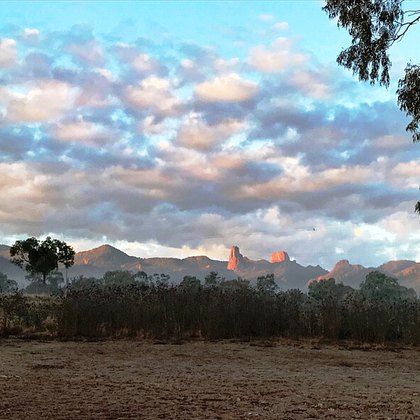
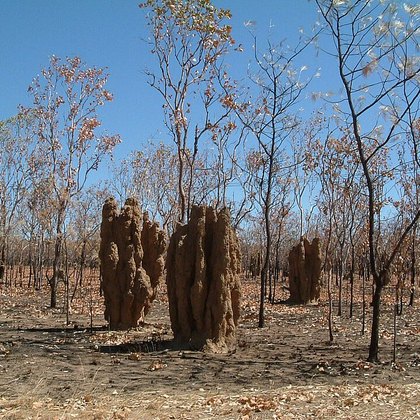
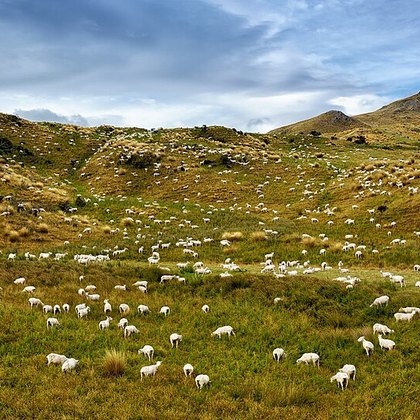
Open eucalypt forest and woodland on inland plains, with a thin shrub layer, little grass and plenty of fallen timber and leaf litter — that is where it feeds. Also river timber along creeks, brigalow, roadside strips, farmland with remnant trees, and golf courses. It needs two things that seldom go together: large trees with forks for the nests, and ground with litter and dead wood beneath them. Dense forest, bare grazed land and closed scrub are avoided.
Where the bird is most often found, arranged by main group and formation.


Range and movements
North-western, northern, central and eastern Australia, and southern New Guinea. The groups are sedentary and do not leave their territory; young birds stay with their parents for years and help raise the following broods. In the south-east — Victoria and the western slopes of New South Wales — the species has declined sharply over the past century and has gone from many districts, while in the north and the interior it remains common. The decline follows the boundary of fragmented farmland exactly.
- Resident
- dark = core range, pale = thinly spread
Where and when to look
Follow the sound: a party is audible from far off and moves slowly along roadside strips and windbreaks, so there is all the time you need. Look in the tree forks for the large domed stick nests; they betray a territory even when the birds are elsewhere, and there are usually several together. On the birds themselves, check the eye colour: dark means a young bird of this season or the last, and that tells you the group is doing well.
Conservation
Not threatened globally (LC), but in south-eastern Australia the species stands on the regional lists of threatened birds. The causes are the removal of fallen timber, the grazing of the understorey and above all fragmentation: a group needs helpers, and a small isolated party that loses a few birds can no longer breed and dies out. Recovery works where roadside strips and windbreaks stay connected and dead wood is left lying.
Scientific name
Pomatostomus temporalis | (Vigors & Horsfield, 1827)
Vigors and Horsfield described the bird in 1827 as Pomatorhinus temporalis, among the Asian scimitar babblers; because the species was later moved to another genus, authors and year stand in parentheses. The genus name Pomatostomus is formed from Greek pomatos (lid) and stoma (mouth), after the little lid that closes the nostrils. temporalis is Latin for 'of the temples', after the stripe running along the side of the head. The type locality is Shoalwater Bay, Queensland.