All species › Passerines › Australasian babblers › White-browed Babbler
White-browed Babbler | Pomatostomus superciliosus
Witbrauwbabbelaar | Gárrulo cejudo
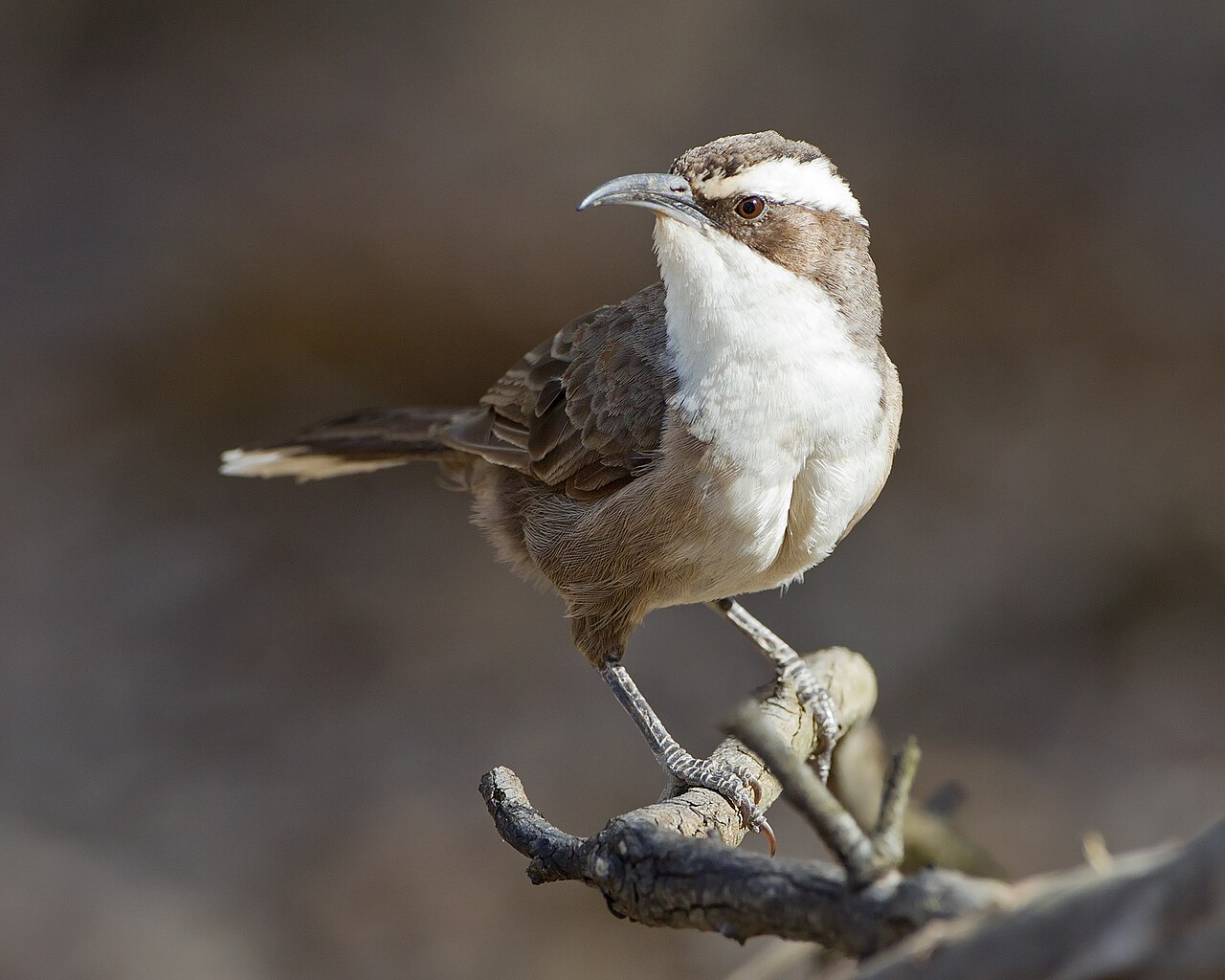
The White-browed Babbler is the smallest and by far the most widespread of the Australian babblers: from the wheatbelt of Western Australia right across the south to inland New South Wales. It is greyish brown, with a long white eyebrow above a dark eye-stripe, a curved bill and a long, white-tipped tail. Like all babblers it lives in noisy family parties that move through the shrub layer one bird after another.
Voice
A soft but continuous chatter of twittering, squeaking and faintly plaintive notes that the party keeps up while feeding; it is clearly quieter and higher than in the Grey-crowned Babbler (Pomatostomus temporalis) and lacks that bird's harsh paired call. When disturbed there is a fast, sharp rattling alarm at which the whole group vanishes into one bush. Once you know the chatter you often hear the species at the edge of a paddock or along a roadside verge before a single bird is in view.
Recording: Eddy Smith — CC BY-NC-SA 4.0 · Monarto South, The Rural City of Murray Bridge, South Australia, Australia · xeno-canto
Identification
Eighteen to twenty-one centimetres — the smallest babbler in this guide. The upperparts are dull greyish brown, the crown dark brown, and below it runs a long, narrow white eyebrow that starts at the base of the bill and continues well behind the eye, with a dark eye-stripe beneath it. The throat is white and passes gradually, without a sharp border, into a dull greyish brown breast and belly. There are no white bars on the wing. The bill is slender and downcurved, and the long dark tail carries white tips that show best in flight.
Confusion species
Hall's Babbler (Pomatostomus halli) is the hardest: it was not separated from this species until 1964. The difference is on the underside — in Hall's Babbler the white of the breast ends in a sharp, straight line against dark brown, in this species it fades gradually — and Hall's is besides darker above, with a broader and whiter eyebrow. Their ranges also overlap only in a narrow band in south-western Queensland and north-western New South Wales. Chestnut-crowned Babbler (Pomatostomus ruficeps) has a chestnut crown and two white wing bars. Grey-crowned Babbler (Pomatostomus temporalis) is clearly larger and bulkier, with a pale central stripe over the crown and a large rufous wing panel. A small, dull babbler with no wing markings and a long white eyebrow is this species.
Habitat
Dry open woodland and scrub with an intact shrub layer: mallee (low, multi-stemmed eucalypt scrub of dry southern Australia), mulga (acacia scrub of the dry interior, dominated by Acacia aneura) and other acacia scrub, dry eucalypt woodland, belah, and also woodland edges along paddocks and roadside verges with remaining regrowth. It tolerates farmland better than the other babblers as long as shrubs are left to nest in. Parties usually hold two to ten birds, breed cooperatively and build several large domed stick nests in one territory, some of which serve only for roosting. Food is insects and other small animals picked from the ground, from litter and from under loose bark.
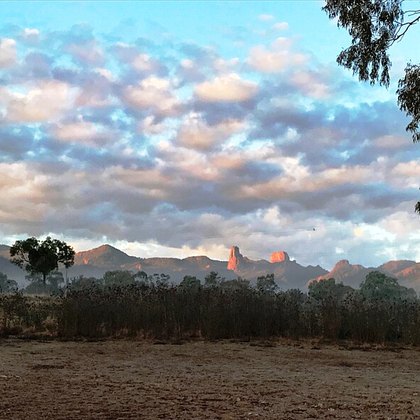
Where the bird is most often found, arranged by main group and formation.

Range and movements
By far the largest range of the Australian babblers: from the wheatbelt and interior of Western Australia east across the Nullarbor to South Australia, Victoria, inland New South Wales and south-western Queensland. It avoids the wettest coastal districts and the true tropical north. Within that country it is locally common, but in heavily cleared cropping districts it has fallen back to scattered parties in verges and scrub remnants. It is sedentary and parties stay in the same ground all year.
- Resident
- dark = core range, pale = thinly spread
Where and when to look
Look at the underside and the wing, and keep the range in mind. Across almost the whole south of Australia a small babbler with a long white eyebrow and no wing bars is simply this species. Only in the narrow overlap zone in the north-east do you still have to judge the breast border to rule out Hall's Babbler. Search roadside verges with remaining scrub and the edges of mallee blocks: parties often cross there one bird after another, which gives the best chance of seeing both underside and tail tip.
Conservation
Least Concern (LC). The range is enormous and the species common over most of it. Where it disappears, it is almost always because the shrub layer has been removed entirely: cropping to the fence line, the burning or clearing of mallee, and grazing that strips the understorey and fallen timber. Remnant parties in narrow verges are vulnerable to foxes and feral cats, and to the thinning of the group, since cooperative breeding depends on helpers.
Scientific name
Pomatostomus superciliosus | (Vigors & Horsfield, 1827)
Vigors and Horsfield described the species in 1827 as Pomatorhinus superciliosus, from material on the south coast of Australia; the species now sits in Pomatostomus, so author and year stand in parentheses. The specific name is Latin for eyebrowed, after the long white stripe above the eye, and the Dutch and English names say the same. Pomatostomus is formed from Greek poma (lid) and stoma (mouth), after the build of the bill. In Australia these birds are known colloquially as happy families or twelve apostles, after their inseparable group life — a nickname they share with the Apostlebird (Struthidea cinerea), to which they are not related.