All species › Passerines › Quail-thrushes and jewel-babblers › Chestnut Quail-Thrush
Chestnut Quail-Thrush | Cinclosoma castanotum
Roodrugkwartellijster | Zordala castaña
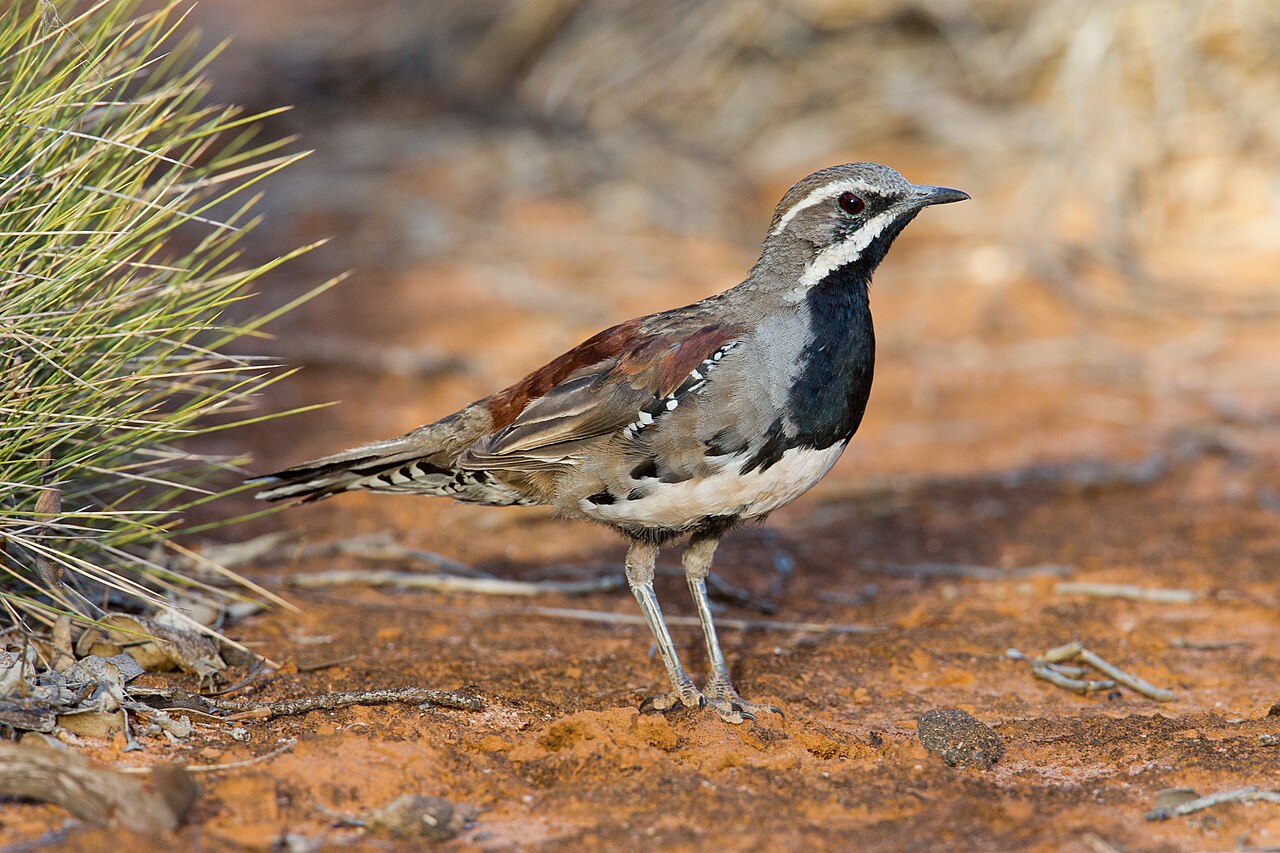
The Chestnut Quail-Thrush is the quail-thrush of the south-eastern mallee (low, multi-stemmed eucalypt scrub of dry southern Australia): a solid, short-winged ground bird with a deep chestnut back and a black breast, walking between the many-stemmed eucalypts and the spinifex (spiny, hummock-forming desert grass of the interior) hummocks. It is the largest of the six inland species and at the same time one of the hardest, for its western counterpart was recognised as a separate species only recently.
Voice
A slow, very high series of wheit-wheit-wheit, delivered at even intervals and held on one pitch, and beside it a thinner, insect-like see-see see that many ears do not register at all. The sounds come from the ground or a low side branch and can hardly be placed: they seem to come from every direction at once. The male calls most in the first two hours after sunrise, in spring from August to November. At any disturbance the bird falls silent and stays silent for a long time.
Recording: Richard White — CC BY-NC-SA 4.0 · Hattah - Kulkyne National Park (near Hattah), Mildura Rural City, Victoria, Australia · xeno-canto
Identification
Twenty-one to twenty-five centimetres, with a heavy head, short rounded wings, sturdy legs and a long tail tipped with white. The male has a grey crown and nape and a deep chestnut mantle and back, a sharp white eyebrow, a black throat with a white patch in it, and a black breast standing sharply against the white belly; the flanks are grey to black streaked with white. The female has a grey throat and breast instead of black, a buff to yellowish-buff eyebrow and a rufous to light brown back. Both sexes have a white belly. It flushes late and low, with white in the tail corners, and vanishes back into cover within a few tens of metres.
Confusion species
Here too, field identification is often not possible without a known range. Cinclosoma clarum, the Copperback Quail-Thrush, is the western counterpart and was treated as a subspecies of this bird until molecular work in 2015; it is the same size and the same weight, and differs only in the shade of the back, coppery against chestnut — a difference that disappears in other light or on worn feathers. The two are separated by the Eyrean Barrier, Spencer Gulf and the Nullarbor: this species lies east, clarum west. Chestnut-breasted Quail-Thrush (Cinclosoma castaneothorax) is smaller, has a chestnut breast band instead of a wholly black breast and lives in the Queensland interior. Western Quail-Thrush (Cinclosoma marginatum) is likewise smaller, has paler-edged back feathers and lives in west-central Western Australia. Cinnamon Quail-Thrush (Cinclosoma cinnamomeum) and Nullarbor Quail-Thrush (Cinclosoma alisteri) are clearly smaller, paler and birds of bare stone and saltbush plains without trees. The Spotted Quail-Thrush (Cinclosoma punctatum) is larger, spotted black and white on scapulars and flanks and keeps to moister, stony eucalypt forest; their ranges overlap locally in New South Wales and Victoria, and there the spotting is the decisive character.
Habitat
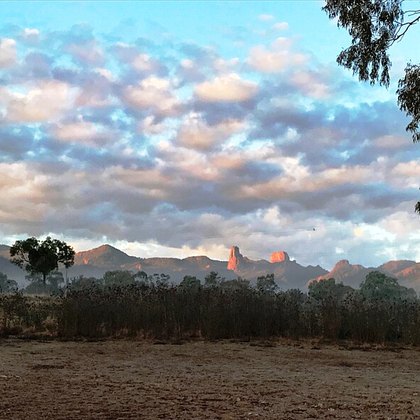
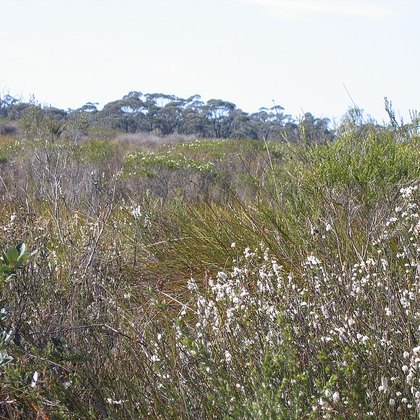
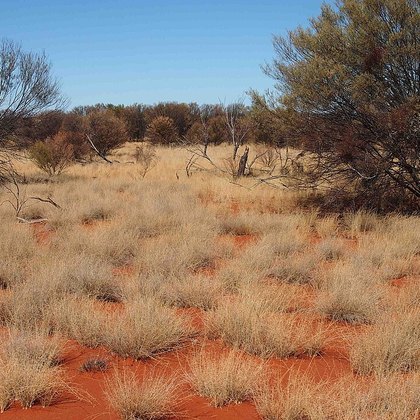
Mallee with an understorey of spinifex, broombush or low heath, and beyond that dry eucalypt forest and woodland on sandy or stony ground, and strips of acacia scrub. A thick layer of leaf litter and fallen branches is essential: in it the bird forages and into it it vanishes at any alarm. Old, long-unburnt mallee is far better than young regrowth. It does not use open pasture or cropland.
Where the bird is most often found, arranged by main group and formation.

Range and movements
South-eastern Australia east of Spencer Gulf: Yorke Peninsula, the southern Flinders Ranges, the eastern Mount Lofty Ranges, north-western Victoria and south-western and central New South Wales. Resident on a fixed territory that a pair holds for years. The range has become badly fragmented over the past century as the mallee belt of the Murray country was largely cleared for grain; what remains are islands of old mallee in reserves and along roadsides. In Victoria and South Australia survival hangs above all on those reserves.
- Resident
- dark = core range, pale = thinly spread
Where and when to look
In the first hour after sunrise, walk slowly along a sand track through old mallee and stop every fifty metres. Listen for something very high and even that comes from nowhere; that is the bird. Then do not walk towards the sound but stand still — the bird walks off as soon as you move and comes back when you are motionless. The best season is spring, August to November, and the best places are mallee blocks unburnt for twenty years or more.
Conservation
Least Concern (LC), although the species appears on regional lists of species of concern in several states. The split from the Copperback roughly halved this species' range, and what remains lies precisely in the part of Australia where the mallee has been hit hardest. Large-scale clearing for grain, big hot fires that take whole mallee blocks at once, and the feral cat and the fox are the three concrete threats.
Scientific name
Cinclosoma castanotum | Gould, 1840
John Gould described the bird in 1840 as Cinclosoma castanotus, and it still stands in that genus; the ending was later adjusted to the neuter gender of Cinclosoma, a grammatical and not a nomenclatural change, so author and year remain without parentheses. Vigors and Horsfield introduced Cinclosoma in 1827, from Greek kinklos (an unspecified waterside bird) and soma (body). The epithet combines Greek kastanon (chestnut) and nōton (back) and means 'chestnut-backed'. The type locality is 'the Belts of the Murray' in South Australia, the mallee belt along the Murray. The western form clarum was split from this species in 2015, after work on mitochondrial DNA.