All species › Passerines › Quail-thrushes and jewel-babblers › Cinnamon Quail-thrush
Cinnamon Quail-thrush | Cinclosoma cinnamomeum
Bruine kwartellijster | Zordala canela
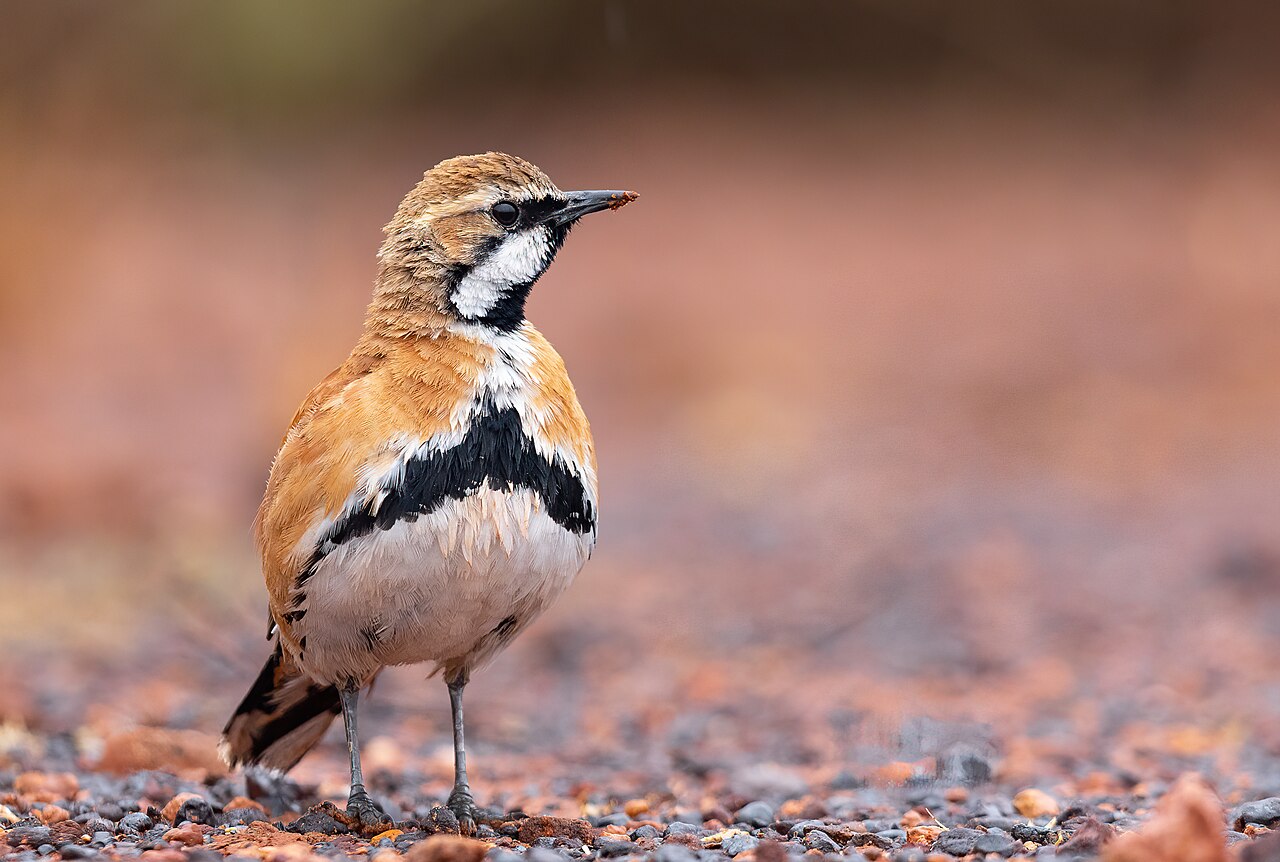
The Cinnamon Quail-thrush is the bird of the bare stone plains around Lake Eyre, where at thirty degrees in the shade there is no shade. It is cinnamon-brown like the gravel it walks on and shows itself only when one nearly steps on it. Of the six quail-thrushes of the dry interior this is the species of the central, hottest part.
Voice
An extremely high, thin whistle held for a few seconds and hard to place; many birders hear it back only on a recorder. There is also a short, hard tsip that passes back and forth between the birds of a pair when they lose one another on the plain. The male calls in the cool of the early morning, from a stone, a low shrub, or simply from the ground. In the heat of the middle of the day the bird is entirely silent and sits under a bush.
No freely licensed recording has been found for this species yet; what to listen for is described below.
Identification
Seventeen to twenty centimetres: the smallest of the quail-thrushes after the Nullarbor bird, with a short tail, rounded wings and proportionally long legs. The male has warm cinnamon upperparts without markings, a broad white eyebrow running behind the eye, a black throat with a white patch on either side, and a narrow black breast band standing sharply against the white belly. The flanks are black with round white spots. The female lacks the black: throat and breast are greyish buff, the eyebrow off-white to buff, and the upperparts a duller cinnamon. In flight one sees a low, straight, short line over the gravel with white in the tail corners.
Confusion species
With this complex, field identification without a known range is often simply impossible, and that has to be said. Cinclosoma alisteri of the Nullarbor is the nearest relative and was treated as a subspecies of this bird until the recent revision; it is slightly smaller, sandy grey rather than cinnamon above and has more white below, but occurs only on the Nullarbor Plain, hundreds of kilometres to the south-west. Cinclosoma castaneothorax is larger and has a broad chestnut breast band instead of a narrow black one; it lives further east, in Queensland. Cinclosoma marginatum is larger, more pale-edged above and lives in the west. Cinclosoma castanotum and Cinclosoma clarum are both considerably larger and heavier, with a deep chestnut and a coppery back respectively, and prefer mallee and woodland to bare stone. Only the Spotted Quail-thrush (Cinclosoma punctatum) is unmistakably different: larger, spotted black and white, and a bird of forest in the south-east. Anyone who does not know where they are standing should record the sighting as 'quail-thrush, species undetermined' — that is not weakness but the right practice.
Habitat
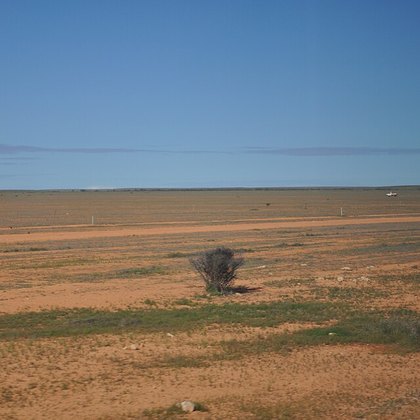
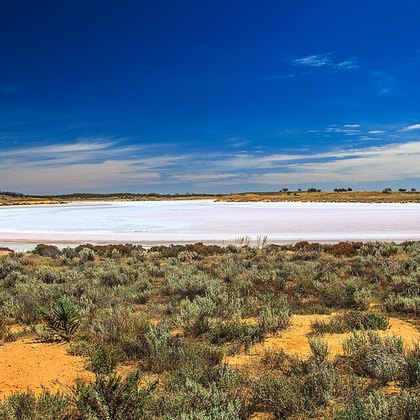
The barest country in Australia: gibber plains of dark, sun-polished gravel with only scattered low shrubs, saltbush and bluebush flats on clay, the margins of dry salt lakes and salt pans, and sandy strips with some spinifex between. The distinguishing feature is that there is no tree anywhere. The bird uses the few shrubs there are for shade and cover, and the open ground between them to walk and forage.
Where the bird is most often found, arranged by main group and formation.


Range and movements
The heart of arid Australia, around the Lake Eyre basin: northern South Australia, the far south of the Northern Territory, south-western Queensland and the far west of New South Wales. The type locality, Sturt's Depot in north-western New South Wales, lies in the middle of this area. Resident on a fixed territory, but after years of exceptional rain or of prolonged drought pairs shift over considerable distances; the range breathes with the weather. There is hardly any overlap with the five relatives — which is what makes the map so useful.
- Resident
- Winter
- dark = core range, pale = thinly spread
Where and when to look
Just after sunrise, drive at walking pace across a gibber plain and watch the verges of the track: quail-thrushes walk there because the gravel lies looser. Stop at any movement, even if you think it was a leaf. The best time is the first two hours of the day, for after that the bird has vanished under a bush until evening. Carry more water than you think you need and note the place to within a kilometre.
Conservation
Not threatened, with a large range and a habitat of little value to people. The threats are indirect: grazing by stock and feral goats removes the low shrub and herb layer, taking away both shade and cover, and feral cats and foxes reach even the deepest interior along stock watering points and roads. Drought in itself is no threat to this species but the normal condition; the combination of drought and grazing is. Reliable numbers are lacking, as for almost every bird of this part of the country.
Scientific name
Cinclosoma cinnamomeum | Gould, 1846
John Gould described the bird in 1846 as Cinclosoma cinnamomeus, and it still stands in that genus; the ending was later adjusted to the neuter gender of Cinclosoma, a grammatical and not a nomenclatural change, so author and year remain without parentheses. Vigors and Horsfield introduced the genus in 1827, from Greek kinklos (an unspecified waterside bird) and soma (body). The epithet cinnamomeum is Latin for 'cinnamon-coloured', after the upperparts. The type locality is Sturt's Depot in north-western New South Wales. The form alisteri of the Nullarbor was long kept as a subspecies of this bird and has ranked as a species of its own since the recent revision.