All species › Passerines › Quail-thrushes and jewel-babblers › Copperback Quail-thrush
Copperback Quail-thrush | Cinclosoma clarum
Koperrugkwartellijster | Zordala cobrizo
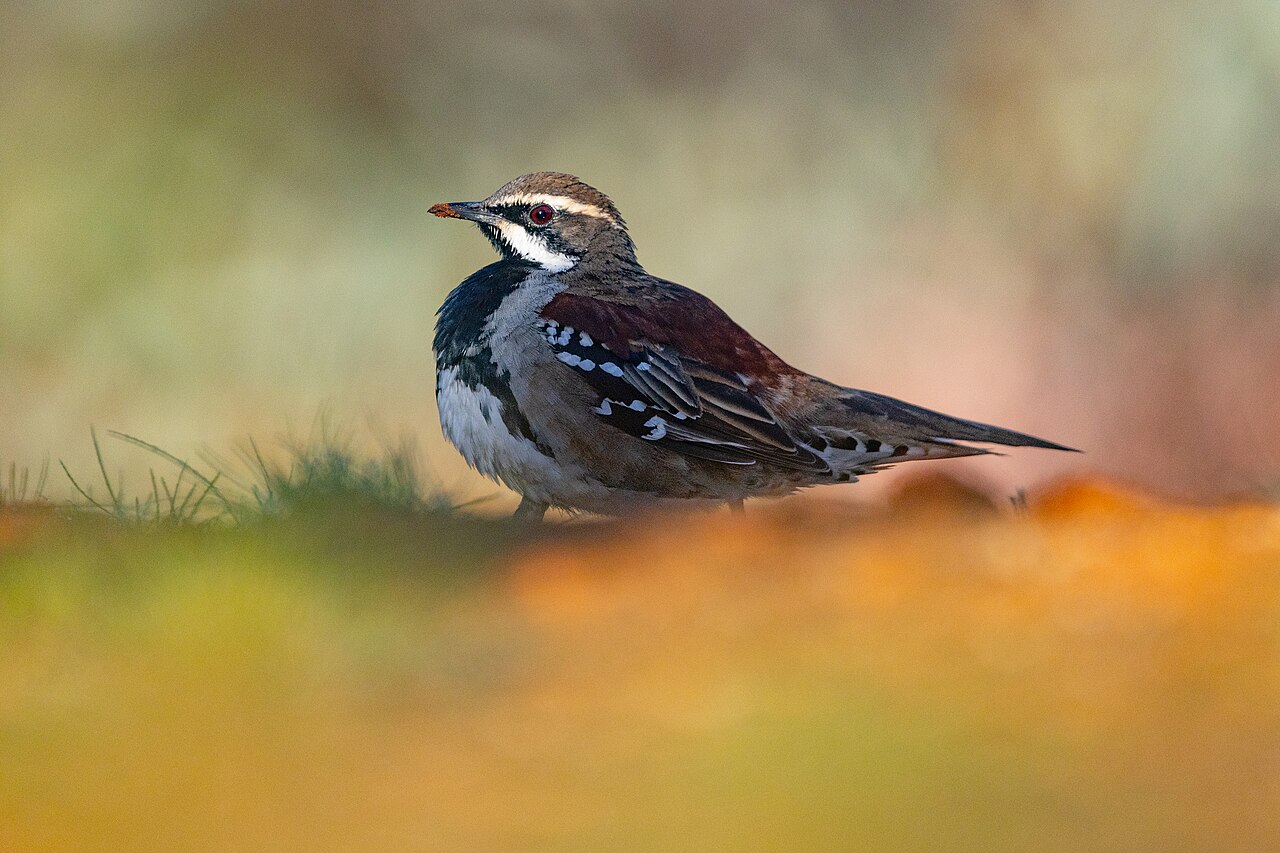
The Copperback Quail-thrush is the western half of what until recently counted as a single species. It walks the mallee and acacia scrub of Western Australia and western South Australia, with a back that in the morning sun glows coppery rather than chestnut — hence its name. Anyone who does not know the map simply sees a Chestnut Quail-thrush here.
Voice
A very high, thin series of wheit-wheit-wheit, delivered slowly and held on one pitch, and beside it a still higher, insect-like see-see that one feels rather than hears. Both come from the ground or a low branch and cannot be placed in direction. The male calls in the first hours after sunrise and again shortly before dark; in the heat of the day the bird is silent. No reliably described differences in voice from the Chestnut Quail-thrush exist, so this is not an identification key, often as that is suggested.
No freely licensed recording has been found for this species yet; what to listen for is described below.
Identification
Twenty-one to twenty-four centimetres: a solid, short-winged ground bird with a long white-tipped tail and strong legs. The male has a grey crown and nape, a warm coppery to rufous mantle and back, a sharp white eyebrow, a black throat with a white patch on it, and a black breast standing sharply against the white belly; the flanks are black streaked with white. The female has a grey instead of a black throat and breast, a buff eyebrow and a duller, more brown-grey back. The coppery sheen on the back is the character the species is named for, but in dull light and on worn feathers that sheen is simply not there.
Confusion species
This is the clearest case in the complex where field identification is not possible without a known range. Cinclosoma castanotum, the Chestnut Quail-thrush, is the same size, the same weight and almost identically marked; the only difference put forward is the shade of the back, copper to rufous in this species against a deeper chestnut in castanotum, and that difference is useless in the field once light or feather wear comes into play. The two were separated only after molecular work and are held apart by the Eyrean Barrier — Spencer Gulf and the Nullarbor: castanotum lies east of it, this species west. Cinclosoma marginatum is smaller, has a breast band instead of a wholly black breast and lives further north in Western Australia; the ranges may meet. Cinclosoma alisteri of the Nullarbor is much smaller and sandy grey and lives on the bare plain without mallee. Cinclosoma cinnamomeum and Cinclosoma castaneothorax are smaller, cinnamon and birds of stone and gibber rather than scrub. The Spotted Quail-thrush (Cinclosoma punctatum), finally, is spotted and lives in moister forest in the south-east. In short: first establish where you are standing.
Habitat
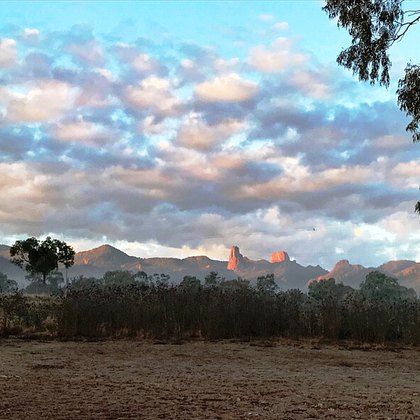
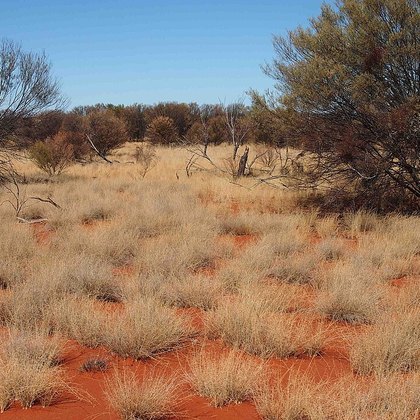
Mallee with an understorey of spinifex or broombush, dry eucalypt forest and woodland on sand, and mulga and other acacia scrub with open ground between. Unlike the Cinnamon and Nullarbor Quail-thrushes this is not a bird of bare stone plains but of low, dense scrub in which it can walk and disappear. A thick layer of leaf litter matters: that is where it forages. Recently and severely burnt mallee is avoided for years, until the understorey has recovered.
Where the bird is most often found, arranged by main group and formation.


Range and movements
Southern Western Australia and western South Australia: from the Goldfields and the margins of the Great Victoria Desert east to the Gawler Ranges and Eyre Peninsula. The type locality, Wipipippee near the southern end of Lake Gairdner in South Australia, lies in the eastern part of that area. Note: this species is emphatically a western bird and does not occur on the east coast of Australia — a confusion easily made, because the English and Dutch names of the two sister species both refer to back colour and say nothing about position. Resident on a fixed, fairly small territory.
- Resident
- dark = core range, pale = thinly spread
Where and when to look
Walk slowly along a sand track through old mallee early in the morning and listen for the high whistled series from the ground. Quail-thrushes do not fly away but walk away, so do not walk on when you hear something: stand still and let the bird start walking again. Photograph the back if you can, with the light behind you: the copper tone is easier to establish on a good photograph than through binoculars. And above all note the place — with this species that is the piece of evidence.
Conservation
AviList gives the species no assessment of its own: it stands there as not evaluated (NE), because it has ranked as a separate species only recently and is still counted under the Chestnut Quail-thrush in the world lists. That is a matter of data and no proof that things go well or badly. The known concerns for this bird are the large, hot fires that in recent decades have taken great areas of mallee at a stroke, the lack of old unburnt mallee with a thick litter layer, and the feral cat. Clearing of mallee for agriculture matters most in the east of the range, around Eyre Peninsula.
Scientific name
Cinclosoma clarum | Morgan, 1926
Alexander Matheson Morgan described the bird in 1926 as Cinclosoma castanotum clarum, that is, as a subspecies of the Chestnut Quail-thrush, in the South Australian Ornithologist; because the name has remained within the same genus, author and year stand without parentheses. Vigors and Horsfield introduced Cinclosoma in 1827, from Greek kinklos (an unspecified waterside bird) and soma (body). The epithet clarum is Latin for 'bright, clear', after the paler back by which Morgan separated the western birds from the eastern. The type locality is Wipipippee, some eight kilometres east of the southern end of Lake Gairdner in South Australia. Molecular work on mitochondrial DNA showed in 2015 that the eastern and western populations have long been separated by the Eyrean Barrier, after which clarum was raised to species rank.