All species › Passerines › Quail-thrushes and jewel-babblers › Western Quail-thrush
Western Quail-thrush | Cinclosoma marginatum
Westelijke kwartellijster | Zordala occidental
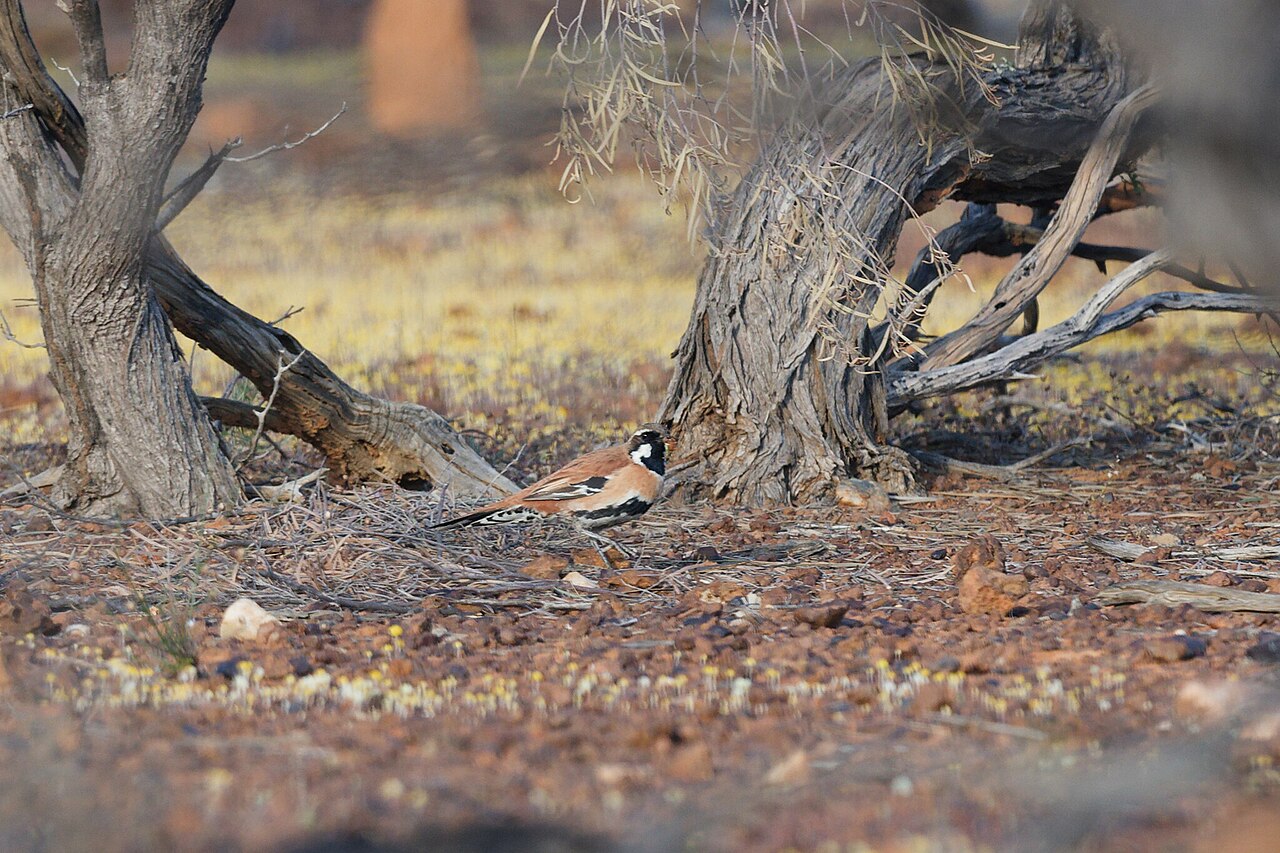
The Western Quail-thrush walks the stony ridges and breakaways of west-central Australia, from the Pilbara to the Goldfields. Until recently it ranked as the western subspecies of the Chestnut-breasted Quail-thrush; since the revision of the complex it is a species of its own, with a range more than two thousand kilometres from that of its eastern counterpart. The pale edges on back and scapulars, from which it takes its name, are its only character of its own — and a weak one.
Voice
A very high, thin, sustained whistle that carries across the plain and cannot be placed, and beside it a short, hard tsip as a contact note between the birds of a pair. The voice is not reliably described as different from that of the Chestnut-breasted Quail-thrush, which is what one would expect of two forms that until recently counted as one species; sound is therefore no identification key between these two. The male calls in the first hours after sunrise, from a stone or simply from the ground, and is wholly silent in the heat of the day.
No freely licensed recording has been found for this species yet; what to listen for is described below.
Identification
Nineteen to twenty-two centimetres, with a heavy head, short rounded wings, sturdy legs and a medium tail tipped with white. The male has grey-brown to sandy upperparts whose feathers carry pale edges, giving the back a finely scaled look; further a sharp white eyebrow, a black throat with a white malar patch, and a chestnut breast band narrower and duller than in the Chestnut-breasted Quail-thrush, separated from the white belly below by a black band. The flanks are black streaked with white. The female is duller, with a grey throat, a buff eyebrow and a faint breast band. It flushes late and low, with white in the tail corners.
Confusion species
Without a known range, field identification here is often impossible — more so in this species than in any of the other five. Cinclosoma castaneothorax, the Chestnut-breasted Quail-thrush, is the eastern counterpart and was treated as one species with this bird until the recent revision; it has a broader, warmer chestnut breast band and lacks the pale edges on back and scapulars, but that is a difference that in the field simply disappears in other light or on worn feathers. The range is the only hard fact here: castaneothorax lives in Queensland and north-western New South Wales, this species more than two thousand kilometres to the west. Cinclosoma cinnamomeum is smaller, warmer cinnamon, has a black instead of a chestnut breast band and lives further east, in the Lake Eyre basin. Cinclosoma alisteri is clearly smaller and sandy grey and lives only on the Nullarbor Plain. Cinclosoma clarum and Cinclosoma castanotum are both considerably larger and heavier, with a coppery and a chestnut back respectively and a wholly black breast without a chestnut band; clarum may come close in the south of this range, but the difference in size is then the quickest character. The Spotted Quail-thrush (Cinclosoma punctatum) does not occur in Western Australia.
Habitat
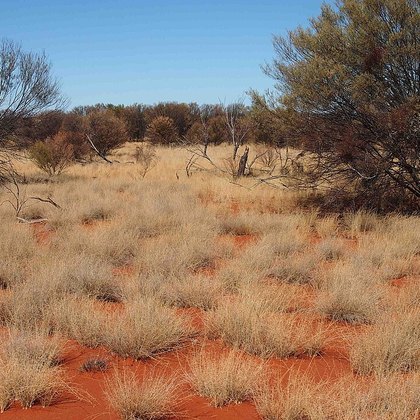
Stony, open, low-vegetated dry country: mulga and other acacia scrub on gravel, spinifex hummocks on stony slopes and ridges, gibber plains with scattered shrubs, and the breakaways and small mesas where loose stone and cover come together. Unlike the Chestnut and Copperback Quail-thrushes this is not a bird of mallee or woodland: it needs stone underfoot. Sand-dune desert without stone is avoided.
Where the bird is most often found, arranged by main group and formation.



Range and movements
West-central Australia: from the Pilbara in the north-west south to about Southern Cross in the Western Australian Goldfields, and east into the south-west of the Northern Territory. Resident on a fixed territory. Little is known of its numbers, which says mainly how thinly settled and little travelled this part of Australia is. The original type locality was given in the description as 'north-western Australia' and 'corrected' by Mathews in 1930 to north-western New South Wales — a correction that cannot hold for a purely western bird, and one that illustrates the confusion around this complex well.
- Resident
- dark = core range, pale = thinly spread
Where and when to look
In the first hour after sunrise, drive slowly along a gravel track through mulga on stone and stop at every breakaway or stony ridge. Walk a stretch and stand still; the bird walks away and flushes only at close quarters. Photograph back and scapulars if you can, because the pale feather edges are easier to judge on a sharp photograph than through binoculars. And note the place: with this species the map is the heaviest piece of evidence you have.
Conservation
Not threatened according to the world lists, with a large range in country unsuited to agriculture. The concerns are the same as for its relatives of the dry interior: grazing by stock, feral goats and camels removes the low shrub and herb layer in which the bird finds cover and food, and the feral cat is dangerous to a ground-nester. Mining and the roads and camps that come with it have local effects in the Pilbara and the Goldfields. Because the species was split off only recently, older counts cannot be assigned to the present species limit and the evidence is thin.
Scientific name
Cinclosoma marginatum | Sharpe, 1883
Richard Bowdler Sharpe described the bird in 1883 as Cinclosoma marginatum in the Catalogue of the Birds in the British Museum, and it still stands in that genus, so author and year remain without parentheses. Vigors and Horsfield introduced Cinclosoma in 1827, from Greek kinklos (an unspecified waterside bird) and soma (body). The epithet marginatum is Latin for 'edged, bordered', after the pale edges on the back and scapular feathers. Sharpe gave the type locality as 'north-western Australia'; Mathews 'corrected' this in 1930 to north-western New South Wales, which given the western range must be wrong. The form was long kept as a subspecies of Cinclosoma castaneothorax and has ranked as a species of its own since the recent revision of the complex.