All species › Passerines › Quail-thrushes and jewel-babblers › Spotted Quail-thrush
Spotted Quail-thrush | Cinclosoma punctatum
Gevlekte kwartellijster | Zordala manchada
The Spotted Quail-thrush behaves like a quail and is marked like a thrush: it walks in the litter of dry, stony forest ridges and only flushes when you are almost on top of it. It belongs to the quail-thrushes and jewel-babblers, a family of ground-dwelling songbirds of Australia and New Guinea. Anyone looking for it usually hears it first, and that sound is too high for many ears.
Voice
The song is an extremely high, thin series of seet-seet-seet notes, so high that older birders no longer hear it; it comes from the ground and carries hundreds of metres in still weather. There is also a short, sharp chuk as a contact note between the birds of a pair. The male sings mainly in the first hour after sunrise, often from a fallen log or a block of stone, holding his head low. On disturbance everything falls silent, and stays silent for a long time.
No freely licensed recording has been found for this species yet; what to listen for is described below.
Identification
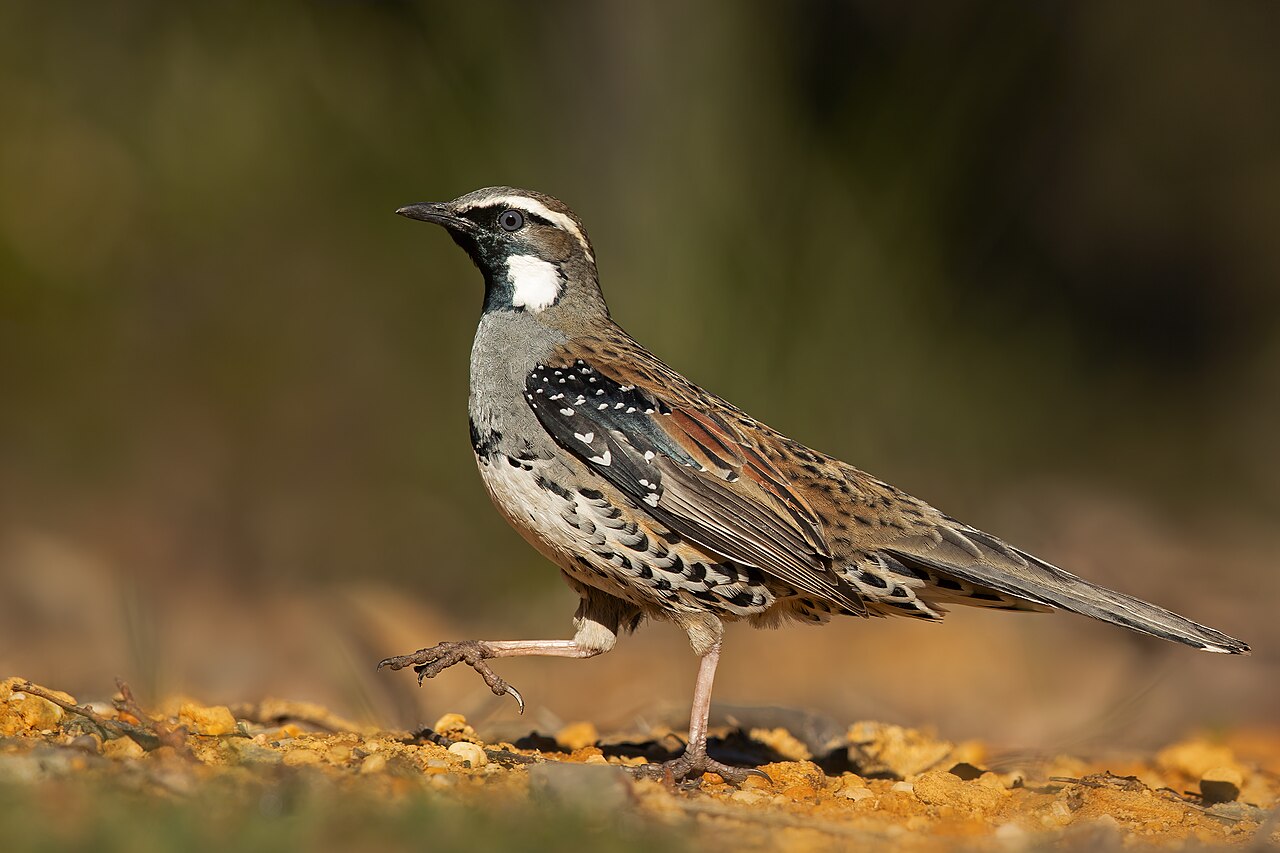
Twenty-eight centimetres, with a heavy head, short rounded wings and a long tail tipped with white. The male is olive-brown above with black and white spotting on shoulder and flank, has a black face with a white eyebrow and a white cheek patch, and a black throat running into a white breast. The female is duller: the throat is cream rather than black and the flanks are browner streaked. Young birds resemble the female but are washed out and vaguely marked. In flight one sees a short, low, straight line across the forest floor with a flash of white in the tail corners, and then the bird is gone.
Confusion species
The other quail-thrushes occupy drier and more open inland country and lack the black throat with the large white cheek patch. On the forest floor it is confused with a button-quail or a true quail: those are shorter, have no long tail and flush steeply and whirring rather than low and straight. A motionless Spotted Quail-thrush is all but invisible; the black-and-white marking on breast and flank is then the only thing that shows. Females of the northern population in Queensland are paler and cause the most doubt.
Habitat
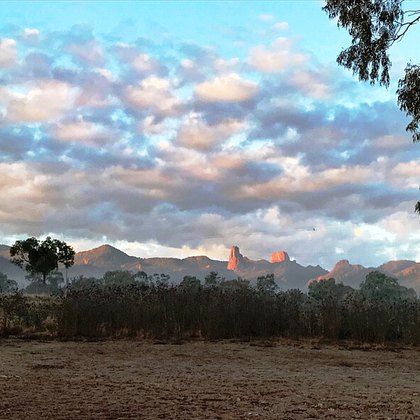
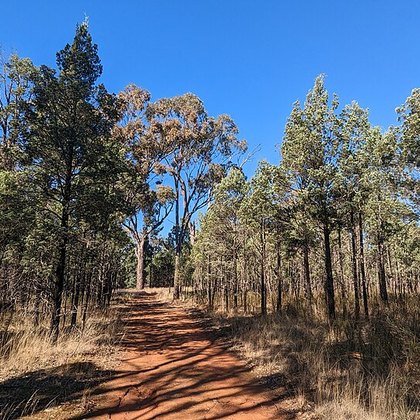
Dry eucalypt forest on poor, stony ground, with a thick layer of leaves and fallen branches and an open understorey — the bird has to be able to walk. Rocky slopes and ridges with loose blocks, and strips of casuarina or white cypress, are the best places. It avoids wet forest, a dense shrub layer and grazed country where the litter has been trodden away. The population in northern Queensland is in open forest on higher ridges, separated from the southern one by a thousand kilometres.
Where the bird is most often found, arranged by main group and formation.


Range and movements
South-eastern Australia: from south-eastern South Australia through Victoria and New South Wales into south-eastern Queensland, and throughout Tasmania; and in addition a small, separate area in northern Queensland. Resident, with a territory a pair holds all year. Over the past century the species has disappeared from large parts of the lower country, above all where forest has been thinned to pasture with trees; in Tasmania it holds on better. The northern population is so small and so poorly known that there are hardly any recent records of it.
- Resident
- dark = core range, pale = thinly spread
Where and when to look
Walk slowly along a dry, stony forest ridge, stop every hundred metres and listen for something very high and very thin; it is more a sensation than a sound. The best time is the first hour after sunrise in spring, from September to November. If you see nothing, look at the ground beneath fallen logs: the bird forages there and freezes the moment you stand still.
Conservation
Not threatened globally, but locally much reduced; in Victoria and on mainland South Australia the species has gone from many old districts. The causes are fragmentation of dry forest, grazing that removes the litter layer, and foxes and cats. The northern population in Queensland probably numbers very few birds; how few is not known.
Scientific name
Cinclosoma punctatum | (Shaw, 1794)
George Shaw described the bird in 1794 as Turdus punctatus, among the thrushes; because the species was later moved to another genus, author and year stand in parentheses. Vigors and Horsfield introduced the genus Cinclosoma in 1827, from Greek kinklos (an unidentified waterside bird) and soma (body). punctatum is Latin for 'spotted', after the black and white marks on shoulder and flank. The type locality is New South Wales.