All species › Passerines › Thornbills, scrubwrens, gerygones and allies › Chestnut-rumped Heathwren
Chestnut-rumped Heathwren | Hylacola pyrrhopygia
Vuurstuitheidesluiper | Sedosito culirrojo
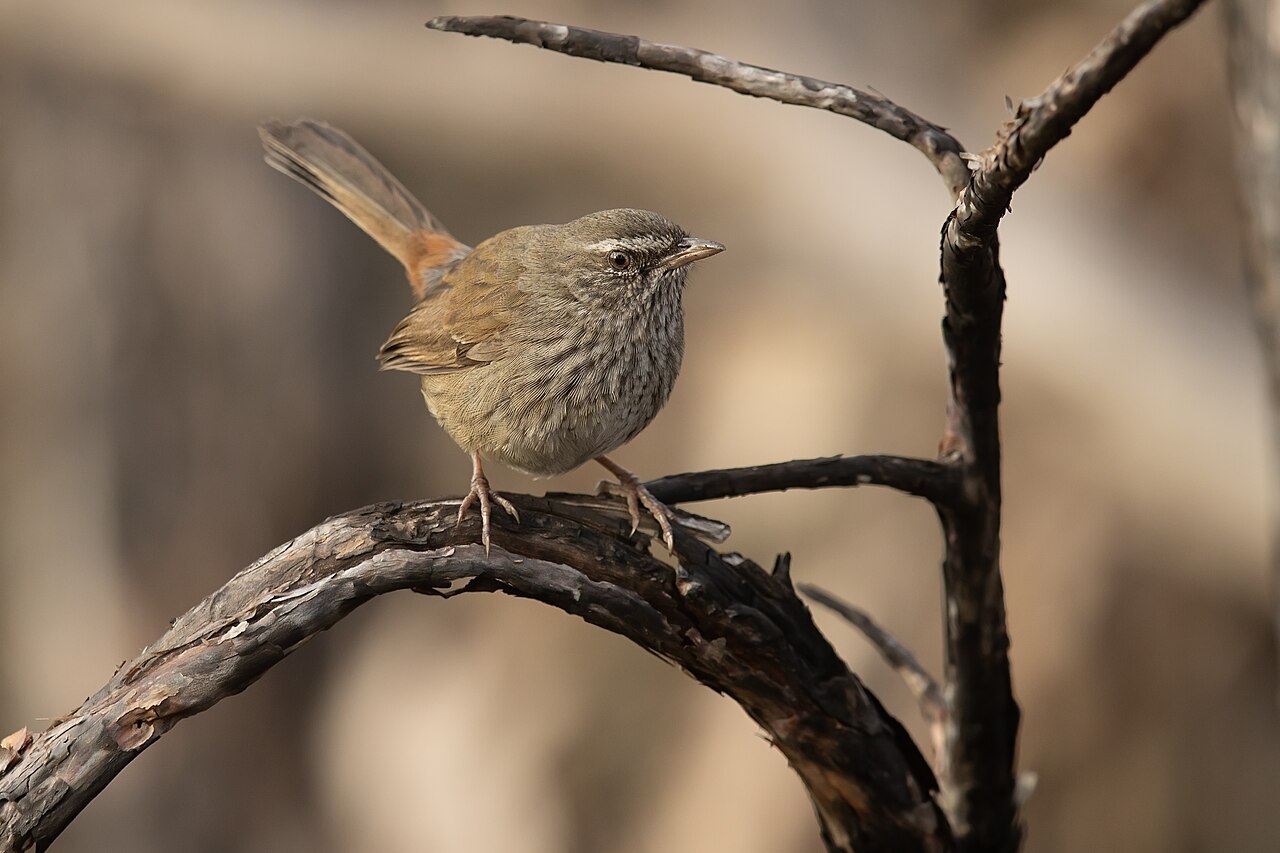
A shy ground bird of fourteen centimetres in the heaths and dense undergrowth of southeastern Australia, with a rufous rump that only shows as it flies off. Outside the breeding season it is next to invisible; from July to November both sexes sing from half-hidden perches and suddenly it can be heard everywhere.
Voice
A rich, melodious, drawn-out warble with widely varying notes, sung by both sexes from a partly concealed perch. Into it the bird works mimicry of other species, done remarkably well for a bird of this size. The alarm is harsh and grating. In the heath it is normally found by this sound alone, because it would rather walk than fly.
No freely licensed recording has been found for this species yet; what to listen for is described below.
Identification
Olive-brown above, with a conspicuous reddish-brown rump and upper tail coverts best seen in flight or when the tail is spread. The breast is streaked, the belly grey-buff. Both sexes have a dull white eyebrow and yellow eyes; bill and legs are grey. The tail is long and carried cocked like a wren's. There is no white patch on the wing.
Confusion species
Shy Heathwren (Hylacola cauta) is the twin species and the only real problem. That bird does have a white wing patch, a brighter white eyebrow, whiter underparts, crisper breast streaking and a more fiery rufous rump. Where both occur the wing patch is the quickest feature; otherwise the difference is largely habitat, because this species holds the eastern heaths and dense forest undergrowth while the Shy Heathwren holds mallee and sandplain heath. The fieldwrens of the genus Calamanthus — Calamanthus fuliginosus, Calamanthus campestris and Calamanthus montanellus — are the closest relatives, but live in low open vegetation without a shrub layer and are streaked on the back as well. Speckled Warbler (Pyrrholaemus sagittatus) has a heavily streaked head and no rufous rump.
Habitat
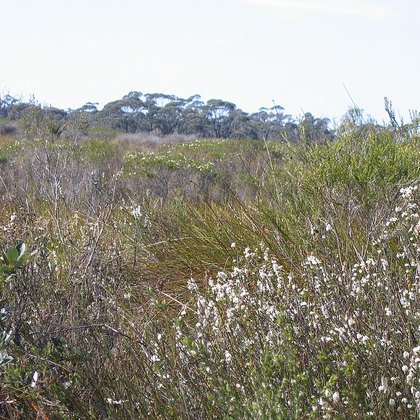
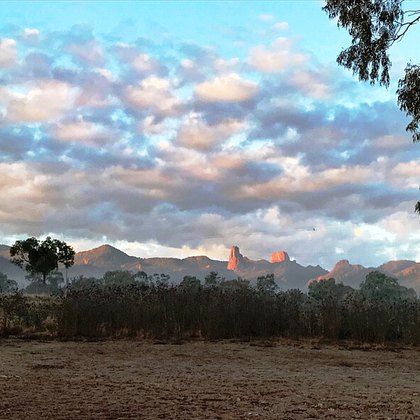
Heaths of coastal, mountain and hinterland country, and the dense undergrowth of forest and woodland; in South Australia also heathy eucalypt woodland and mallee with several layers of low heath shrubs beneath. It favours ridges, hilltops and slopes, sometimes gullies. It forages on the ground for flies, spiders, moths, ants and cicadas, and takes grass seed besides.
Where the bird is most often found, arranged by main group and formation.

Range and movements
Southeastern Australia, from the Granite Belt in Queensland through New South Wales and Victoria into South Australia. Three subspecies: pyrrhopygia in New South Wales and Victoria, parkeri in the Mount Lofty Ranges and pedleri in the southern Flinders Ranges. It is sedentary and uncommon to scarce throughout; the two South Australian forms sit in small, separated areas.
- Resident
- dark = core range, pale = thinly spread
Where and when to look
Come in winter and early spring, between July and November: that is when it sings and can be found, and the rest of the year it cannot. Work ridges and slopes with a closed, multi-layered heath understorey, and stand on the track and listen rather than walking into the cover. If it does flush, look straight at the rump.
Conservation
Least Concern globally, but in trouble at state level: Endangered in South Australia and Vulnerable in Victoria. The subspecies parkeri of the Mount Lofty Ranges is listed as Endangered both federally and in South Australia; a survey found it at only 25 of 83 apparently suitable sites, with the largest population between Black Hill and Cleland Conservation Park. The causes are housing development, fragmentation, decline of the understorey through grazing and weeds, unsuitable fire regimes, dieback of the shrub layer caused by the fungus Phytophthora cinnamomi, and predation by foxes and feral cats.
Scientific name
Hylacola pyrrhopygia | (Vigors & Horsfield, 1827)
Vigors and Horsfield described the bird in 1827 as Acanthiza pyrrhopygia, from a specimen taken in New South Wales; because the species later moved to Hylacola, author and year stand in parentheses. The genus name, introduced by Gould in 1843, joins Greek hulē, wood or thicket, and Latin colere, to inhabit. pyrrhopygia means fire-rumped, from Greek purrhos, flame-red, and pugē, rump — exactly what the Dutch name Vuurstuitheidesluiper and the English name Chestnut-rumped Heathwren both point at.