All species › Passerines › Thornbills, scrubwrens, gerygones and allies › Shy Heathwren
Shy Heathwren | Hylacola cauta
Malleeheidesluiper | Sedosito tímido
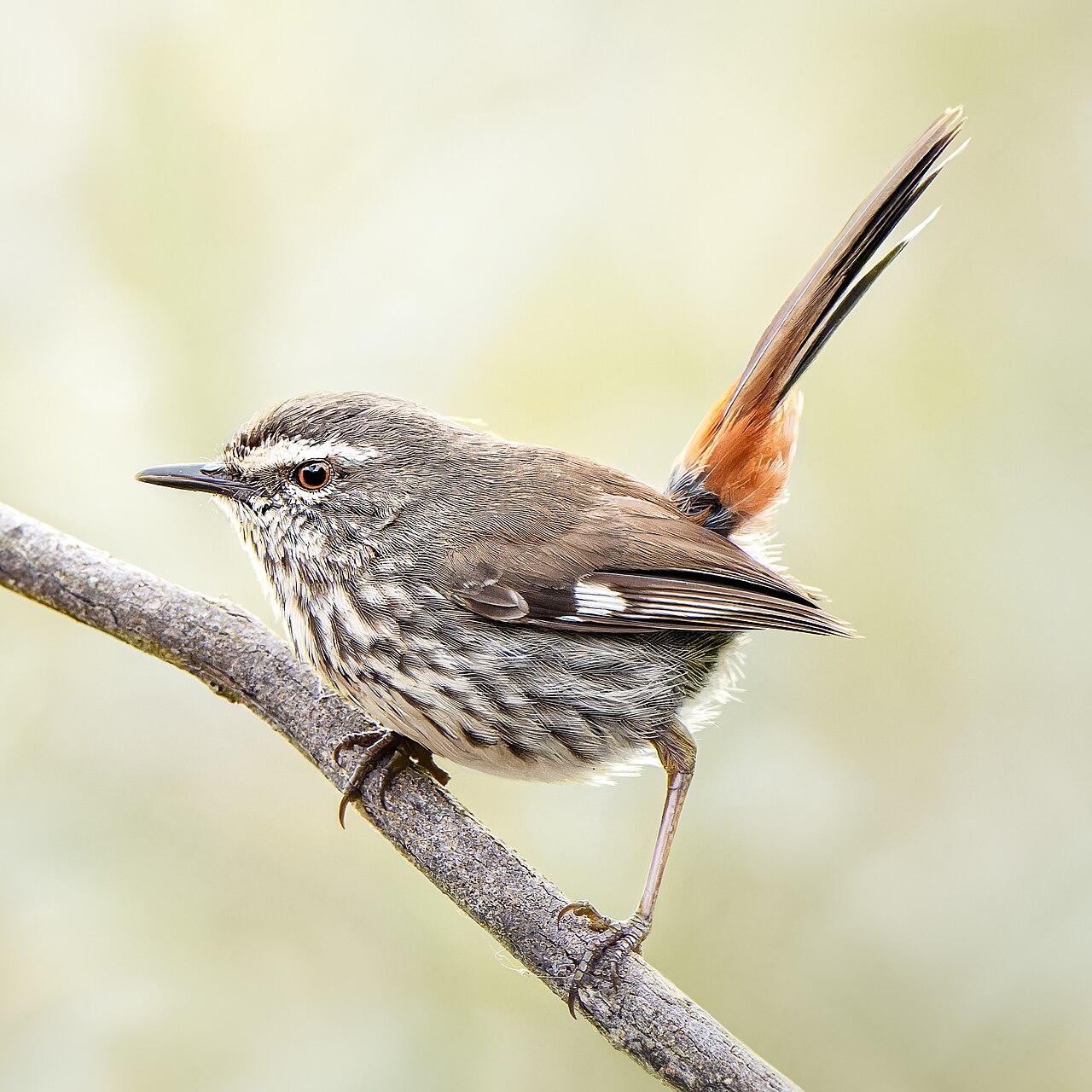
A shy ground bird of the mallee with a fiery rufous rump, a white eyebrow and a tail carried cocked and tipped with white. It lives in the dense heath layer beneath the mallee shrubs of southern Australia and is rarely seen; the loud song from half-hidden cover gives it away long before the eye does.
Voice
A loud, varied and melodious warble, strikingly powerful for a bird of fifteen grams, usually delivered from a half-concealed twig in the heath. Alongside it comes a harsh rattling alarm as soon as anyone comes too close. Anyone who does not know the sound will walk past the species in the mallee every time. Mimicry of other birds has been described for the genus, but the sources consulted do not record it explicitly for this species, so that claim has been left out here.
No freely licensed recording has been found for this species yet; what to listen for is described below.
Identification
Grey-brown to warm brown above, with grey on head and neck, and a sharply defined, bright rufous-chestnut rump that darkens towards the base of the tail. The underparts are white with brown streaking on breast and flanks. The eyebrow is bright white, the tail is carried cocked and white-tipped, and there is a white patch on the wing — a feature no other bird in this group shows so clearly. Females and young are duller, juveniles sometimes fawn on the belly.
Confusion species
Chestnut-rumped Heathwren (Hylacola pyrrhopygia) is the twin species and the only real problem: it lacks the white wing patch, has a duller, less fiery rump, dingier white underparts and less crisp breast streaking, and an off-white rather than bright eyebrow. The ranges also barely overlap: this bird holds the mallee and sandplain heath of the south and west, the Chestnut-rumped the eastern heaths and forest undergrowth. The fieldwrens of the genus Calamanthus — Calamanthus fuliginosus, Calamanthus campestris and Calamanthus montanellus — are the closest relatives and look much alike, but they live in open low vegetation without a shrub layer and are streaked on the back as well as below, where this bird has a plain back. Speckled Warbler (Pyrrholaemus sagittatus) has a more heavily streaked head and no rufous rump.
Habitat
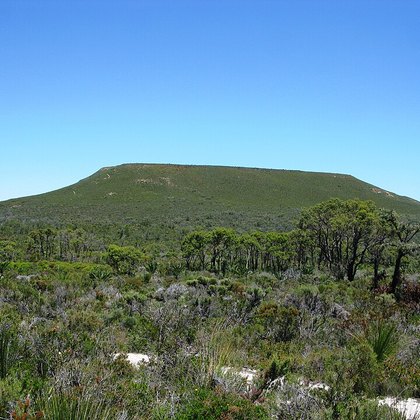
Mallee woodland with a dense, closed understorey of heath shrubs, and the sandplain heath beyond it. The shrub layer is the key: where it has gone to stock, fire or clearing the bird goes too, even if the mallee stems remain. It forages almost entirely on the ground, among the stems and the litter, on insects and other arthropods and very occasionally on seed.
Where the bird is most often found, arranged by main group and formation.

Range and movements
Southern Australia, from the Western Australian wheatbelt through South Australia and northwestern Victoria into central New South Wales. Two separate populations remain in New South Wales, one around Griffith and West Wyalong and one in the far southwest between Balranald and Mallee Cliffs. It is sedentary and barely moves; its flight is weak and its dispersal across open country correspondingly poor.
- Resident
- dark = core range, pale = thinly spread
Where and when to look
Go towards the song and then stand still: movement pushes it into cover and that is the end of it. The best time is the first hours after sunrise in the breeding season, when both partners sing. On a glimpse, look at the wing first — the white patch is the quickest feature to read, and the Chestnut-rumped Heathwren does not have it.
Conservation
Least Concern globally, but listed as Vulnerable in New South Wales; it carries no federal listing. The causes are the same everywhere: clearing of mallee for cropping, fragmentation that isolates the remaining groups, loss of the understorey to grazing and to fires that are too frequent or too large, and predation by foxes and feral cats. Because the bird flies poorly, emptied patches do not fill again by themselves.
Scientific name
Hylacola cauta | Gould, 1843
Gould described the species in 1843 directly in Hylacola, which he introduced in the same year, so author and date carry no parentheses; the type locality is the timber belts along the Murray in South Australia. The genus name joins Greek hulē, wood or thicket, and Latin colere, to inhabit: dweller of the scrub. cauta is Latin for cautious or wary, and the English name Shy Heathwren says the same. The species stood for a long time in Calamanthus, as Calamanthus cautus; since 2008 Hylacola is in use again.