All species › Passerines › Thornbills, scrubwrens, gerygones and allies › Dusky Gerygone
Dusky Gerygone | Gerygone tenebrosa
Witoogmangrovezanger | Gerigón oscuro
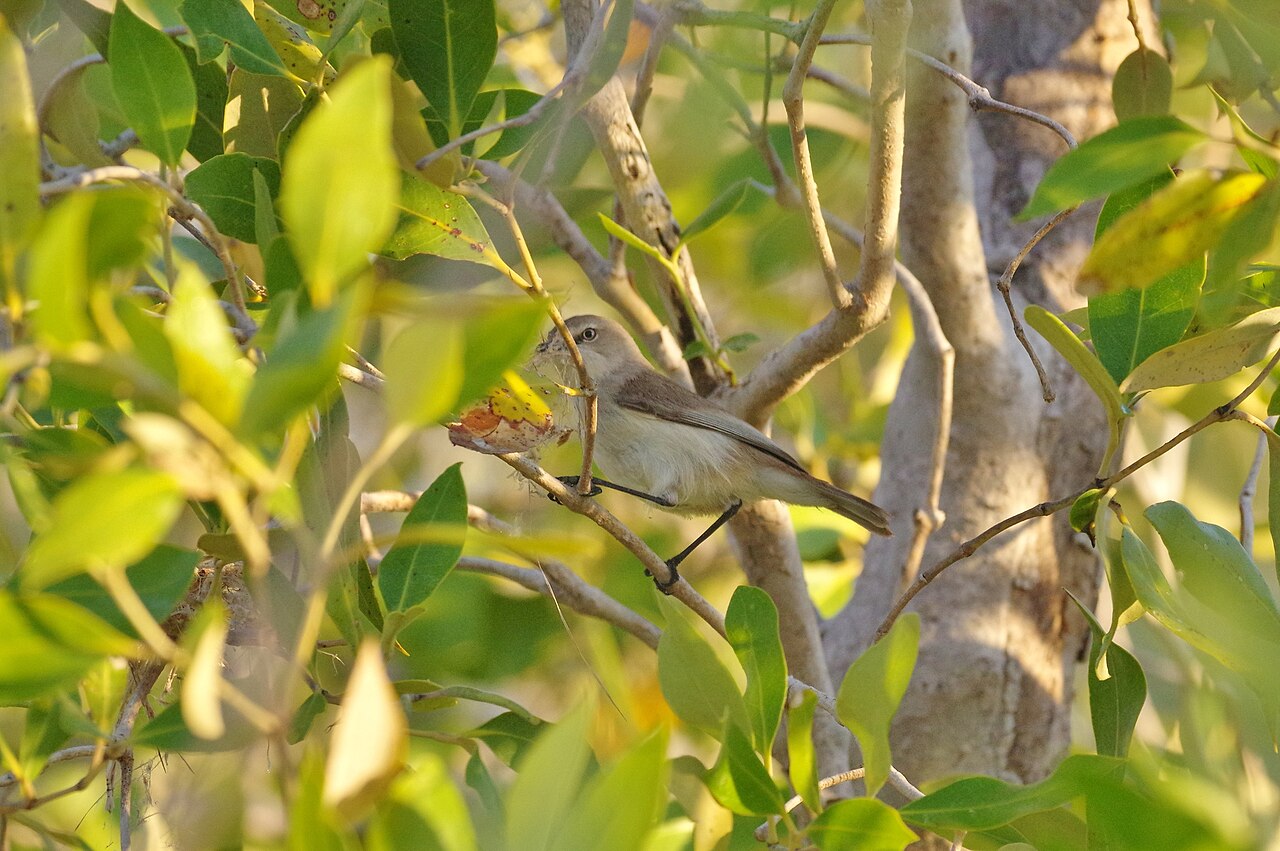
The one gerygone that fully lives up to the Dutch family name: it occurs nowhere but in the mangroves of the Western Australian coast, from Shark Bay into the Kimberley. Ten to thirteen centimetres, grey-brown with an olive wash, off-white below, with a black bill and black legs — a bird without a single striking feature, in a habitat that does the distinguishing for it.
Voice
A thin, high phrase, shorter and less sweet than in most of its relatives, with the falling pitch that marks the genus. Song and alarm recordings exist, but the sources consulted give no rendering that helps in the field; the honest advice is to compare recordings before going into the mangroves, because Mangrove and Large-billed Gerygones are singing there too.
No freely licensed recording has been found for this species yet; what to listen for is described below.
Identification
Plain and dark: grey-brown above with an olive wash, greyish white below, with no yellow tones and no clear white in the tail. Bill and legs are black. The Dutch name points at the narrow pale eye-ring and the pale eye, and that, together with the uniform dull brown, is as much as the plumage offers. In practice this species is identified above all by where it is sitting.
Confusion species
Mangrove Gerygone (Gerygone levigaster) shares the coast and is the hard case: it is paler and greyer, with a clear white eyebrow and white tail tips, where this bird is darker and plainer. Large-billed Gerygone (Gerygone magnirostris) has a heavier bill and a more conspicuous eye-ring. Western Gerygone (Gerygone fusca) occurs in the same districts but in dry woodland and mulga, and has the black-and-white tail bars this species lacks. Of the remaining members of the genus — Gerygone mouki, Gerygone palpebrosa, Gerygone igata, Gerygone modesta, Gerygone albofrontata and Gerygone olivacea — only the last overlaps, and it is yellow below. Be honest about it: between this bird and the Mangrove Gerygone the field distinction rests mainly on song and on exactly where in the mangrove the bird is.
Habitat
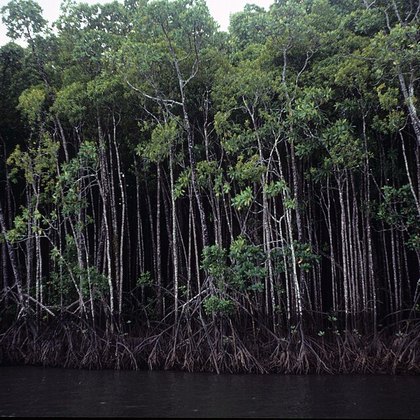
Mangrove, and almost nothing else: the belts of Avicennia and Rhizophora along the river mouths, creeks and bays of the Western Australian coast. Locally it follows the creek up into the fringing vegetation along the water, but it always stays close to the tidal forest. It forages in the foliage, gleaning small insects and spiders from leaf and twig.
Where the bird is most often found, arranged by main group and formation.

Range and movements
The coast of Western Australia only, from Shark Bay in the south to Kunmunya and the Kimberley in the north — a narrow, broken strip that brings the total range to under forty thousand square kilometres. Two subspecies are recognised, tenebrosa and christophori. The species is sedentary and does not move about.
- Resident
- dark = core range, pale = thinly spread
Where and when to look
Go into the mangroves at low tide and follow the creek edges: it likes the zone where the trees stand thickest. Do not go by colour but by shape and behaviour — after that the only question left is which of the three mangrove gerygones you are looking at, and for that you need the song. Exmouth and the Dampier Archipelago are the best-known places.
Conservation
Least Concern (LC), but a species with a small, narrow range that is tied entirely to one habitat type. Mangrove on the Western Australian coast lies beside ports, salt works and iron-ore terminals and their access corridors, and is besides vulnerable to cyclones and to dieback after exceptional drought and heat. Because the bird does not fall back on other woodland, every patch of mangrove lost weighs more heavily here than for relatives with a wider choice.
Scientific name
Gerygone tenebrosa | (Hall, 1901)
Robert Hall described the bird in 1901 as Pseudogerygone tenebrosa, from a specimen on the Fitzroy River in northwestern Australia; because the species later moved to Gerygone, author and year stand in parentheses. Gould introduced the genus in 1841, from Greek gērugonos, born of sound. tenebrosa is Latin for dark or shadowy, after the dull colouring, and the English name Dusky Gerygone says the same. The Dutch name Witoogmangrovezanger instead names the pale eye with its pale ring.