All species › Tubenoses › Petrels, shearwaters and diving petrels › Cook's Petrel
Cook's Petrel | Pterodroma cookii
Cook-stormvogel | Petrel de Cook
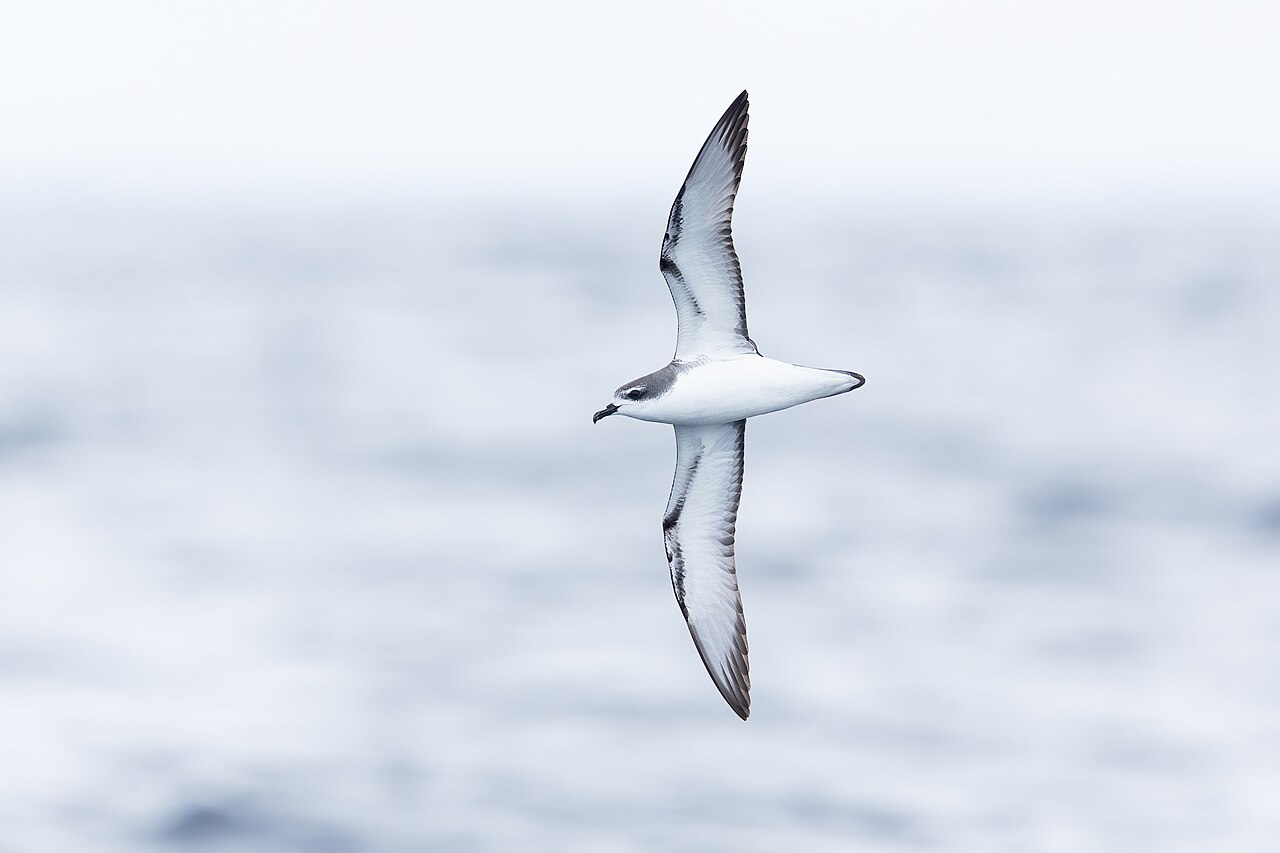
Cook's Petrel is the palest and lightest of New Zealand's small gadfly petrels: pale grey above with a dark M, almost wholly white below, and with a slender black bill. It breeds in mountain forest on three islands and ranges across half the Pacific outside the breeding season.
Voice
At sea it is silent. Over the colony by night comes a goat-like bleating kek-kek-kek or eh-eh-eh, alternating with lower boor notes from the burrow; on Hauturu that sound fills the dark forest. The Maori name titi, used for several tubenoses, is formed after such calling.
Recording: Nathan El — CC BY-NC-SA 4.0 · near Matakana, Auckland, New Zealand · xeno-canto
Identification
A small, slight petrel of twenty-eight centimetres, pale blue-grey above with a dark brown to black M running from wingtip across the back to the other wingtip, and a darker rump and tail tip. The head is grey with a finely speckled pale forehead and crown, so that no sharp cap is ever formed. The underparts are white and the underwing is almost entirely white, with only a thin, broken dark line along the leading edge of the outer wing. The bill is strikingly slender and black, 25 to 30 millimetres long; the legs are dull blue-grey with yellowish webs and black margins. Flight is fast and light, in short beats and high arcing bows.
Confusion species
Pycroft's Petrel (Pterodroma pycrofti) is the nearest problem: slightly smaller, darker grey above and without the finely speckled crown, with a shorter bill. Gould's Petrel (Pterodroma leucoptera) has a distinctly darker head with an extensive, sharply bounded black hood and far more black along the leading edge of the underwing. Chatham Islands Petrel (Pterodroma axillaris) is darker above and carries a black diagonal bar ending in a black axillary patch, where the underwing of Cook's Petrel is as white as it gets. Black-winged Petrel (Pterodroma nigripennis) has a darker, more uniform grey cap and a heavy black diagonal across the underwing. The three small species Cook's, Gould's and Chatham Islands can be told at sea only on head contrast and the amount of black on the underwing; anyone who has not seen that should settle for 'small Pterodroma'.
Habitat
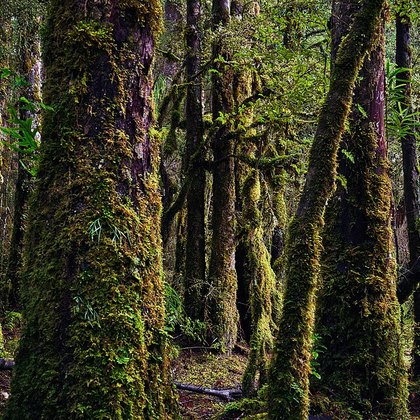
Outside the breeding season open ocean over deep water, mainly the Tasman Sea and the western Pacific from about 32 degrees south to the subtropical convergence. On the breeding islands it is a forest bird: it digs its burrow in the soil of podocarp and broadleaf forest, on Hauturu right up to the ridge, and comes ashore only at night.
Where the bird is most often found, arranged by main group and formation.

Range and movements
Endemic as a breeder to New Zealand, with three colonies: Hauturu or Little Barrier and Aotea or Great Barrier in the north, and Whenua Hou or Codfish Island in the south. Hauturu carries by far the largest share, estimated at 286,000 breeding pairs in 2007, against about 5,000 pairs on Whenua Hou in 2008. At sea it is common in the Hauraki Gulf and along the north-east coast of the North Island from October to April, and also in the Tasman Sea off eastern Australia, where it turns up regularly on pelagic trips out of New South Wales. Outside the breeding season it travels far: northern birds to the Aleutians, southern birds to the seas off Chile and Peru.
- Breeding (summer)
- dark = core range, pale = thinly spread
Where and when to look
The easiest chance is an evening or pelagic trip in the Hauraki Gulf between November and March, when thousands of birds head for Hauturu towards sunset; trips out of Tutukaka and Whitianga work well too. Look for a small, very pale petrel with a fluttering, arcing flight and above all check the almost white underwing — with this species that is the mark that survives poor light.
Conservation
Vulnerable (VU), but with a story that ends well. Introduced predators — Pacific rat, ship rat, feral cat, pig and weka — had driven the species from much of the country and held breeding success on Hauturu at five per cent. After rats were eradicated there in 2006 that rose to sixty per cent, and the two main populations (Hauturu and Whenua Hou) are now increasing rapidly. Between 2010 and 2016 more than four hundred chicks were moved from Hauturu to found new colonies, and since 2013 transfers have also run to Boundary Stream on the mainland, behind a predator-proof fence.
Scientific name
Pterodroma cookii | (Gray, 1843)
The British zoologist George Robert Gray described the species in 1843 as Procellaria cookii; because it has since moved to another genus, author and year go in parentheses. The genus Pterodroma was introduced by Bonaparte in 1856, from the Greek for 'wing' and 'runner'. The epithet honours Captain James Cook, whose Pacific voyages began the scientific exploration of New Zealand. The type locality is simply 'New Zealand', with no indication of any of the islands on which the bird actually breeds.