All species › Tubenoses › Petrels, shearwaters and diving petrels › Grey-faced Petrel
Grey-faced Petrel | Pterodroma gouldi
Grijsmaskerstormvogel | Fardela de alas grandes
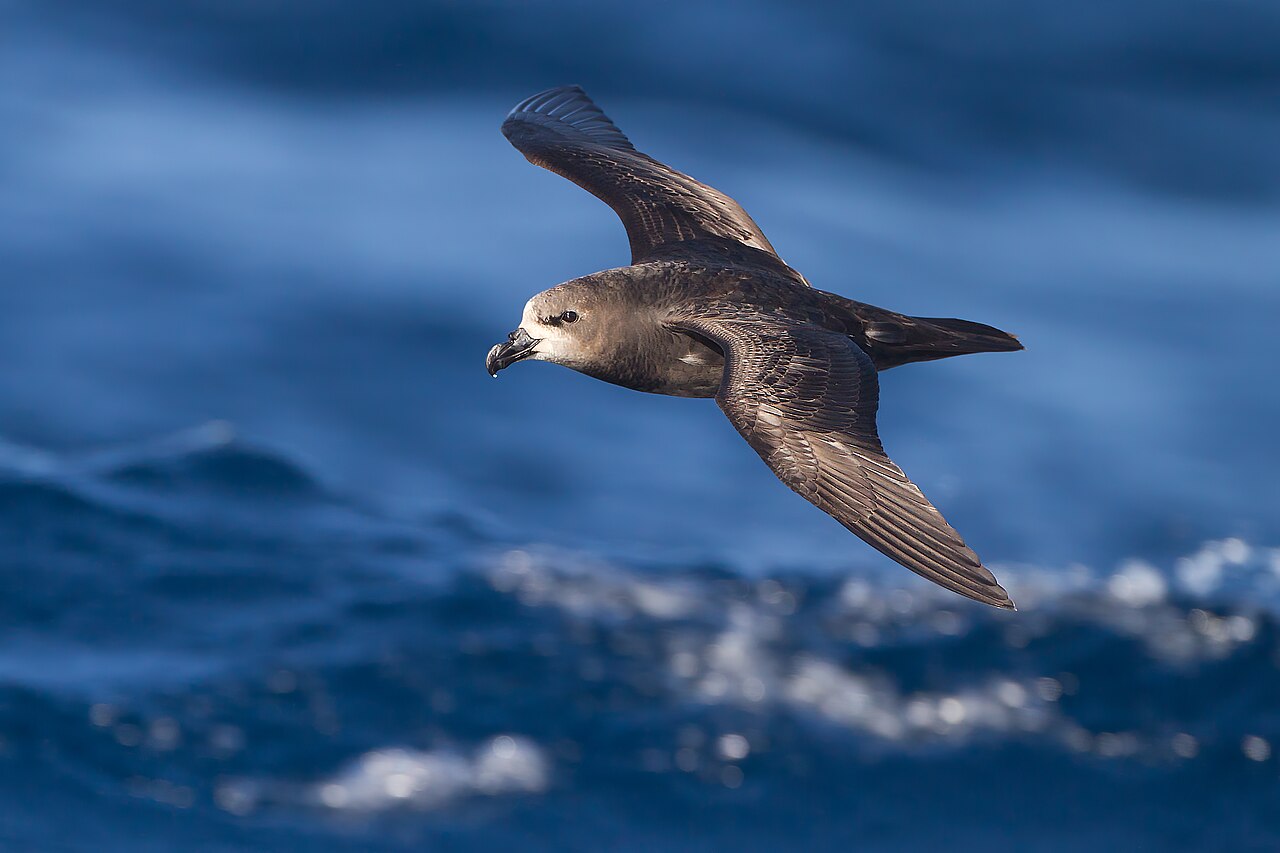
The Grey-faced Petrel is the dark gadfly petrel of northern New Zealand, known to Maori as oi: a sooty-black bird that arcs high through the wave troughs on stiff wings and gives its name away only when the light catches the pale mask around the bill base and throat. It breeds in winter, against the clock of almost every other seabird, returning in darkness to the cliffs and islets of the north from March onwards. It has ranked as a full species since 2014, split from the Great-winged Petrel, and with tens of thousands of pairs on Moutohora alone it is anything but scarce in its own waters. Outside the breeding season it wanders right across the Tasman Sea into Australian waters.
Voice
At sea this bird is almost always silent, as petrels are; the voice belongs to the colony and to the night. Above the breeding slopes comes a mixture of high, sharp whistles and low moaning notes, rendered in the literature as a two-syllable whis-her and a faster wik-wik. Birds call both in flight over the colony and from the ground and the burrow, and on a still night in April or May, when courtship activity peaks, a whole cliff slope whistles and groans. By day the same place is dead quiet. To hear the voice you must stand by a colony after dark, not sit on a boat.
No freely licensed recording has been found for this species yet; what to listen for is described below.
Identification
A large, wholly dark petrel of around forty-two centimetres and roughly 550 grams, with long, narrow, slightly crooked wings. The plumage is uniform black-brown, flecked with paler worn feathers when abraded. The feature behind the name is the pale mask: light grey to off-white on the forehead, lores, chin and throat, standing out clearly against the black of the rest of the head at close range. The bill is short, deep, black and strongly hooked, thirty-three to forty millimetres long, with the typical tube-nose on top; eye and legs are black. Flight is the best first clue: fast, high arcs on stiff wings, much gliding and little flapping, quite unlike the straight, low-shearing flight of the large shearwaters.
Confusion species
The hardest case is the Great-winged Petrel (Pterodroma macroptera), from which this species was split. They are the same size and the same weight - AVONET gives both an identical wing length and mass - and differ only in how far the pale face extends: the Grey-faced Petrel averages more extensive and more contrasting pale grey on forehead, chin and throat, while the Great-winged is more restricted and dingier there. At sea that difference is unreliable, since wear, light and salt change the impression, and the 2016 revision that underpinned the split states outright that most field identifications rest on geography and that the possible overlap zone off south-eastern Australia is poorly characterised. In New Zealand waters a dark Pterodroma is almost certainly this species; off southern and western Australia almost certainly the other; in the Tasman Sea caution is required. Beyond that there is the Providence Petrel (Pterodroma solandri), which shows white primary bases on the underwing and a paler, scaly face; the dark morph of the Kermadec Petrel (Pterodroma neglecta), which shows white shafts on the upperwing; and the Kerguelen Petrel (Aphrodroma brevirostris), smaller and greyer, big-headed, and silvery on the underwing in certain light. The large dark Procellaria species and the Flesh-footed Shearwater (Ardenna carneipes) separate at a glance on their pale, horn-coloured bills and their much flatter, less wild flight.
Habitat
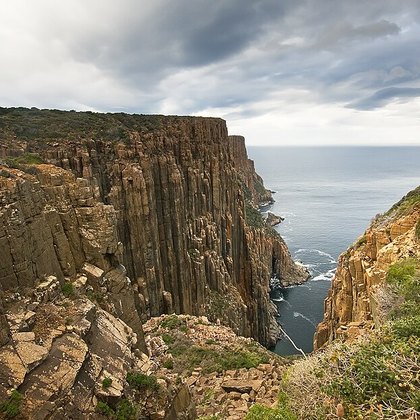
Outside the breeding season a bird of the open ocean, chiefly the subtropical and temperate south-west Pacific between roughly 25 and 50 degrees south, where it forages over deep water and usually crosses the continental shelf only in transit. The diet is largely squid, supplemented with fish and crustaceans, and is taken mostly at night from the surface - probably helped by the light of bioluminescent prey. For breeding it comes ashore on steep vegetated cliffs and on islands off the northern North Island, digging its burrow into forest floor or among the vegetation of clifftops. Some colonies are on the mainland itself, on headlands kept safe by fencing and predator control.
Where the bird is most often found, arranged by main group and formation.


Range and movements
Breeds only in northern New Zealand, along a band of about six hundred kilometres from the Three Kings Islands in the far north south to Cape Kidnappers in Hawke's Bay. The largest colony is on Moutohora (Whale Island), with an estimated 95,000 breeding pairs. Outside the breeding season birds disperse across the south-west Pacific and the Tasman Sea into Australian waters, where they are regular off the south-east coast in particular. The guide's measurement data show the same: present in ten of ten years in both Australia and New Zealand, with 5,975 Australian, 4,340 New Zealand and 55 Norfolk records. That makes this by far the best-documented of the three recent splits in this guide, despite the fact that the GBIF backbone taxonomy has not yet adopted the split and the figures had to be gathered at subspecies level.
- Resident
- Passage
- dark = core range, pale = thinly spread
Where and when to look
Pelagic trips from the north-east coast of the North Island - Whitianga, Tutukaka, the Hauraki Gulf - produce this species year-round, with the best odds between March and December while birds are attending colonies. On a dark Pterodroma look at flight first and head second: high, fast arcs on stiff wings, and a short, thick, black bill. To see the mask, wait until the bird banks low past the boat with the light behind you; head-on and backlit it simply looks uniformly black. For the voice, stand at a managed mainland colony after dark in April or May.
Conservation
The IUCN places the species in the Least Concern category and New Zealand rates it Not Threatened; with a population running into the hundreds of thousands and a breeding range spread over six hundred kilometres of coast, that is fair. The threats are local rather than national: rats, cats, stoats and pigs at mainland colonies and on islands not yet predator-free, disturbance and light pollution affecting fledglings departing in December and January, and longline fishery bycatch. The customary harvest of chicks by some iwi is a long-standing practice whose sustainable scale is now being underpinned by research. Predator control on mainland headlands and eradication programmes on the coastal islands have measurably improved breeding success in several places.
Scientific name
Pterodroma gouldi | (Hutton, 1869)
The species name gouldi honours John Gould, the nineteenth-century British ornithologist whose work on the Australian avifauna still echoes through dozens of scientific names. The genus name Pterodroma is Greek for wing-runner, from pteron, wing, and dromos, running - an apt description of how these birds hunt across the waves. The Dutch name seizes on the one feature that distinguishes it from its sister species: the pale grey mask around the bill base and throat. In Maori it is oi, also titi or northern muttonbird.