All species › Tubenoses › Petrels, shearwaters and diving petrels › Herald Petrel
Herald Petrel | Pterodroma heraldica
Salvins stormvogel | Fardela heráldica
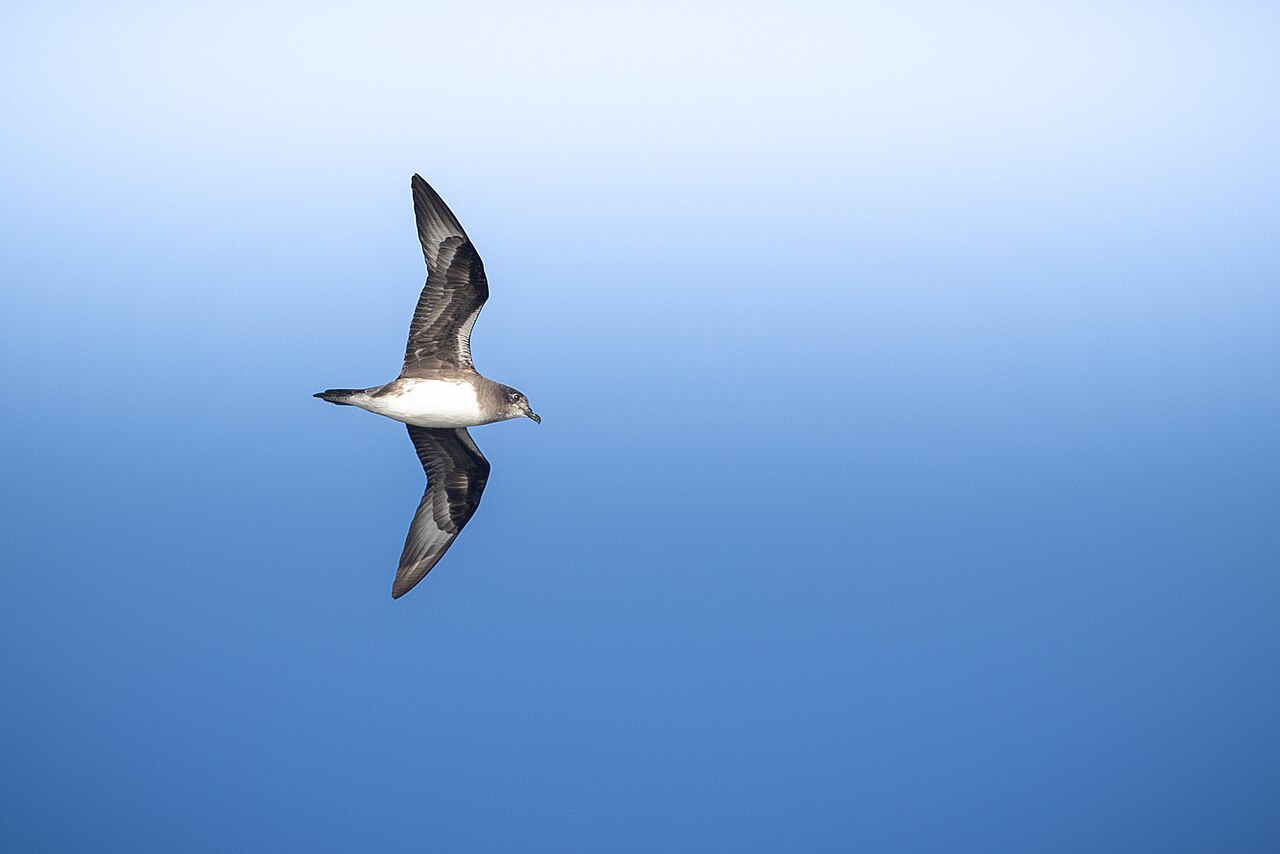
The Herald Petrel (Pterodroma heraldica) is a medium-sized, strongly variable gadfly petrel of the tropical Pacific, which in this region occurs only as a scarce breeder on Raine Island and otherwise as a vagrant. All morphs — dark, intermediate and pale — share one feature: a pale flash at the base of the primaries on the underwing.
Voice
Silent at sea, as all gadfly petrels are; nobody will ever hear it in Australian waters. At the tropical island colonies it calls in flight over the breeding ground with short high cries; the repertoire is poorly documented because the colonies are so remote, and there is next to no recorded material from Raine Island.
No freely licensed recording has been found for this species yet; what to listen for is described below.
Identification
A slim petrel of thirty-six centimetres and about two hundred and ninety grams, with long narrow wings and a long pointed tail. It occurs in three morphs. The dark morph is grey-brown throughout; the intermediate morph looks strongly hooded, with a dark head and breast, white belly and dark undertail coverts; the pale morph has white underparts and a faint dark collar. What all three share is the pale flash at the base of the primaries on the underwing, and that is the feature you identify it by. The shafts of the primaries are dark, so no pale patch appears on top of the wing. Bill black, eye dark, legs pink with black outer toes.
Confusion species
This is the hardest identification among the tropical species. Kermadec Petrel (Pterodroma neglecta) is equally variable and its dark and intermediate morphs give almost the same impression; the one usable difference lies in the shafts of the primaries. In Kermadec Petrel these are pale to white, so a pale patch shows on the upperwing as well, whereas Herald Petrel has dark shafts and shows a patch only from below. An observer who cannot see the upperwing well often simply cannot separate the two at sea, and the literature says so plainly. Providence Petrel (Pterodroma solandri) also has a white underwing flash but is larger and heavier built, has a pale scaly face, and sits in the Tasman Sea rather than the Coral Sea. Great-winged Petrel (Pterodroma macroptera) lacks the underwing flash altogether. Pterodroma alba, not covered by this guide, is darker on the forehead, where Herald Petrel usually shows pale lores. Note the name trap: Salvin's Prion (Pachyptila salvini) and Salvin's Albatross (Thalassarche salvini) are entirely different birds in other genera, named after the same man.
Habitat
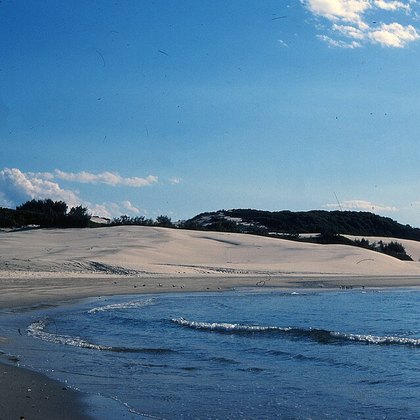
At sea, warm tropical water, usually far out of sight of land and over great depth. To breed it comes to low tropical islands and coral cays, where it nests on the ground among herbs and low scrub on sandy or rough coral substrate — not in a burrow, which on such an island makes it that much more exposed to predators.
Where the bird is most often found, arranged by main group and formation.

Range and movements
Within the window of this guide, Raine Island off the north-east coast of Queensland is the only known Australian breeding site. It also breeds on the Chesterfield Reefs near New Caledonia and scattered across the tropical Pacific to Tonga, American Samoa, the Marquesas and Pitcairn. At sea it stays mainly south of the equator, from northern Queensland east to Easter Island; in the Coral Sea it is therefore rare but regular. For New Zealand there is a single record: an intermediate-morph bird seen and photographed off the Meyer Islets (Herald Islets) in the Kermadec group on 29 March 2016.
Where and when to look
Do not count on it. Raine Island is strictly protected and closed, and in Australian waters the species is practically only seen on far-offshore Coral Sea trips or by chance from a ship bound for the outer reefs. If a dark or hooded gadfly petrel appears in tropical water, photograph the upperwing before anything else: only the absence of a pale patch above, combined with a pale patch below, rules out Kermadec Petrel.
Conservation
Least Concern (LC) globally, because the stock across the tropical Pacific as a whole is large. In Australia the picture is quite different: there it is listed as critically endangered, since an estimated forty to fifty pairs breed, all on Raine Island. The proof of breeding there is recent: in June 2017 an adult was found on an egg and later that season a healthy chick. In 2018 eighteen birds were fitted with geolocators; by 2023 seventeen had returned, and the data showed that after breeding the birds move east towards the Solomon Islands and then to an area north of New Guinea, three and a half to four thousand kilometres each way. The threats at Raine Island are sea-level rise on a low sand cay and the effect of warming seas on the food supply.
Scientific name
Pterodroma heraldica | (Salvin, 1888)
Salvin described the species in 1888 as Oestrelata heraldica, so author and year stand in parentheses. The epithet heraldica refers to HMS Herald, the British survey ship from which the type material was collected at the Chesterfield Islands, and that is where the English name comes from too. The Dutch guide name Salvins stormvogel, by contrast, honours the describer himself, Osbert Salvin. That creates a trap worth flagging: this guide also holds Salvin's Prion (Pachyptila salvini) and Salvin's Albatross (Thalassarche salvini), three species in three genera and two families, all named after the same British ornithologist — so always use the full name in the field. The type locality is the Chesterfield Islands. The genus Pterodroma was introduced by Bonaparte in 1856, from Greek pteron (wing) and dromos (runner).