All species › Tubenoses › Petrels, shearwaters and diving petrels › Mottled Petrel
Mottled Petrel | Pterodroma inexpectata
Regenstormvogel | Petrel moteado
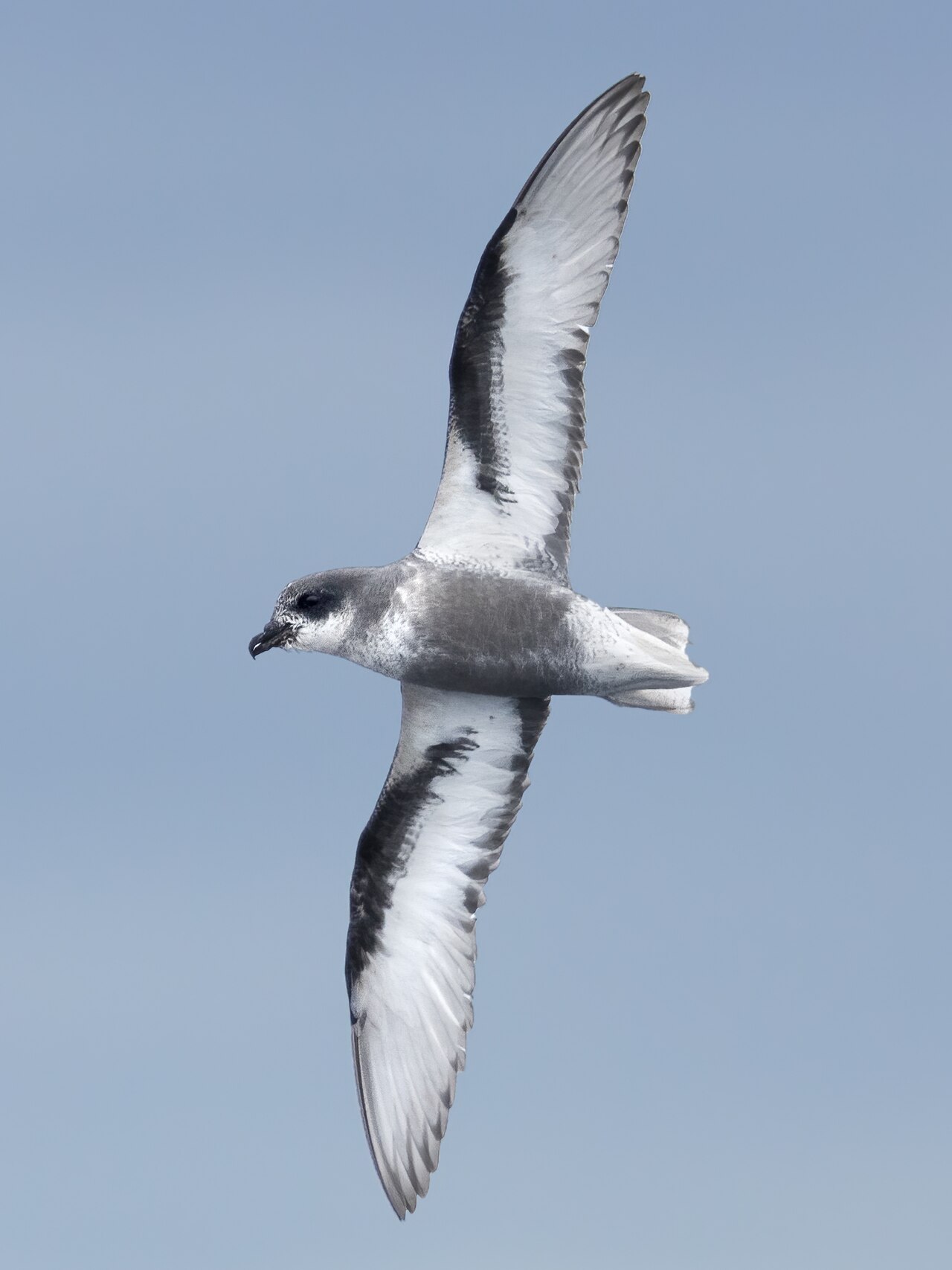
The Mottled Petrel, korure in Maori, is the only gadfly petrel that regularly ranges right into the pack ice: a grey-marbled bird of thirty-four centimetres with a smudgy grey belly patch and a broad black diagonal across the underwing. It now breeds on only a handful of islands around Stewart Island and Fiordland, the remnant of a species that once bred throughout New Zealand.
Voice
Silent at sea. Over the colony at night come a rapid ti-ti-ti… or kek-kek-kek…, alongside lower oooi and gorr notes. On the ground it gives a growling gor-wik, usually in answer to another bird. Over The Snares in summer that night chorus is one of the great sounds of the southern islands.
No freely licensed recording has been found for this species yet; what to listen for is described below.
Identification
A medium-sized petrel of thirty-four centimetres and about three hundred and twenty-five grams. The upperparts are dark grey with a distinct darker M across the wings and rump; the face is mottled grey and white with a dark patch across each eye. The underparts are white but carry a smudgy grey patch across the lower breast and belly — the only species of the genus in this region with so obvious a grey belly field. A prominent black band runs diagonally across the underwing, sharply set against the remaining white. The bill is short and black, the legs pink. The flight is fast and powerful, with high arcs and an impression of compactness.
Confusion species
The combination of grey belly patch and black underwing bar makes it fairly distinctive, if you get to see both. At range, or on a brief view, Soft-plumaged Petrel (Pterodroma mollis) is the real trap: it has a smudgy grey breast band higher on the breast and a wholly dark underwing, where Mottled Petrel has a broader grey patch lower down, on lower breast and belly, and a strongly contrasting black-and-white underwing. Black-winged Petrel (Pterodroma nigripennis) has the same black diagonal but is clearly smaller, with a pale grey head and a wholly white belly without a grey patch. Cook's Petrel (Pterodroma cookii) and Pycroft's Petrel (Pterodroma pycrofti) are smaller and paler, with white bellies and only a thin line along the leading edge of the underwing. White-headed Petrel (Pterodroma lessonii) is much bigger, with a white head and, on the contrary, a wholly dark underwing.
Habitat
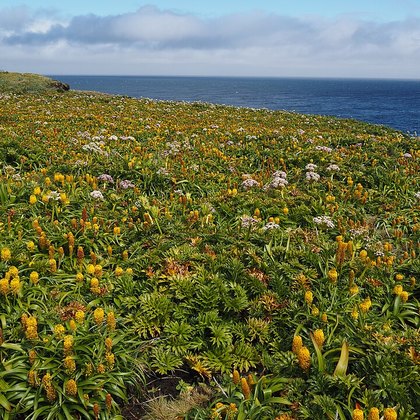
For a petrel of temperate latitudes its feeding range is remarkably cold: from its colonies it flies south into subantarctic and even Antarctic water and up to the edge of the pack ice. It breeds in burrows in forest soil and under tussock on islands and at a few mainland sites, from coastal forest to open grassy slopes, and on The Snares under the Olearia forest.
Where the bird is most often found, arranged by main group and formation.


Range and movements
Within this window essentially New Zealand alone. The large colonies are on The Snares, Codfish Island (Whenua Hou) and Big South Cape Island, with smaller ones on other islands around Stewart Island, in Foveaux Strait, on islets off Fiordland and even on an island in Lake Hauroko. At sea it can be met throughout southern New Zealand, above all in Foveaux Strait and off Stewart Island and Fiordland, and on passage through Cook Strait. After breeding it leaves the region entirely for the North Pacific and the Bering Sea. In Australian waters it is a rare vagrant, mostly beach-wrecked in Tasmania and Victoria after storms.
- Breeding (summer)
- dark = core range, pale = thinly spread
Where and when to look
The cheapest way is the Foveaux Strait ferry between Bluff and Oban: in summer Mottled Petrels pass regularly, and closer than on most pelagics. Better still is a boat at The Snares or off Fiordland in December or January, towards evening, as birds head in to the colony. Check the belly of every gadfly petrel: a smudgy grey field across lower breast and belly is shown by no other species here so clearly.
Conservation
Near Threatened (NT) globally, but in New Zealand it is rated “Relict”, and the word tells the story: it once bred in the mountains of the whole South Island and on the North Island, and is now pushed back to a few island remnants. Feral cats, rats, mustelids, pigs and dogs cleared out the mainland colonies; the invasion of ship rats on Big South Cape Island in 1964 is the best-known example of how fast that happens. The largest colonies still hold over ten thousand pairs each, so the stock is large in absolute terms, but it hangs on a small number of predator-free islands, and keeping them that way is the whole of its management.
Scientific name
Pterodroma inexpectata | (Forster, 1844)
Johann Reinhold Forster described the species as Procellaria inexpectata; his description did not appear until 1844, more than forty years after his death, in Lichtenstein's edition of the Descriptiones Animalium drawn from the material of Cook's second voyage. Because the species now sits in Pterodroma, author and year go in parentheses. inexpectata means unexpected. The type locality is no more than “in oceano antarctico”, the Southern Ocean — fitting for the one species of the genus that truly belongs there. The Maori name korure and the English Mottled Petrel both point clearly to the marbled plumage.