All species › Tubenoses › Petrels, shearwaters and diving petrels › White-headed Petrel
White-headed Petrel | Pterodroma lessonii
Witkopstormvogel | Petrel de frente blanca
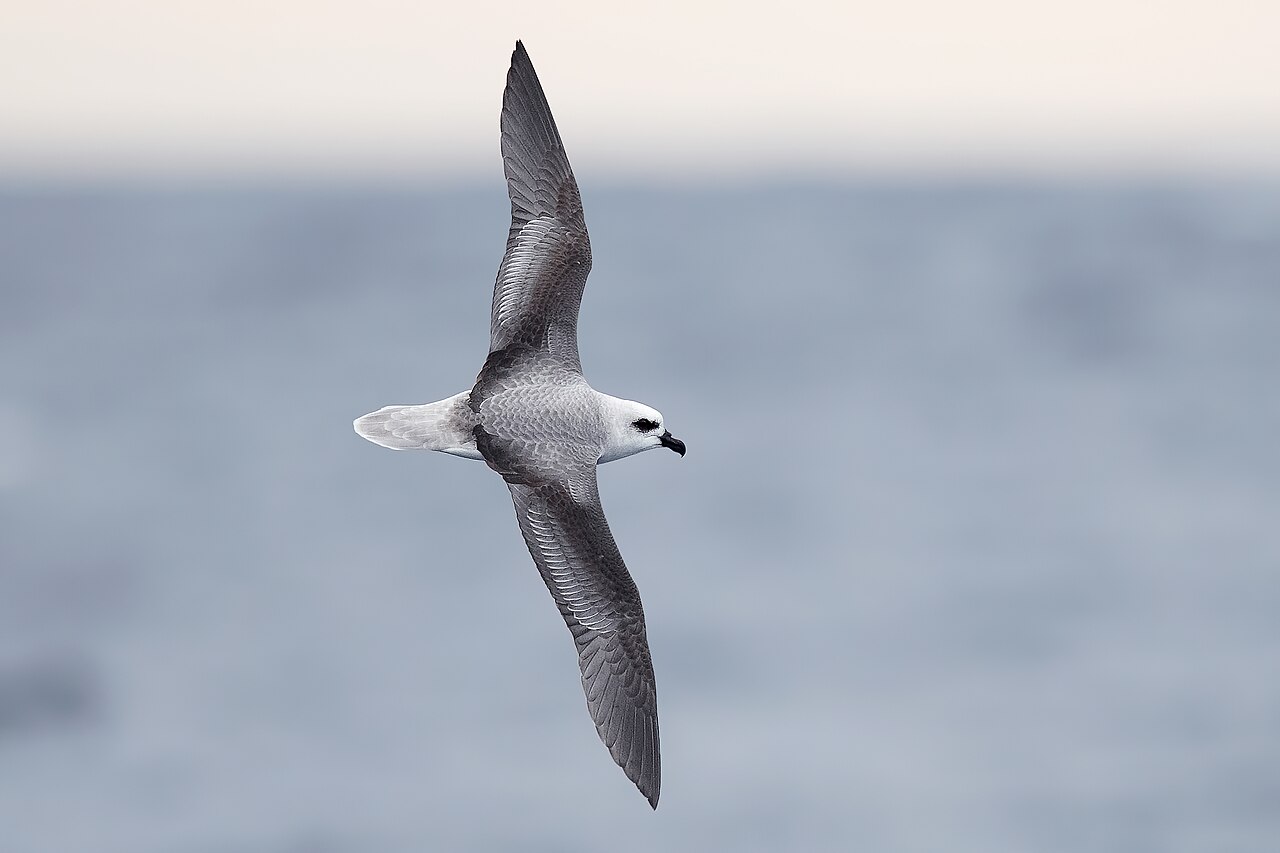
The White-headed Petrel is the largest gadfly petrel of the southern ocean and one of the few you can fix at once on shape and colour: forty-three centimetres, with a snow-white head carrying a black eye patch like a mask, and a wholly dark grey underwing beneath an otherwise white underbody. It breeds on the subantarctic islands and forages as far as the Antarctic Convergence.
Voice
Silent at sea. Over the colony at night come high shrill whistles ti-ti-ti or wik-wik-wik, alternating with lower moaning oooo-er and or-wik notes. Disturb a bird in the hand or at the burrow and it gives a loud screaming alarm call. On Adams Island and the Antipodes that chorus is everywhere on a summer night.
Recording: Kevin Guille — CC BY-NC-SA 4.0 · Mayes island, France · xeno-canto
Identification
A large, heavy petrel of forty-three centimetres and some six hundred grams. Head and neck are white, with a striking black patch around and behind the eye that gives the bird a masked face. The upperparts are pale grey on mantle and back, with clearly darker grey on the upperwings and rump, producing a dark M. The underparts are white, but the underwing is wholly dark grey — that contrast between white head and white belly on one side and dark underwing on the other carries a long way. The tail is long and pointed, the bill stout, black and hooked, thirty-eight millimetres long and eighteen deep; the legs are pink-white with black patches on the toes. The flight is the highest and most sweeping of the genus, with long arcs that in wind rise far above the swell.
Confusion species
Few species combine a white head with a dark underwing, which makes it relatively easy. Soft-plumaged Petrel (Pterodroma mollis) has the same build and the same dark underwing but is smaller and hooded, with dark grey on head and upper breast instead of a white head. White-necked Petrel (Pterodroma cervicalis) does have white on the nape, but above it a black cap, and a largely white underwing — the reverse pattern. The pale morph of Kermadec Petrel (Pterodroma neglecta) lacks the black eye patch and shows prominent white flashes on the outer underwing. Grey Petrel (Procellaria cinerea) is larger, with a dark head and a pale greenish rather than black bill. Magenta Petrel (Pterodroma magentae) also has a dark underwing, but a closed dark hood instead of a white head.
Habitat
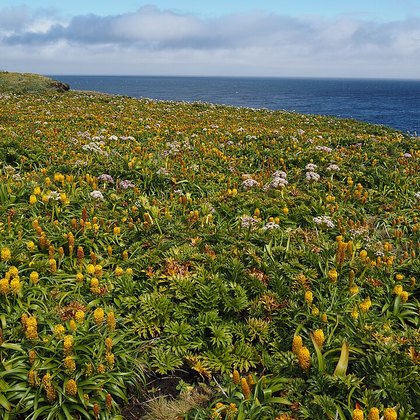
At sea mainly cold water between the subantarctic and Antarctic convergences, though it ranges from subtropical to Antarctic water. It breeds in burrows dug in deep peat under tussock (grassland of loose, tall clump-forming grasses, especially in New Zealand) grassland and low scrub on subantarctic islands, usually on slopes and plateaux with a clear take-off.
Where the bird is most often found, arranged by main group and formation.


Range and movements
Within this window it breeds on the Auckland Islands — above all Adams Island — and on the Antipodes, with Macquarie Island to the south-east of Australia and possibly some Campbell Island stacks; outside the region there are colonies on Crozet and Kerguelen. At sea it is present year-round in southern New Zealand and around the subantarctic islands. In Australian waters it is a regular bird on the southern pelagics, above all in winter and spring off Tasmania, Victoria and southern New South Wales, and after heavy south-westerly gales it turns up beach-wrecked as well.
- Resident
- Winter
- dark = core range, pale = thinly spread
Where and when to look
Take a pelagic out of Eaglehawk Neck, Portland or Wollongong between June and October: it usually does not come in to the chum but passes at range in high arcs — and that is exactly when the white head plus dark underwing gives it away. On a boat trip to the Auckland Islands or the Antipodes you will see it daily in summer. Do not go by the colour of the back but by the face: the black mask in a white head is visible at hundreds of metres.
Conservation
Least Concern (LC), with a world population of about six hundred thousand birds, including some hundred thousand pairs on the Auckland Islands and another hundred thousand on the Antipodes. The main threat is and remains the introduction of mammals to breeding islands: feral cats, pigs, rats, rabbits and the introduced Weka have done demonstrable damage on the Auckland Islands, and on the Antipodes the effect of the — now eradicated — mice was never properly measured. At sea longline bycatch plays a part, though less than for the albatrosses.
Scientific name
Pterodroma lessonii | (Garnot, 1826)
Garnot described the species in 1826 as Procellaria lessonii, so author and year stand in parentheses. The epithet honours René Primevère Lesson, the French naval surgeon and naturalist with whom Garnot sailed round the world on the Coquille. The type locality lies in the Pacific near Cape Horn, at about 52 degrees south and 85 degrees west. The genus Pterodroma was introduced by Bonaparte in 1856, from Greek pteron (wing) and dromos (runner); both the English and the Dutch name point straight at the white head.