All species › Tubenoses › Petrels, shearwaters and diving petrels › Gould's Petrel
Gould's Petrel | Pterodroma leucoptera
Gould-stormvogel | Petrel aliblanco
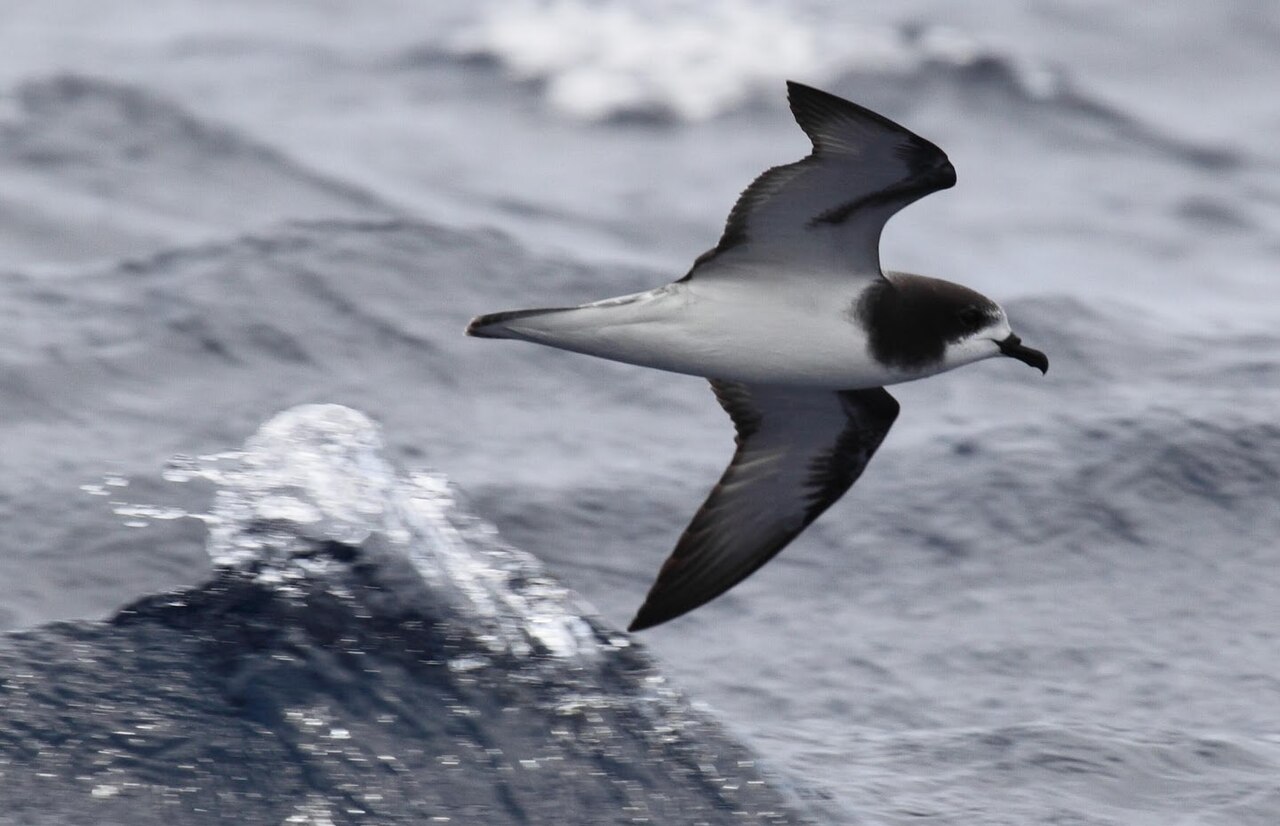
Gould's Petrel is the only Pterodroma that breeds on islands close to the Australian mainland, in a handful of steep gullies near Port Stephens. It is a small, black-and-white bird with a sharply drawn dark hood and a broad black margin along the underwing.
Voice
At sea it is silent. Over the colony by night comes a fast, cicada-like tit-tit-tit-tit from the air, and from the ground high squeaky pee-pee-pee-peeoo notes alternating with a low trembling growl from the nest. On Cabbage Tree Island that sound is the background of every night from November into autumn.
No freely licensed recording has been found for this species yet; what to listen for is described below.
Identification
A small petrel of thirty centimetres with a white face and a strikingly dark, sharply bounded hood running from crown over the cheeks — the mark that separates it from all its pale-headed small relatives. The mantle is pale grey and contrasts with a dark grey rump and a dark M across the wings. The underparts are white; the underwing is white with a broad black margin along the trailing edge and tip, and with a dark diagonal bar running inward from the leading edge towards the body. The bill is small and black. Flight is fast and agile, in high arcs with many beats between.
Confusion species
Cook's Petrel (Pterodroma cookii), Pycroft's Petrel (Pterodroma pycrofti) and Black-winged Petrel (Pterodroma nigripennis) are all about the same size, but have a clearly paler grey head without the dark hood of Gould's Petrel; in Cook's the underwing is also almost wholly white, against the broad black border here. Chatham Islands Petrel (Pterodroma axillaris) has a vaguely speckled pale forehead and a black axillary patch where the wing meets the body; that black armpit is absent in Gould's. In short: dark hood plus broad black underwing margin is Gould's, pale head plus white underwing is Cook's, pale head plus black armpit is Chatham Islands. Anyone who sees only a small, fast-arcing silhouette at sea cannot separate these three and does well to say so.
Habitat
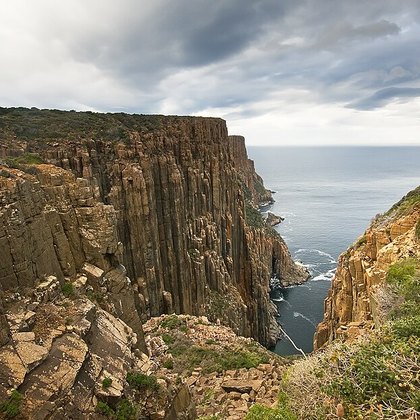
Open sea over deep water beyond the continental shelf, mainly the Tasman Sea and the tropical Pacific. To breed it comes ashore on steep, rocky gully slopes under cabbage-tree palm forest, laying in crevices among boulders, in hollow fallen palm trunks and among the buttress roots of figs — not a dug burrow but a natural niche.
Where the bird is most often found, arranged by main group and formation.

Range and movements
The Australian population breeds on Cabbage Tree Island off Port Stephens in New South Wales, with smaller numbers on three neighbouring islets including Boondelbah, and more recently on Barunguba or Montague Island further south, which now holds over forty pairs. A separate subspecies breeds in the mountains of Grande Terre in New Caledonia, between Mt Dzumac and Poya. At sea it is to be expected in the Tasman Sea off New South Wales from October to April; in New Zealand it is known only from over thirty beach-wrecked birds, mostly between November and June. Outside the breeding season it moves north-east into the central and eastern Pacific.
- Breeding (summer)
- dark = core range, pale = thinly spread
Where and when to look
Take a pelagic trip out of Port Stephens or Sydney between November and March; the birds pass then on their way to and from Cabbage Tree Island and sometimes come close to the boat. Look at the head first: only in this species does a genuine dark hood stand against a white face. The colony itself is a nature reserve with no public access.
Conservation
Vulnerable (VU), with a world population estimated at three to twenty-one thousand birds, but with an Australian story that counts as a textbook case. In the early 1990s Cabbage Tree Island held only 186 to 252 pairs, with breeding success under twenty per cent. Two causes proved decisive: adults became entangled in the sticky fruits of the birdlime tree (Pisonia umbellifera), which had spread under rabbit grazing, and Pied Currawongs and Australian Ravens preyed on breeding birds. After control of those predators, eradication of the rabbits in 1997 and the provision of artificial nest boxes, breeding success rose to an average of 49 per cent and the colony grew to over a thousand pairs; chick transfers founded a second colony on Boondelbah Island. The New Caledonian population, by contrast, is declining under introduced predators.
Scientific name
Pterodroma leucoptera | (Gould, 1844)
John Gould described the species in 1844 as Procellaria leucoptera; because it has since moved to another genus, author and year go in parentheses. The genus Pterodroma was introduced by Bonaparte in 1856, from the Greek for 'wing' and 'runner'. leucoptera means 'white-winged' and refers to the white field on the underwing — a choice that reads oddly in hindsight, since it is precisely the broad black border of that field which identifies the bird; the Spanish name keeps Gould's choice literally. The type locality is Cabbage Tree Island off Port Stephens, New South Wales, still the heart of the species, and the Dutch and English names honour the describer himself.