All species › Tubenoses › Petrels, shearwaters and diving petrels › Great-winged Petrel
Great-winged Petrel | Pterodroma macroptera
Langvleugelstormvogel | Petrel alas grandes
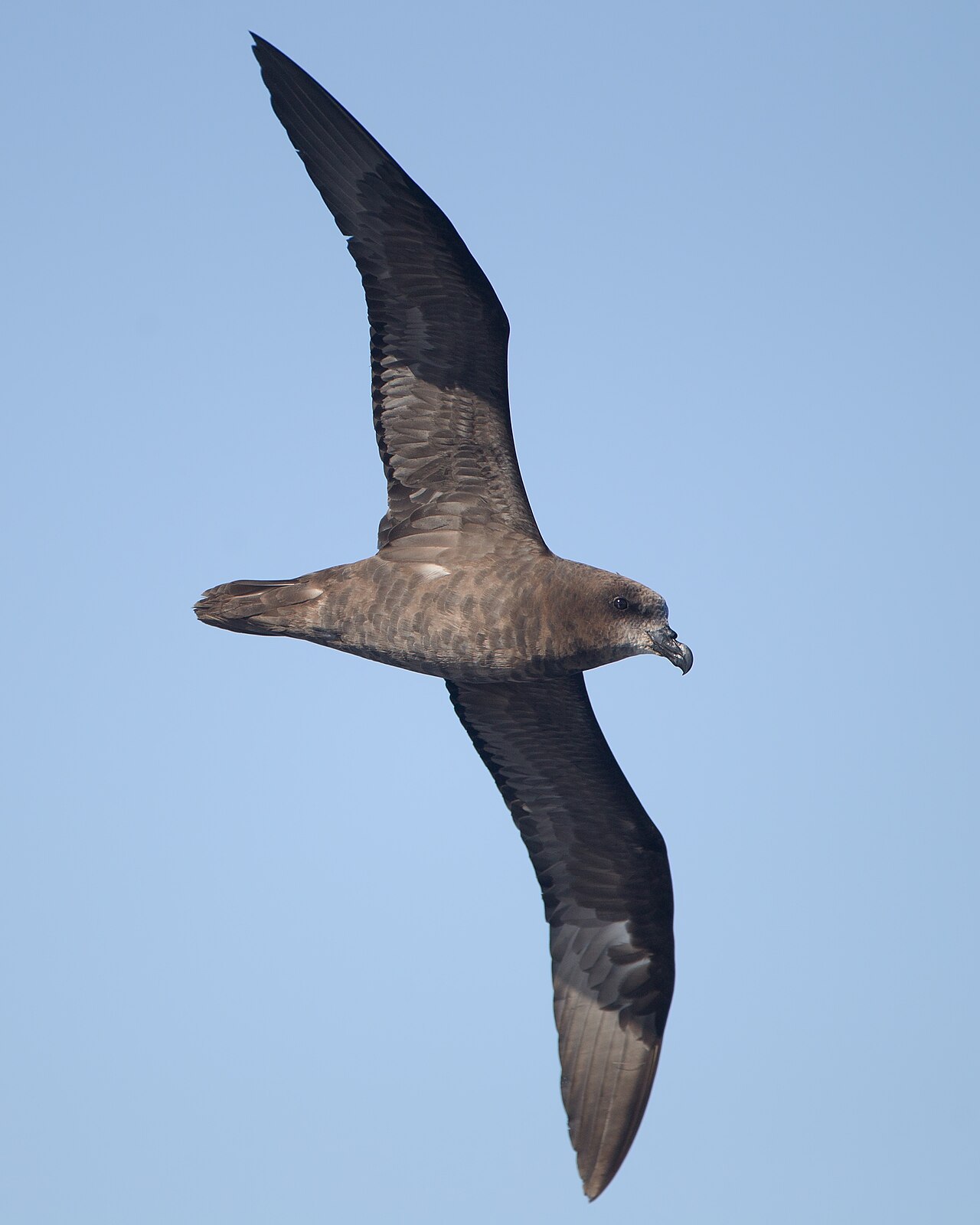
The Great-winged Petrel is the large, all-dark gadfly petrel of southern Australian waters: sooty brown from head to tail, with only a vague grey face around the bill base. It breeds in midwinter, when most other seabirds are away.
Voice
At sea it is silent. Over and in the colony come high whistled notes by night, whis-her and wik-wik, alternating with low, plaintive oor-wik moans rising from the burrows.
No freely licensed recording has been found for this species yet; what to listen for is described below.
Identification
A solid petrel of just over forty centimetres with a wingspan of nearly a metre, wholly dark sooty to blackish brown, worn feathers looking browner and paler than fresh ones. The only pale part is a variable grey or off-white field around the bill base, chin and sometimes forehead, which gives a grey face at close range and vanishes at distance. The bill is short, black and heavy, with a large sharp hook; the tail is long and wedge-shaped. In wind the flight is impressive: high, steep arcs on stiff, strongly swept-back wings, with long glides and few beats.
Confusion species
This is a genus of dark look-alikes. Providence Petrel (Pterodroma solandri) is greyer, has a distinctly paler, hooded-looking face and shows a white flash at the base of the primaries on the underwing that the Great-winged Petrel lacks. The dark morph of Kermadec Petrel (Pterodroma neglecta) is smaller and shorter-tailed and has white shafts on the upper primaries. Kerguelen Petrel (Aphrodroma brevirostris) is smaller, glossy slate-grey rather than brown, with a finer bill and a silvery white line along the underwing edge. Outside the genus it comes down to bill colour: Black Petrel (Procellaria parkinsoni), Westland Petrel (Procellaria westlandica) and White-chinned Petrel (Procellaria aequinoctialis) all have a pale, horn-coloured bill with dark markings and fly straighter and more steadily, against the all-black bill and arcing flight of this species. Flesh-footed Shearwater (Ardenna carneipes) has a pink bill with a dark tip and pink legs. Note one taxonomic point: the all-dark petrel of northern New Zealand, the Grey-faced Petrel Pterodroma gouldi, has been treated as a separate species since 2014 and is not covered in this guide; a dark Pterodroma in New Zealand waters is almost certainly that bird and not this one.
Habitat
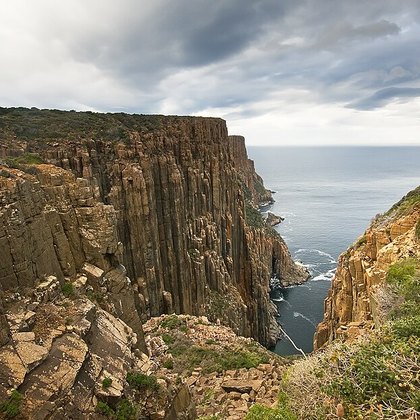
Open sea over deep water, from cool temperate to subtropical, usually beyond the continental shelf but in winter also over the shelf break. It breeds in burrows it digs on islands, under low scrub and tussock and on vegetated slopes above sea cliffs.
Where the bird is most often found, arranged by main group and formation.


Range and movements
Within this region the nominate form breeds on islands off south-western Western Australia, among them Eclipse Island and Coffin Island near Albany, and on islets in the Recherche Archipelago. The rest of the world population sits on the islands of the southern Indian and Atlantic oceans, from Tristan da Cunha and Gough to Kerguelen. At sea it occurs year-round along the whole southern coast of Australia, from Western Australia through the Great Australian Bight and Tasmania to off New South Wales, in highest numbers in the cold months. In New Zealand waters it hardly occurs; there the Grey-faced Petrel takes its place.
- Resident
- Winter
- Passage
- dark = core range, pale = thinly spread
Where and when to look
Take a pelagic trip out of Albany, Portland, Eaglehawk Neck or Wollongong; this species is present all year and often comes close to the berley. Look for a large, all-dark bird with a short black bill, a long wedge tail and high, steep arcs, and check the bill on every dark bird: pale with dark markings means a Procellaria, wholly black and short means this species. Over the breeding islands it can be watched at dusk from May to July, in the depth of the Australian winter.
Conservation
Least Concern (LC), widely spread over many island groups in three oceans. The familiar risks apply here too: introduced predators on breeding islands, cats and rats above all, and longline bycatch, to which a night-feeding species like this is exposed. Because the birds breed in midwinter, their most vulnerable period falls outside the season in which most islands are visited, which makes monitoring harder but limits disturbance.
Scientific name
Pterodroma macroptera | (Smith, 1840)
The Scottish zoologist Andrew Smith described the species in 1840 as Procellaria macroptera; because it has since moved to another genus, author and year go in parentheses. The genus Pterodroma was introduced by Bonaparte in 1856, from the Greek for 'wing' and 'runner'. macroptera means 'long-winged', after the strikingly long, narrow wing — the Dutch, English and Spanish names all render the same thing. The type locality is given broadly as the seas off the Cape.