All species › Tubenoses › Petrels, shearwaters and diving petrels › Magenta Petrel
Magenta Petrel | Pterodroma magentae
Magenta-stormvogel | Fardela taiko
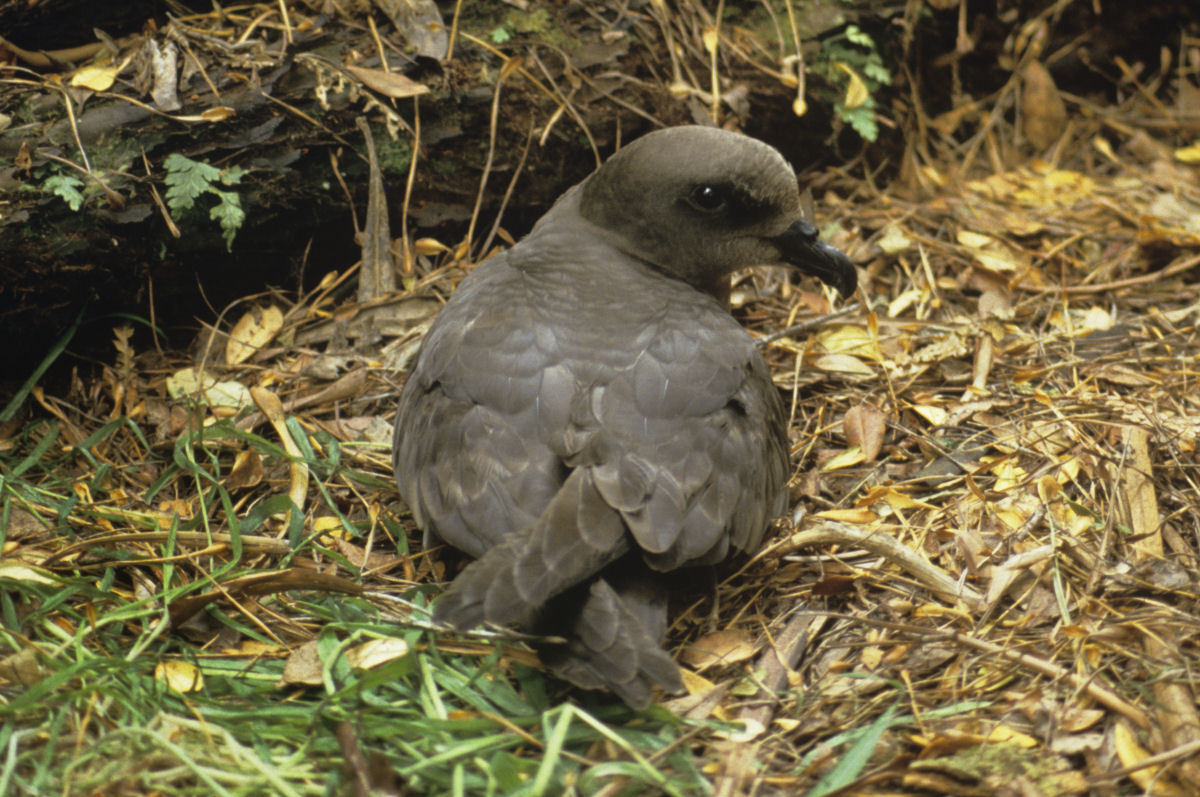
The Magenta Petrel, known on the Chatham Islands as taiko, is one of the rarest seabirds in the world: a dark-hooded gadfly petrel of nearly forty centimetres that for a hundred and eleven years existed only as a single skin taken in 1867, and was not found alive again until 1978. It breeds only in the forest of southern Chatham Island and numbers fewer than a hundred mature birds.
Voice
At sea it is silent, as nearly all gadfly petrels are. In and around the burrow at night come low moaning notes, ooooorr and uuuur, mixed with higher squeaky calls — a repertoire much like that of the Soft-plumaged Petrel, which did not make the rediscovery any easier. Birds call in flight over the colony in the dark; by day there is nothing to hear.
No freely licensed recording has been found for this species yet; what to listen for is described below.
Identification
A medium-sized petrel of thirty-eight centimetres and about four hundred and fifty grams, with a heavy dark hood over head, neck and upper breast that cuts sharply against the white underparts. The forehead is high and domed, the upperparts dark slate-grey fading brown with age; some birds show a small white chin patch. The decisive feature is the underwing: wholly dark grey, without any pale patch or flash. The bill is stout and black, thirty-two millimetres long and fifteen deep, with a sharp hook. Wings long and narrow, tail long and pointed; the flight is the high arcing bounding flight of the genus.
Confusion species
The picture that counts is the combination of dark hood, white belly and uniformly dark underwing. Soft-plumaged Petrel (Pterodroma mollis) is the closest match but is smaller and shows clearly more pale on chin and cheeks and a grey breast band rather than a closed hood. Kermadec Petrel (Pterodroma neglecta) and Herald Petrel (Pterodroma heraldica) show, in every morph, a pale flash at the base of the primaries on the underwing — Magenta Petrel never does. Tahiti Petrel (Pseudobulweria rostrata) holds its wings straighter and flies more slowly and languidly, where gadfly petrels hold the wing slightly flexed and fly fast and impetuously. Grey Petrel (Procellaria cinerea) is larger with a pale greenish bill. Chatham Island Petrel (Pterodroma axillaris), from the same island group, is far smaller and instead shows a black underwing bar running into black axillaries. To be honest, separating it from a Soft-plumaged Petrel at sea is so hard, and the records so few, that almost nobody has had the chance to gain experience with it.
Habitat
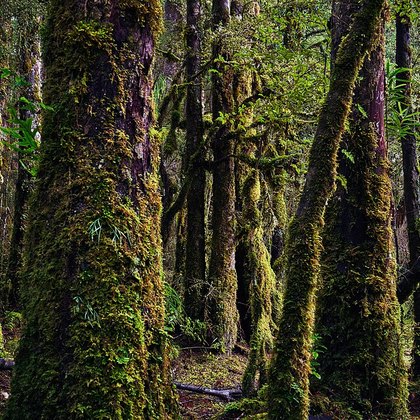
At sea, deep warm to temperate water well beyond the continental shelf. Ashore it is a forest bird, unusual for a petrel: it digs its burrow in peaty soil under tall dense forest and tree ferns, up to five kilometres inland, on slopes and valley floors and usually near a watercourse. The burrows lie under roots and thick undergrowth, which is exactly why they are so hard to find.
Where the bird is most often found, arranged by main group and formation.

Range and movements
Within the window of this guide it is effectively confined to the sea around the Chatham Islands, since it now breeds only in the south of Chatham Island itself — in the Tuku valley and the adjoining Sweetwater block. Outside the breeding season it wanders thousands of kilometres across the Pacific, from the Tasman Sea to the coast of South America and into tropical waters. From mainland New Zealand it has essentially never been seen.
- Breeding (summer)
- dark = core range, pale = thinly spread
Where and when to look
Be honest with yourself: the chance is close to nil. The breeding grounds lie in privately protected land that is not open, and searching for burrows does harm. The only realistic chance is a dedicated Chatham Islands pelagic, where every dark-hooded petrel has to be checked for underbody and underwing: white belly, plus a wholly dark underwing, plus a heavy black bill. Anyone who really wants to help the bird supports the Chatham Island Taiko Trust.
Conservation
Critically Endangered (CR), and with that the most threatened species in this whole cluster: the entire stock is fewer than two hundred birds, of which an estimated eighty to a hundred are mature. In the 1990s some twenty burrows were known; by 2017 thirty-four pairs were being monitored. Every threat is an introduced one: feral cats, three species of rat, feral pigs that collapse burrows, possums and the introduced Weka. Intensive control has run since 1987, with cat traps and rodent poison, and the Tuku Nature Reserve has been fenced against sheep and cattle. In 2006 a predator-proof fence was built at Sweetwater, and nearly sixty chicks were transferred inside it between 2007 and 2011; birds from those transfers have since returned to breed there — the beginning of a second, safe colony.
Scientific name
Pterodroma magentae | (Giglioli & Salvadori, 1869)
Giglioli and Salvadori described the species in 1869 from a single bird shot on 22 July 1867 from the Italian corvette Magenta, midway between New Zealand and South America; magentae therefore refers to that ship and not to a colour. Because the species was originally placed in Oestrelata, authors and year stand in parentheses. The genus Pterodroma was introduced by Bonaparte in 1856, from Greek pteron (wing) and dromos (runner): the wing-runner. There is no exact type locality, only a position on the open sea. The name taiko had been in use on Chatham for generations for a bird nobody could produce; David Crockett brought name and skin back together in 1978 when he caught a living bird.