All species › Tubenoses › Petrels, shearwaters and diving petrels › Soft-plumaged Petrel
Soft-plumaged Petrel | Pterodroma mollis
Donsstormvogel | Petrel collar gris
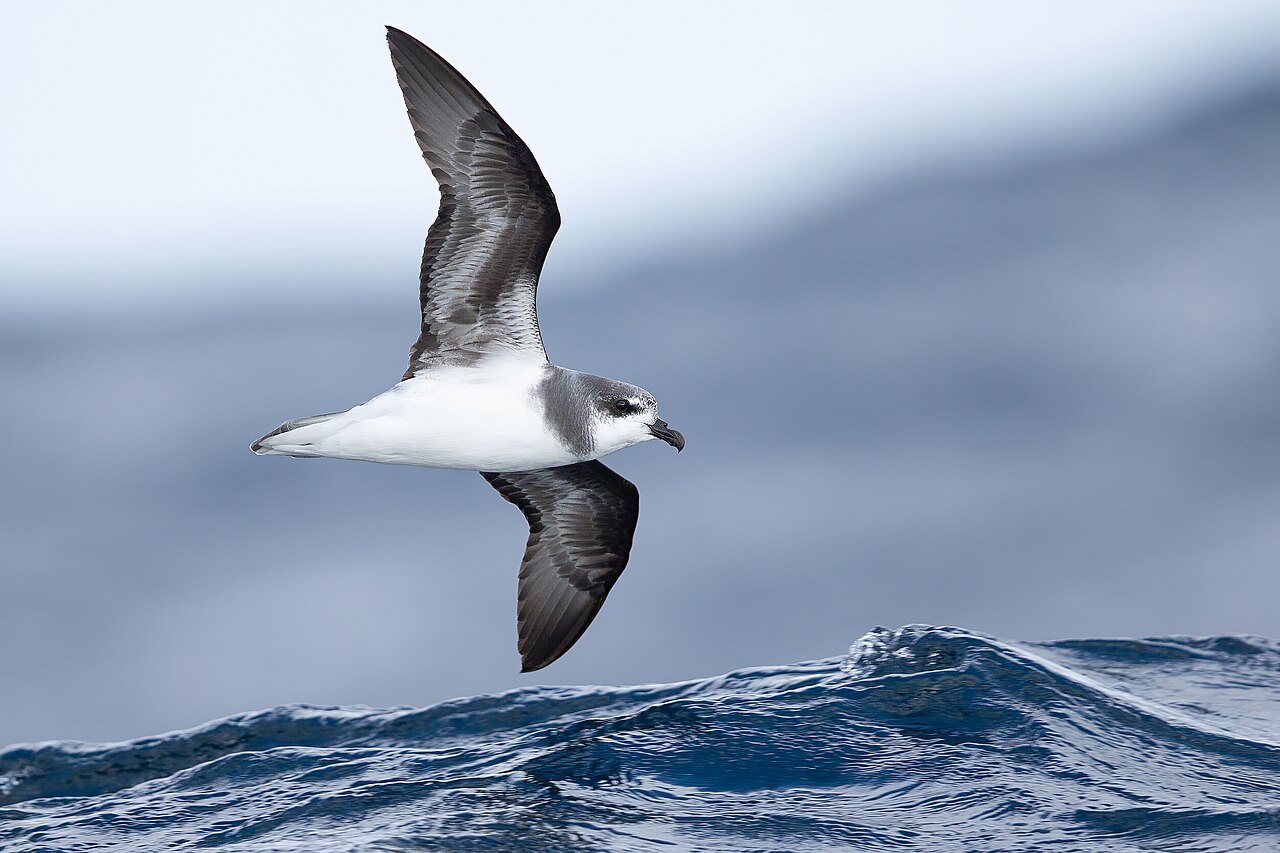
The Soft-plumaged Petrel is the cold-water gadfly petrel with a grey collar: white below, but with a grey band across the breast and a wholly dark grey underwing, which sets it apart at once among all its white-bellied relatives. The soft, downy plumage that gives it its name can only be judged in the hand.
Voice
At sea it is silent. Over and in the colony come medium-pitched musical moans and shrill squeaks by night, a plaintive chorus rising out of the tussock on the Antipodes Islands.
No freely licensed recording has been found for this species yet; what to listen for is described below.
Identification
A petrel of thirty-five centimetres with a dark grey head carrying a pronounced dark eye patch, set against white cheeks and a white throat. A grey band runs along the side of the neck and often right across the breast, so that at range the bird looks hooded and the breast band is complete on some birds and broken into two grey patches on others. The upperparts are grey with a dark brown-black M from wingtip across the rump to the other wingtip. The underparts are white, but the underwing is wholly dark grey with no white — the mark that catches the eye first at sea. The bill is short, black and heavy; the flight is fast, in high, steep arcs.
Confusion species
White-headed Petrel (Pterodroma lessonii) is larger, paler grey above and has an all-white head with no collar, its dark eye patch standing out all the more for it; its underwing is also largely pale. Magenta Petrel (Pterodroma magentae) is larger, with a darker head and underwing and no obvious M across the upperwing. Kerguelen Petrel (Aphrodroma brevirostris) is smaller and glossy slate-grey all over, with no white belly and a silvery white line along the underwing edge. Small species such as Cook's Petrel (Pterodroma cookii) and Black-winged Petrel (Pterodroma nigripennis) have a largely white underwing; whoever sees the underwing has already separated the Soft-plumaged Petrel from nearly everything.
Habitat
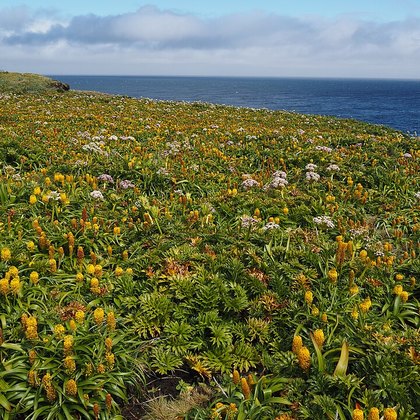
Cold to cool water over the deep sea, north of about 55 degrees south and almost always beyond the continental shelf. It breeds in burrows dug among tussock, ferns and low scrub on subantarctic and cool-temperate islands, and on the cliffs and steep slopes nearby.
Where the bird is most often found, arranged by main group and formation.


Range and movements
Within this region it breeds in two places: the Antipodes Islands south of New Zealand, where it was found breeding in 1969 and where possibly 2500 to 5000 pairs sit, and Maatsuyker Island off southern Tasmania, the only Australian colony. At sea it occurs in the cold waters south of Australia and New Zealand, mainly in winter and mainly far offshore; on pelagic trips out of Tasmania, Victoria and southern New Zealand it appears regularly but never in numbers. The bulk of the world population is Atlantic, with Gough Island alone carrying millions of pairs.
- Breeding (summer)
- Winter
- Passage
- dark = core range, pale = thinly spread
Where and when to look
Take a pelagic trip that leaves the continental shelf — Eaglehawk Neck in Tasmania, Portland in Victoria or Kaikoura in New Zealand — and on every medium-sized gadfly petrel check two things at once: the grey breast band and the wholly dark underwing. Those two together hold up at some range, where head detail often does not. The best months are May to September.
Conservation
Least Concern (LC), with a world population of the order of five million birds; by New Zealand reckoning it is nonetheless Naturally Uncommon, because the New Zealand foothold on the Antipodes is small. The main threat to the species is everywhere the same: introduced mammals on breeding islands. On the Antipodes Islands the house mouse was the only introduced mammal, with no demonstrated effect on this petrel, and it was removed from the island in a large-scale operation in 2016. On Gough Island introduced house mice do great damage to other tubenoses, which shows how narrow the margin is.
Scientific name
Pterodroma mollis | (Gould, 1844)
John Gould described the species in 1844 as Procellaria mollis; because it has since moved to another genus, author and year go in parentheses. The genus Pterodroma was introduced by Bonaparte in 1856, from the Greek for 'wing' and 'runner'. mollis is Latin for 'soft' and refers to the unusually downy plumage, which also gave the Dutch and English names. The type locality is given broadly as the South Atlantic Ocean.