All species › Tubenoses › Petrels, shearwaters and diving petrels › Kermadec Petrel
Kermadec Petrel | Pterodroma neglecta
Kermadecstormvogel | Fardela negra de juan fernández
The Kermadec Petrel is the gadfly petrel that will not stick to one plumage: there is a pale morph, a dark morph and a series of intermediates, and they fly side by side in the same colony. What all morphs share is a stocky build, a short tail and white shafts on the upper primaries.

Voice
At sea it is solitary and silent. Over the colony comes an explosive, almost retching yuk-ker-a-oooo-wuk, by day as well as by night, for unlike most petrels this species also comes ashore in daylight.
No freely licensed recording has been found for this species yet; what to listen for is described below.
Identification
A solid petrel of thirty-eight centimetres with a heavy, short black bill, long pointed wings and a short, square-cut tail. The pale morph has a pale head and white underparts with a grey-brown cap and mantle; the dark morph is almost wholly brown-grey; the intermediate has a mid-brown head and upper breast with a white throat and white underparts. All morphs have dark grey-brown wings with a pale flash near the tip on the underwing and — the same in every plumage — conspicuously white primary shafts on the upperwing, showing at range as a pale streak in the wingtip. The flight is powerful and heavy, with slow beats and high sweeps; it regularly chases other seabirds to rob them of their catch.
Confusion species
Herald Petrel (Pterodroma heraldica) is the hardest: it also has colour morphs, but is never pale-headed and lacks the white primary shafts on the upperwing. Providence Petrel (Pterodroma solandri) is greyer, with a pale, hooded-looking face and a slimmer build. Great-winged Petrel (Pterodroma macroptera) is all dark but larger and longer-tailed, with a grey face around the bill base and no white shafts. At range a dark bird can suggest a skua (Stercorarius): those fly more directly and powerfully with regular deep beats and often have elongated central tail feathers. Finally, do not be caught by the name: White-necked Petrel (Pterodroma cervicalis) is named after the same islands but is a larger, crisply black-and-white bird with a broad white neck band and a sharply bounded black cap, features the Kermadec Petrel shows in no morph at all.
Habitat
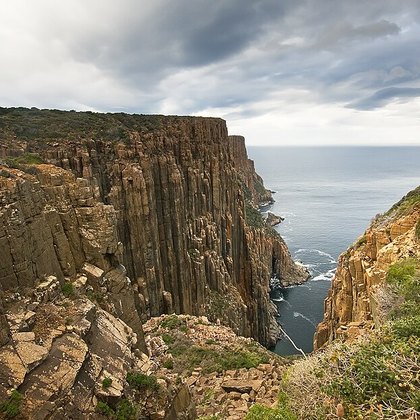
Warm, subtropical open ocean over deep water. Unlike most of its relatives it does not breed in a dug burrow but in a shallow scrape or among boulders at the surface, on vegetated slopes, cliffs and bare rock islets.
Where the bird is most often found, arranged by main group and formation.

Range and movements
Within this region it breeds on the Kermadec Islands, on Balls Pyramid in the Lord Howe group and on Phillip Island off Norfolk; and beyond, across the Pacific and in the South Atlantic. On Raoul Island it was all but lost to feral cats and rats between 1920 and 1967. At sea it wanders the subtropical Pacific and is rarely seen off the New Zealand or Australian mainland; to meet it in this region you must go to the subtropical islands.
- Resident
- dark = core range, pale = thinly spread
Where and when to look
Norfolk and Lord Howe are the best places: from the cliffs by Phillip Island and around Balls Pyramid the birds can be watched over the colony all year, and unlike most petrels they come in during daylight. Judge the upperwing first: the white primary shafts are there in every plumage and every morph. A dark bird at sea without those shafts calls for caution.
Conservation
Least Concern (LC), with a world population of a hundred and fifty to two hundred thousand birds spread over many islands — and that spread is exactly what makes it less vulnerable than its Kermadec neighbours. Where introduced predators did get a foothold the blow was heavy: on Raoul Island the colony was all but wiped out by cats and rats, which were removed between 2002 and 2006. On Phillip Island off Norfolk the vegetation, and with it the breeding birds, recovered after rabbits were taken off the island in the late 1980s. Breeding on the surface and in daylight makes this bird unusually easy for any introduced predator to find.
Scientific name
Pterodroma neglecta | (Schlegel, 1863)
The German-Dutch zoologist Hermann Schlegel described the species in 1863 as Procellaria neglecta; because it has since moved to another genus, author and year go in parentheses. The genus Pterodroma was introduced by Bonaparte in 1856, from the Greek for 'wing' and 'runner'. neglecta is Latin for 'overlooked': among the many closely similar Pacific petrels the species long went unrecognised as distinct, and its colour morphs did not help. The type locality reads 'the Kermadec and Sunday Islands'; Sunday Island was then the usual name for Raoul, the largest of the Kermadecs, so both names point at the same archipelago.