All species › Waterfowl › Ducks, swans and geese › Cotton Pygmy Goose
Cotton Pygmy Goose | Nettapus coromandelianus
Coromandeleend | Gansito asiático
The Cotton Pygmy Goose is a tiny white-and-dark duck of the Queensland lily lagoons, and among the smallest waterfowl in the world. The male stands out with a snow-white head and neck, a glossy black crown and a crisp black neck ring; in flight broad white wing bars flash. It is an Asian species reaching the far south-eastern edge of its range here.

Voice
Unusually for so small a duck the voice is hoarse and rattling rather than whistled. The male gives a low cackling quack-a-dack, quack-a-dack, rendered in British India as 'quacky duck' and also as 'fixed bayonets'. The female keeps to a soft, low quack. Most calling comes as birds take wing and during the fast chases low over the water.
No freely licensed recording has been found for this species yet; what to listen for is described below.
Identification
Thirty-four to thirty-eight centimetres in the Australian form, 255 to 440 grams, with a short neck and a deep, goose-like bill. The breeding male has a white head and neck, glossy black-green crown and back, a black-green neck ring and finely barred grey-brown underparts; in flight the broad white band running out into the primaries is the mark. Female and eclipse male are duller, with a dark line straight through the eye and no neck ring, the female showing only a white trailing edge to the secondaries. The bird lifts straight off the water without a run and flies fast and agile.
Confusion species
Green Pygmy Goose (Nettapus pulchellus) is the direct counterpart and shares the same lagoons in northern Queensland. It has no white neck but a dark green head with only a white cheek, and lacks the black neck ring altogether. In flight the wing is the quickest mark: on Cotton the white runs out into the primaries, on Green it stops at the secondaries. A small white-and-dark bird on open water may also be an Australasian Grebe (Tachybaptus novaehollandiae) in non-breeding plumage, but that dives and has a pointed bill.
Habitat
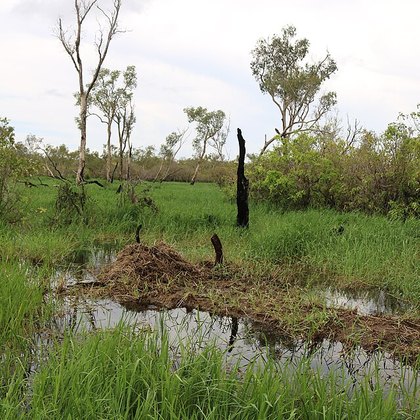
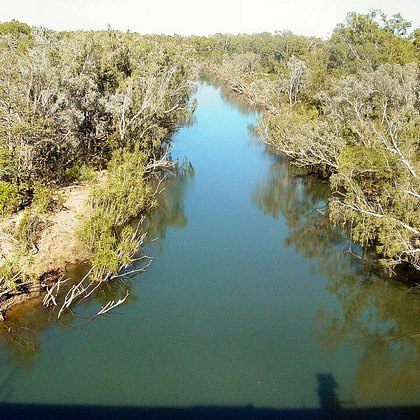
Shallow freshwater lagoons, billabongs, oxbows and farm dams with plenty of floating and emergent vegetation, and as with Green Pygmy Goose preferably thick with lilies. It feeds at the surface — seeds, leaf buds and water plants, with snails, insect larvae and the odd small fish — and never dives. Much of the day it perches on dead branches over the water. It nests high in natural tree hollows, sometimes five metres up, and the downy young jump down.
Where the bird is most often found, arranged by main group and formation.

Range and movements
Within this area, Queensland only. The Australian subspecies albipennis holds the east coast from about Cape Melville and Port Douglas in the north to the New South Wales border, with known sites around Cairns, Townsville, Rockhampton and Brisbane. Occurrence swings from year to year with the rainfall: around Brisbane it is a scarce and local visitor, on about one per cent of counts. In New South Wales it has fallen from a regular breeder to a rare visitor, and it does not occur in New Zealand.
- Resident
- dark = core range, pale = thinly spread
Where and when to look
In Queensland work the lily lagoons — Tyto Wetlands at Ingham, the lagoons around Cairns and the farm dams near Rockhampton are among the more reliable — and look not only at the water but at the dead branches above it, where the bird spends half its day. Check the wing of every pygmy goose that lifts: broad white running out into the primaries means this species. Chances are best after a wet summer.
Conservation
Least Concern (LC) worldwide and locally very numerous in Asia, but the Australian population is small and sits at the edge of the world range. In New South Wales it is listed as Endangered, reduced from a widespread breeder to a rare visitor. The causes are the draining of wetlands for agriculture, the spread of introduced water plants and pasture grasses, trampling by stock, and above all the loss of tall dead hollow-bearing trees beside the water — without those hollows it cannot breed.
Scientific name
Nettapus coromandelianus | (Gmelin, 1789)
Gmelin described the species in 1789 as Anas coromandeliana, in the thirteenth edition of the Systema Naturae; because it later moved to Nettapus, author and year stand in parentheses. The genus Nettapus was introduced by Brandt in 1836, from Greek netta, 'duck', and pous, 'foot'. coromandelianus refers to the Coromandel Coast of south-eastern India, the type locality. The Australian subspecies albipennis, 'white-winged', was described by Gould in 1842.