All species › Waterfowl › Ducks, swans and geese › Pink-eared Duck
Pink-eared Duck | Malacorhynchus membranaceus
Lepelbekeend | Pato pachón
The Pink-eared Duck has the strangest bill of any duck in this guide: a huge square-tipped grey spatula with two limp membranous flaps at the end, with which it filters the surface water. Otherwise it is finely barred black and white from head to tail, with a black eye mask on a white face and a small pink spot behind the eye that you rarely see in the field.

Voice
A musical chirruping trill that sounds wholly unlike a duck and more like a songbird: chirrup, chirrup, given in flight and on the water alike, and in a large party carrying as a continuous murmur across the lake. In a dispute over a feeding spot it runs into an almost unbroken trill. In flight the wings rush softly and fast.
No freely licensed recording has been found for this species yet; what to listen for is described below.
Identification
A small duck of 36 to 45 cm with a head that looks too big for the body, and on it that enormous square-tipped grey bill with its hanging membranous flaps. Face and neck are white with a large dark brown eye patch; along the flank and underparts run fine, regular black bars that earn the species its other name of Zebra Duck. The upperparts are brown. In flight a broad white crescent on the rump catches the eye, with a white tail tip and a white trailing edge to the wing. The sexes are alike.
Confusion species
Really nothing, once you see the bill. Australasian Shoveler (Spatula rhynchotis) also has a big bill, but one that broadens forward rather than ending square, and without the flaps; the bird is larger, sits lower in the water and is warm chestnut on the flank, the male with a pale crescent before the eye. At long range and against the light a party on the water separates from any other small duck mainly by size and by the white rump band.
Habitat
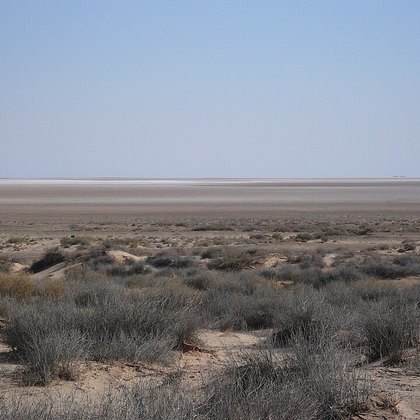
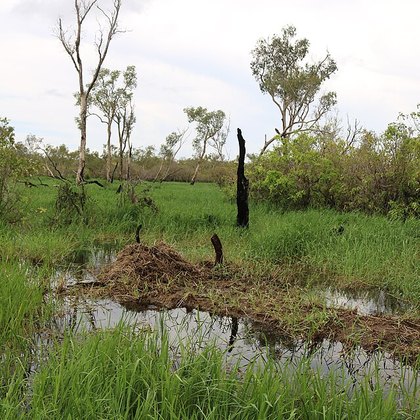
Shallow, temporary, turbid water is its element: claypans and ephemeral inland lakes filling after rain, flooded lignum plains, stock dams, sewage ponds and the margins of large lakes. It is precisely the warm, plankton- and algae-rich water of a newly filled pan that feeds it, and it leaves again as soon as that clears or dries. For nesting it depends on structures already built — it commonly takes over an old coot nest, or a stump or hollow above the water.
Where the bird is most often found, arranged by main group and formation.


Range and movements
Almost all of Australia, except Tasmania, where it appears only exceptionally. It is markedly nomadic: after heavy inland rain tens of thousands gather on the filling lakes of the Lake Eyre basin, the Macquarie Marshes and the Menindee Lakes, then fan back out across the continent as these dry. In New Zealand there is a single accepted record: one bird at the Mangere sewage ponds near Auckland, June-July 1990.
- Resident
- dark = core range, pale = thinly spread
Where and when to look
Look for it on shallow, turbid, newly filled water rather than on a clear deep lake. Watch for the species' most striking behaviour: two birds head to tail spinning about a central point, so that the vortex lifts plankton to the surface. If you hear a chirruping, almost passerine trill over a swamp, look up — it is nearly always this duck.
Conservation
Least Concern (LC) and rated secure in every Australian state, with a population in the hundreds of thousands. The key to its survival is the unpredictability of the Australian interior itself: as long as a pan is filling somewhere on the continent, there is somewhere to breed. What does pinch is the regulation of the inland rivers, which makes the floods smaller and rarer, and the loss of the temporary waters on which its whole way of life is built.
Scientific name
Malacorhynchus membranaceus | (Latham, 1801)
Latham described the bird in 1801 as Anas membranacea, in his Supplementum Indicis Ornithologici; because it later moved to a genus of its own, author and year stand in parentheses, and the type locality is New South Wales. The genus Malacorhynchus was introduced by Swainson in 1831, from Greek malakos, 'soft', and rhunkhos, 'bill' — for the limp membranous flaps at the bill tip. membranaceus is Latin for 'membranous' and points at the same feature. A second species of the genus once existed, the extinct Malacorhynchus scarletti of New Zealand, described only from bones.