All species › Waterfowl › Ducks, swans and geese › Blue Duck
Blue Duck | Hymenolaimus malacorhynchos
Blauwe eend | Pato azul
The Blue Duck, or whio, is the only duck in the world that spends its whole life in fast mountain rivers: a slate blue-grey bird with chestnut spotting on the breast, a yellow eye and a pale pink bill tipped with a black, rubbery flap. It is rare, fiercely territorial and so closely tied to clean mountain water that in New Zealand it stands for a healthy river — it appears on the ten-dollar note.

Voice
Its Maori name is its call. The male whistles a high, thin, disyllabic whee-o that rises over the roar of a rapid and carries hundreds of metres; the female answers with a low rasping growl, a raw krrrr, given above all when disturbed and to her ducklings. At dusk pairs call to one another along the river.
No freely licensed recording has been found for this species yet; what to listen for is described below.
Identification
A slim duck of 50 to 55 cm, uniformly slate grey with a blue cast from head to tail, finely spotted chestnut across the breast. The male is clearly larger, more heavily spotted and shows a greenish gloss on head, neck and back. The bill is pale grey to pink with a conspicuously expanded black flap at the tip — a soft semicircular edge that protects the bill from abrasion on stone; when the bird is excited it flushes pink with blood. The eye is yellow in adults, dark in young birds; legs and feet are dark grey. On the water it holds its head erect and its tail cocked.
Confusion species
On the river there is little else: Pacific Black Duck (Anas superciliosa) and Mallard (Anas platyrhynchos) do reach mountain streams, but are brown and patterned, with a striped face or a green head, and lack the even blue-grey colour and the cocked tail. New Zealand Scaup (Aythya novaeseelandiae) is darker, far more compact, dives constantly and belongs on lakes rather than in running water. Habitat does most of the work in practice: a duck sitting in the middle of a rapid on a forested mountain river is almost always this species.
Habitat
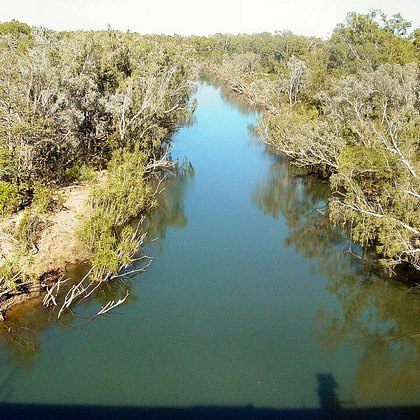
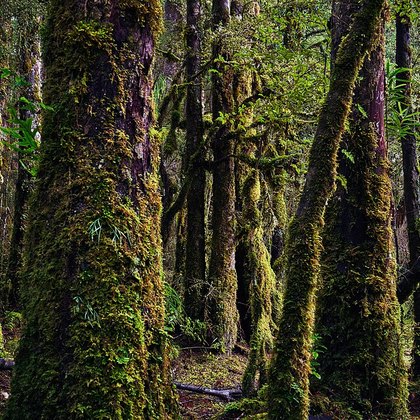
Fast, clear rivers and streams in the forested headwaters of the axial ranges, with a stable bed of coarse gravel and boulders, alternating pools and riffles, and a margin of southern beech or podocarp-broadleaf forest. It eats almost nothing but freshwater invertebrates scraped off the stones — chiefly chironomid and cased caddisfly larvae — and that diet ties it to water clean and well oxygenated enough to carry them. The nest is hidden close to the river, in a bank cavity, under a boulder or beneath dense vegetation.
Where the bird is most often found, arranged by main group and formation.

Range and movements
New Zealand only, and only in the headwaters along the axial ranges of both main islands. On the North Island it is confined to the rivers of the volcanic plateau around Tongariro, the Kaimanawa Ranges, the Whanganui headwaters and Te Urewera; on the South Island it holds on in Fiordland, along the West Coast and in north-west Nelson. Formerly it reached lowland rivers and high tarns and lakes as well. It does not occur in Australia. The range is still contracting slowly, except where predator control is intensive.
- Resident
- dark = core range, pale = thinly spread
Where and when to look
Walk a stretch of mountain river early or late in the day and listen first for the male's high whistle — it carries further than you can see the bird. Then check the pools just below a rapid and the wet boulders mid-stream, where a resting pair passes easily for a stone. Well-known places are the Tongariro and Whakapapa on the North Island and the Clinton and Arthur valleys in Fiordland.
Conservation
Endangered (EN), and 'Nationally Vulnerable' in the New Zealand system. The breeding population in 2011 was unlikely to exceed a thousand pairs, at a density of about one pair per kilometre of river; a 2010 census put the total at two and a half to three thousand birds. The stoat is the leading cause: nesting and moulting females sit flightless in a cavity for days on end, and roughly 57 percent of moulting females are lost. Rats and Weka rob nests, and after a beech mast year a mouse plague is followed by an eruption of stoats, in exactly the year that holds the most ducklings. Beyond that count hydro schemes, silt loads and sudden floods. Since 2011 the Whio Forever programme run by the Department of Conservation with Genesis Energy has maintained eight security sites, large-scale trap lines and the rearing and release of young birds; where that work is done, numbers rise again.
Scientific name
Hymenolaimus malacorhynchos | (Gmelin, 1789)
Gmelin described the species in 1789 as Anas malacorhynchos; because it later moved to a genus of its own, author and year stand in parentheses. The genus Hymenolaimus was introduced by Gray in 1843 and is built from Greek hymen, 'membrane', and laimos, 'throat'. malacorhynchos comes from malakos, 'soft', and rhynchos, 'bill', and refers to that same soft flap at the bill tip. The type locality is Dusky Sound in Fiordland, where Cook met with the bird on his second voyage. The Maori name whio is formed after the male's whistle.