All species › Waterfowl › Ducks, swans and geese › Spotted Whistling Duck
Spotted Whistling Duck | Dendrocygna guttata
Gevlekte fluiteend | Suirirí moteado
The Spotted Whistling Duck is the newest addition to the Australian avifauna: a small, upright tree duck with a grey face, a black cap that sits over head and neck like a hood with a thick collar, and rows of white teardrop spots across breast and flanks. It crossed from New Guinea under its own power in 1995 and has bred on Cape York ever since.

Voice
Of the three whistling ducks this is the quietest. The usual note is a soft, high, clipped whistle, fwee-fwee, far less carrying than the calls of the other two, and generally heard only as a flock lifts or gathers. At the nest and against intruders comes a high ticking tik-tik-tik. Over water what you mostly hear is the soft rush of the wings.
No freely licensed recording has been found for this species yet; what to listen for is described below.
Identification
A whistling duck of 43 to 50 cm, smaller and more compact than either of the others and shorter in the leg. Head and neck are grey, with a black crown and hindneck standing out against the pale cheek like a hood and collar. Breast and flanks are dark brown with large round cream spots, as though drops had been spilled over them; long flank plumes are entirely absent. The bill is dark grey with a pink spot at the base, the legs dull pink with black webs. In flight the bird is simply dark, with the feet projecting and no white in the wing.
Confusion species
Wandering Whistling Duck (Dendrocygna arcuata) is often in the same flock: clearly larger, warm red-brown rather than grey-brown, with dark spots on a pale breast instead of pale spots on a dark breast, and with cream flank plumes. Plumed Whistling Duck (Dendrocygna eytoni) is far paler, carries huge lanceolate flank plumes, has a pink bill and pink legs, and grazes on grass rather than staying on the water. When in doubt look at the face: only the Spotted has that plain grey face beneath a sharply cut black cap.
Habitat
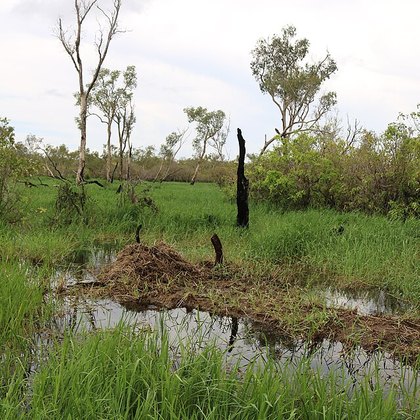
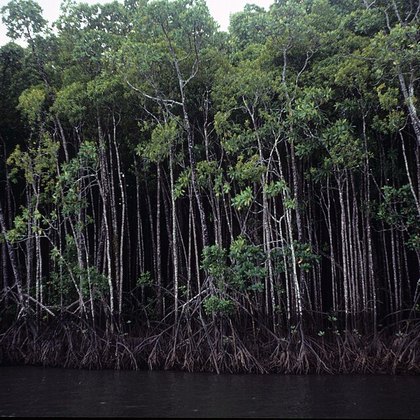
Small tree-fringed ponds, lagoons and melaleuca swamps, mangrove creeks and the settling ponds of mine and sewage works. Unlike its relatives it is a true tree duck: it roosts by day on branches over the water and nests in tree hollows, often in a dead paperbark at a lagoon edge. It avoids open, treeless grassland.
Where the bird is most often found, arranged by main group and formation.


Range and movements
Within the map window of this guide it is confined to the far north-east. The core is on Cape York — the settling ponds at Weipa, Chilli Beach and Lockhart River — and since 2014 birds have turned up as far south as Mission Beach in the Wet Tropics. In December 2011 one appeared near Darwin, again straight after a cyclone, and a small breeding population is suspected on Melville Island. The first Australian record dates from March 1995 at Weipa, in the wake of Cyclone Warren.
- Resident
- Breeding (summer)
- dark = core range, pale = thinly spread
Where and when to look
Look from November to January, at the start of the wet, on the settling ponds at Weipa; that is where the species sits longest and most reliably. Work through every whistling duck flock for a smaller bird with a plain grey face, and look up: this species likes an overhanging branch, where the other two never go.
Conservation
Least Concern (LC), with a world population put at ten to twenty-five thousand birds and apparently stable. In Australia it is actually gaining ground: the species established itself here unaided, is spreading south and benefits from the artificial water bodies around mines and townships. There are no threats of consequence within the guide area.
Scientific name
Dendrocygna guttata | Schlegel, 1866
Schlegel described the species in 1866, and did so straight away in Dendrocygna, so author and year carry no parentheses; the description appears in the catalogue of the natural history museum at Leiden, from museum material out of the Indies archipelago. The genus Dendrocygna was introduced by Swainson in 1837 and combines Greek dendron, 'tree', with Latin cygnus, 'swan' — the tree swan, for the upright neck and the habit of nesting in trees. guttata is Latin for 'spattered with drops', from gutta, 'a drop', for the spotting on breast and flanks.