All species › Waterfowl › Ducks, swans and geese › Plumed Whistling-Duck
Plumed Whistling-Duck | Dendrocygna eytoni
Australische fluiteend | Suirirí australiano
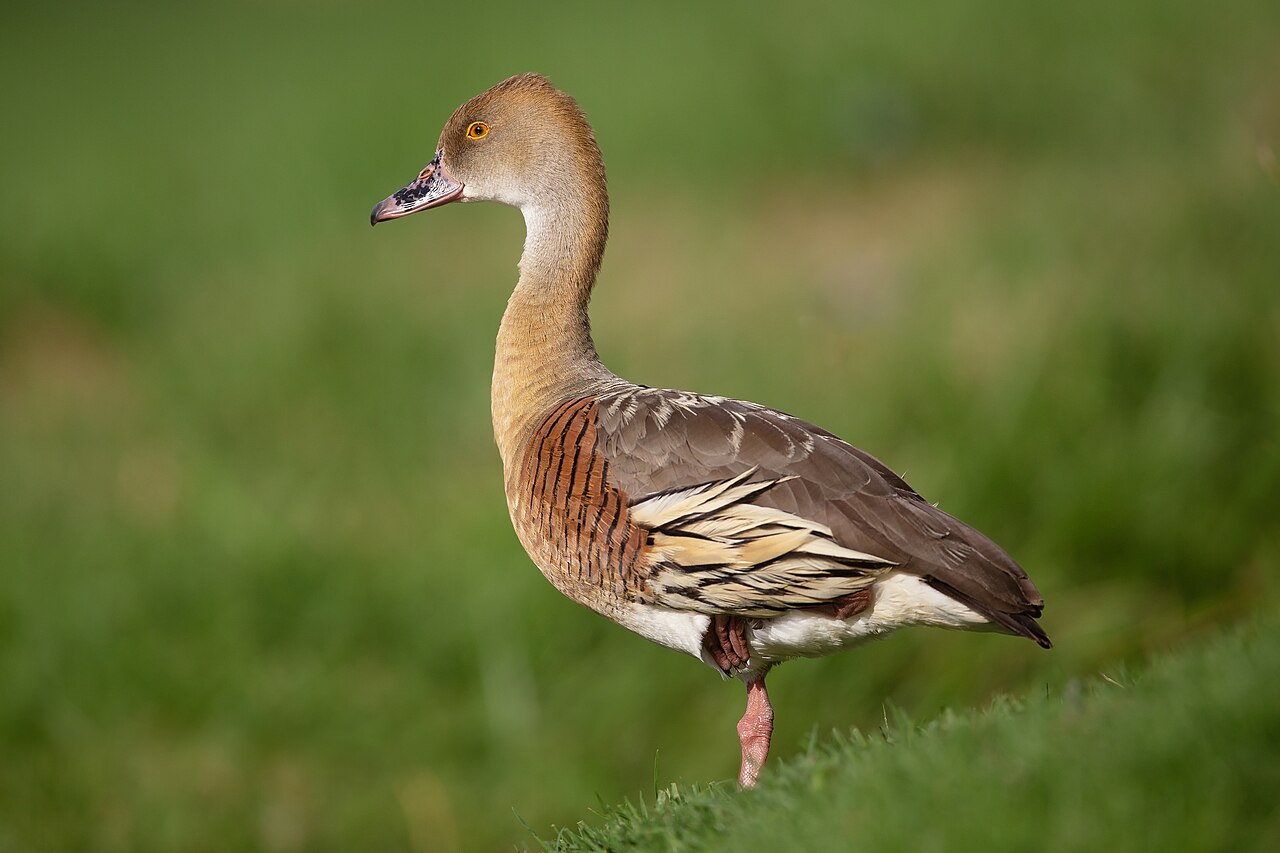
The Plumed Whistling-Duck is the pale, long-legged whistling duck that stands by day in large motionless flocks on a lagoon bank and moves out onto the grass at night to graze. The mark is unmissable: a row of long, lance-shaped cream plumes standing up out of the flank like erect feathers, each edged in black.
Voice
A loud sibilant whistle, fwee-fwee-fwee, high and sharp and audible for hundreds of metres — the sound that gave the whole family its name. A flock taking off gives it continuously and all at once, and over the top of it the wings rush with their own soft whine. On the bank roost there is a softer, chattering whistle between birds.
Recording: Nigel Jackett — CC BY-NC-SA 4.0 · Broome Bird Observatory, Western Australia, Australia · xeno-canto
Identification
An upright, long-necked duck of 40 to 60 cm, far paler than either of the other whistling ducks. Face and foreneck are pale grey, crown and hindneck dull brown, the back brown with broad buff feather edges. The breast is light chestnut with fine black barring. The flank carries the long, tapering, black-edged plumes that stand up over the back. Bill pink mottled with grey, legs bright pink. In flight the bird looks goose-like, slow-beating, with the neck drooped and the feet projecting.
Confusion species
Wandering Whistling-Duck (Dendrocygna arcuata) is the only real alternative: much darker and warmer red-brown, with far shorter flank plumes, a dark bill and dark legs, and it keeps to the water rather than the grass. Its carriage is lower and more curved, where this species stands bolt upright. Spotted Whistling-Duck (Dendrocygna guttata) is smaller, grey-faced and covered in white drops. Maned Duck (Chenonetta jubata) also grazes pasture, but is grey with a brown head and a short neck.
Habitat
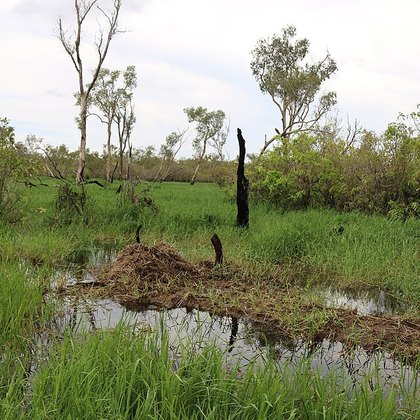
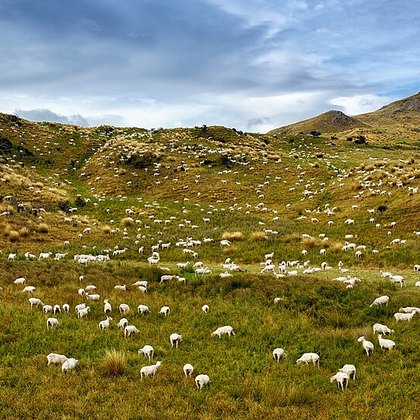
By day the open banks and sandbars of lagoons, stock dams and tropical rivers, where thousands of birds stand packed together in the sun; by night open grassland, eucalypt savanna, grazed pasture and grain stubble, where it crops the grass as a goose does. Water is for drinking and resting, not for feeding — it never dives.
Where the bird is most often found, arranged by main group and formation.

Range and movements
Chiefly the northern and eastern tropics of Australia, from the Kimberley across the Top End and Cape York, and south down the east to New South Wales; in the west it comes little south of the Kimberley. After good rain it appears as far as the Murray in Victoria. In New Zealand it is a vagrant and clearly increasing: about eight times in the whole twentieth century, but at least ten times since 2000, in parties of up to fourteen birds, with records out to the Chathams and the Snares.
- Resident
- dark = core range, pale = thinly spread
Where and when to look
Drive a tropical lagoon or a stock dam in the middle of the day and look for the flock on the bank: it is precisely in the heat that it stands still at the waterline, upright and easy to count. The plumes are the one mark that survives backlighting — a silhouette with feathers standing up out of the flank is this species.
Conservation
Least Concern (LC) and rated secure in every state where it occurs. The building of stock dams and the conversion of savanna to grazed grassland have helped it rather than harmed it; flocks on the northern plains run into tens of thousands. Numbers do swing hard with the wet season, and locally the loss of the shallow bank margins where flocks gather by day does pinch.
Scientific name
Dendrocygna eytoni | (Eyton, 1838)
Eyton published the name in 1838 in his own Monograph on the Anatidae, as Leptotarsis eytoni; because the species later moved to Dendrocygna, author and year stand in parentheses. The epithet eytoni honours Eyton himself — an unusual state of affairs, in which the author put into print a name carrying his own. The genus Dendrocygna was introduced by Swainson in 1837, from Greek dendron, 'tree', and Latin cygnus, 'swan'. The type locality is given as no more than 'Australia'.