All species › Waterfowl › Ducks, swans and geese › Wandering Whistling Duck
Wandering Whistling Duck | Dendrocygna arcuata
Zwervende fluiteend | Suirirí capirotado
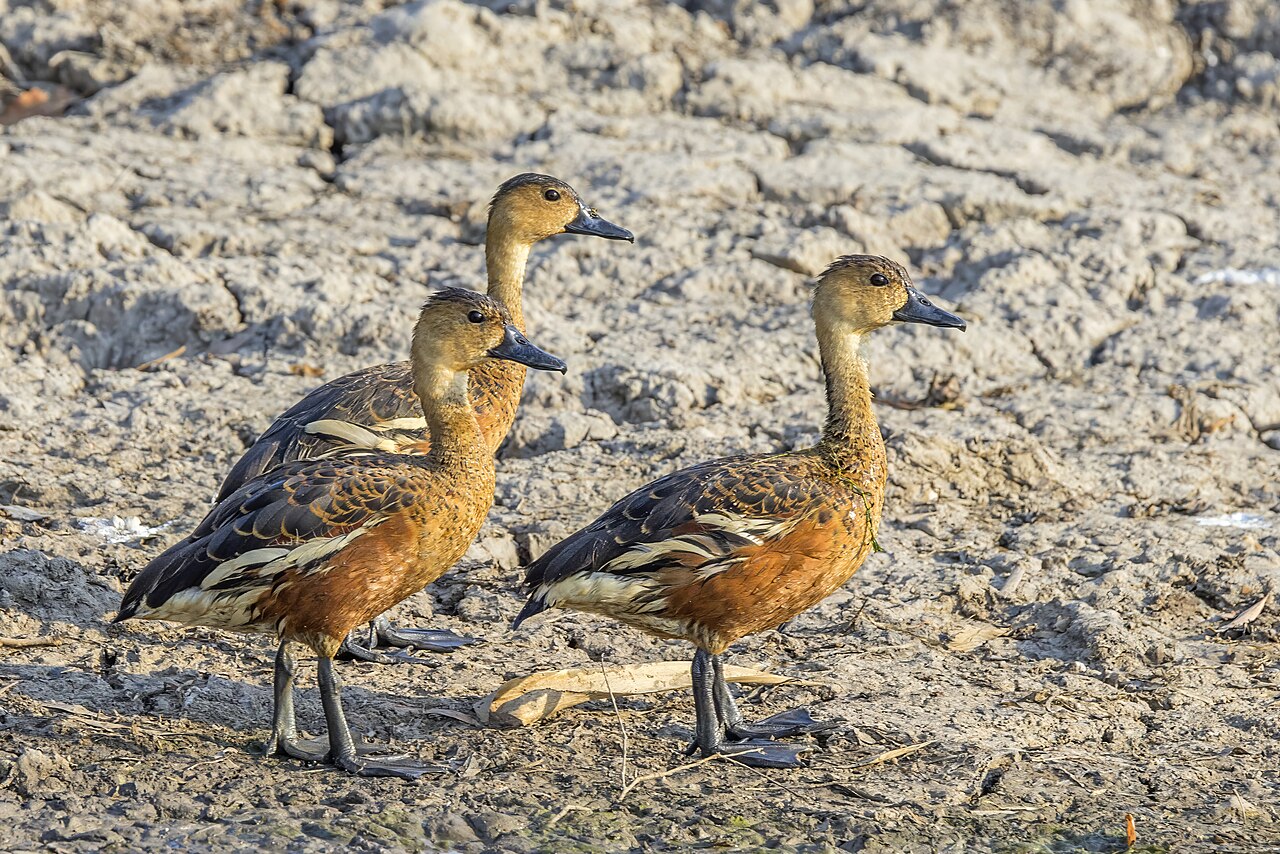
The Wandering Whistling Duck is the darkest of the three and the most tied to water: a large red-brown duck with a long neck that lies low and curved on the surface, dives readily and rarely moves far from the bank. Its name comes from its wandering in search of water and from the ceaselessly whistling flocks that cross a lagoon at dusk.
Voice
A shrill twittering whistle that runs on and on in a flock, above all once the birds are airborne: swee-swee-swee-swee, fast and high and with many voices at once. On the water it is softer and slower, a continuous conversation. To that add the fine high whistle of the wings, clearly heard from a flock passing low.
No freely licensed recording has been found for this species yet; what to listen for is described below.
Identification
A large whistling duck of 55 to 60 cm, warm red-brown overall, with a pale head, foreneck and upper breast and a dark stripe down crown, neck and hindneck. The breast carries black spots on a pale ground. Along the flank run elongated cream plumes with chestnut edges, far shorter and less obvious than in the Plumed Whistling Duck. Bill and legs are dark. In flight one sees a dark underwing, a cinnamon underbody, a white undertail and trailing feet. On the water and standing, the carriage is lower and more curved than in its relatives.
Confusion species
Plumed Whistling Duck (Dendrocygna eytoni) often stands in the same flock: far paler, with pink bill and pink legs, huge erect flank plumes and a bolt-upright stance; and it grazes grass while this one stays on the water. Spotted Whistling Duck (Dendrocygna guttata) is smaller, with a plain grey face under a black cap and pale drops on a dark breast — exactly the reverse pattern. At range a flock can suggest Pacific Black Duck (Anas superciliosa), but the long neck and the straight, stretched flight with drooping feet rule that out.
Habitat
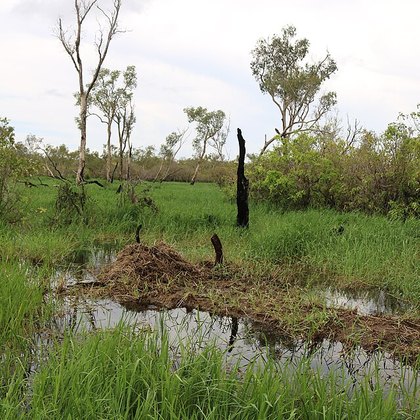
Deep vegetated lagoons and swamps, flooded grassland, stock dams, sewage farms, grain stubble, irrigated land and ricefields. It is the only one of the three that truly swims and dives to feed and that rarely leaves the water's edge; floating plants and waterlily beds are its best ground.
Where the bird is most often found, arranged by main group and formation.


Range and movements
Northern and eastern Australia, from the Kimberley across the Top End and Cape York and south down the east to south-eastern New South Wales. In the south-east and south-west of the continent it is a vagrant. It depends heavily on the wet season and moves with the water: as the northern plains dry, the flocks fall back on permanent lagoons and stock dams.
- Resident
- dark = core range, pale = thinly spread
Where and when to look
Sit at a tropical lagoon in the last hour before sunset and wait for the flocks coming in to roost; they announce themselves whistling before they are in sight. On the water, look for the low-lying red-brown birds among the pale Plumed Whistling Ducks — the difference in carriage, low and curved against bolt upright, is what works best at long range.
Conservation
Least Concern (LC) and rated secure in the Northern Territory, Queensland and Western Australia. The species benefits from stock dams, rice growing and irrigated land, and northern flocks run into tens of thousands. Where it goes wrong is with the draining and regulation of the floodplains it breeds on, and with the spread of introduced water plants that close over the open lagoons.
Scientific name
Dendrocygna arcuata | (Horsfield, 1824)
Horsfield described the species in 1824 as Anas arcuata, in his Zoological Researches in Java; since it later moved to Dendrocygna, author and year stand in parentheses, and Java is the type locality. The genus Dendrocygna was introduced by Swainson in 1837, from Greek dendron, 'tree', and Latin cygnus, 'swan'. arcuata is Latin for 'bent like a bow', from arcus, 'bow' — for the strongly curved line of neck and back. Australian birds are placed in the subspecies australis.