All species › Waterfowl › Ducks, swans and geese › Mute Swan
Mute Swan | Cygnus olor
Knobbelzwaan | Cisne vulgar
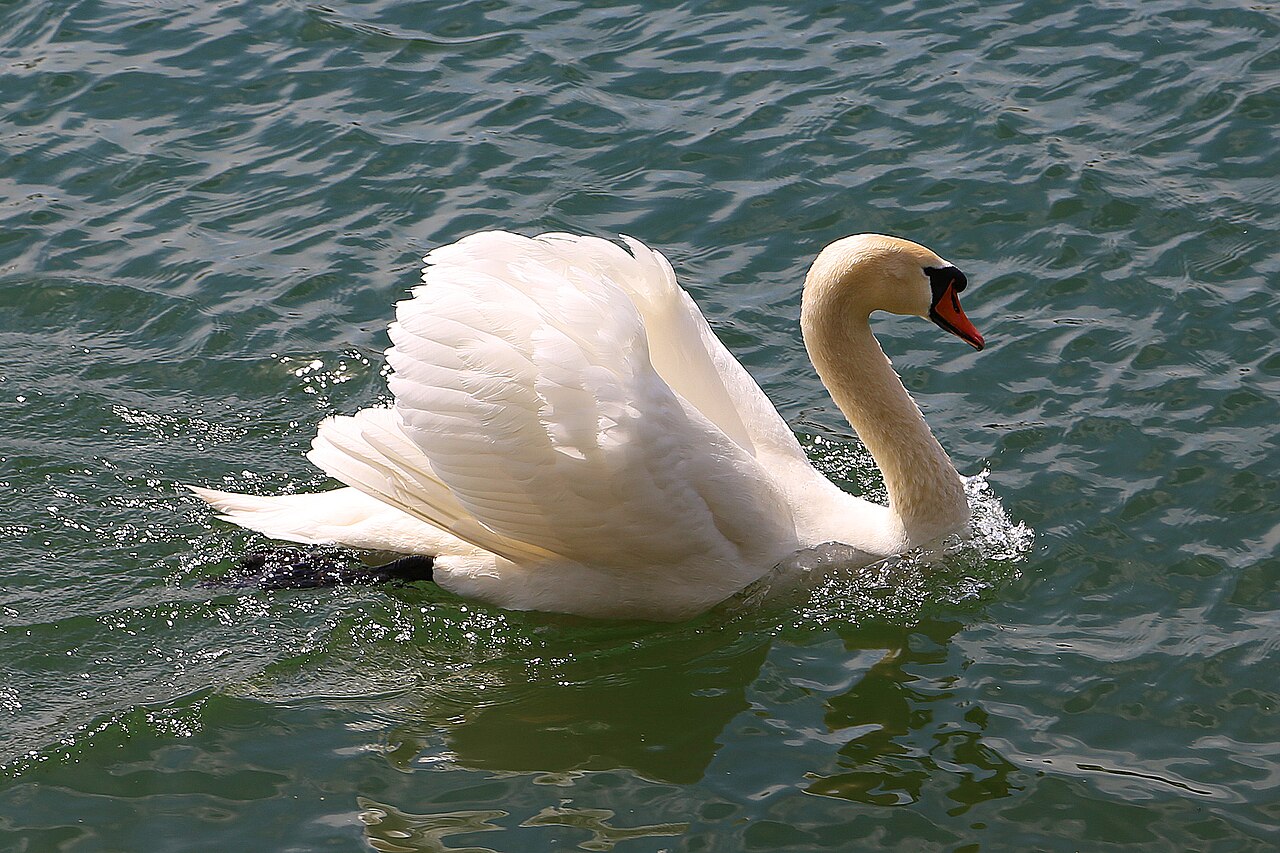
The Mute Swan is not a native bird here but a European ornamental that was let loose and has hung on in a few places. It is unmistakable: all white, with an orange-red bill, a black mask running from the eye to the bill and a black knob on the forehead. In a part of the world where swans are supposed to be black, a white one stands out at once.
Voice
Despite the name it is not mute, though it is quiet compared with other swans. It snorts and grunts, hisses hard in defence of nest or young, and now and then gives a hoarse whistling note. Its most characteristic sound is not made with the throat but with the wings: in flight the primaries produce a heavy rhythmic throbbing audible a kilometre or two away on a still day — something Black Swan does not do.
No freely licensed recording has been found for this species yet; what to listen for is described below.
Identification
A huge, wholly white swan of about one and a quarter to one and seven-tenths metres, with a wingspan approaching two and a half; the male weighs eleven to fifteen kilos, the female eight to nine. The bill is orange-red with a black base and carries a black knob above it, clearly larger in the male. The carriage is diagnostic: the neck is held in a graceful S with the bill angled down, where other swans hold the neck straight up. Young birds are dingy grey-brown with a grey knobless bill and do not turn fully white until their second year.
Confusion species
The only other swan in this area is Black Swan (Cygnus atratus), all black with a red bill and white primaries in flight — no confusion once the bird is seen. Mistakes come rather from white feral farmyard geese on park ponds, from the white domestic form of Greylag Goose (Anser anser) and, at range, from Australian Pelican (Pelecanus conspicillatus); all three are far shorter in the neck and lack the black knob. Young Mute Swans look greyish at distance and are sometimes taken for young Black Swans, but those are darker and have a grey rather than pinkish bill.
Habitat
Still or slow-moving fresh water: lakes, coastal lagoons, town ponds, parks and the slower rivers. It floats for most of the day, using the long neck to graze submerged water plants, and supplements this with grass on the bank. The nest is a great heap of plant material in shallow water or on a low bank, and a pair will keep to it for years. Where the bird persists, it is almost always on water made or managed by people.
Where the bird is most often found, arranged by main group and formation.


Range and movements
Within this map window there are only a handful of small scattered feral populations, probably fewer than two hundred birds in each country. New Zealand has two that maintain themselves: about eighty birds on Te Waihora (Lake Ellesmere) in Canterbury and some twenty in Hawke's Bay, with semi-feral birds around the old release sites. In Australia the best known group is on the Avon at Northam in Western Australia, where the white swan is the town's emblem; beyond that it is scattered park birds and escaped ornamentals in Victoria, Tasmania and South Australia, with no established wild range.
- Resident
- dark = core range, pale = thinly spread
Where and when to look
Do not look in the bush but on town water and at the places where the bird was once released: the Avon through Northam, the southern shore of Te Waihora, and the ponds of old estates. Any white swan in Australia or New Zealand is by definition this species, but still check the bill, because feral white geese on park ponds can spoil the identification at distance. Winter is the best time, when the birds gather on open water.
Conservation
Least Concern (LC) worldwide, but that says little about the birds here, which do not form a natural population. The Mute Swan was brought in during the nineteenth century as an ornamental for parks, estates and botanical gardens: in New Zealand recorded for Canterbury in 1866, Otago in 1868–69 and Auckland in 1869 and 1871. The New Zealand population is small and declining through predation and botulism outbreaks, and its legal protection was reduced in 2010. In Australia the Avon colony crashed from eighty birds in the 1980s to under ten by 2015 through disease and inbreeding, after which zoo-bred birds from Melbourne were added. Nowhere in this area is it regarded as a damaging pest, unlike in North America.
Scientific name
Cygnus olor | (Gmelin, 1789)
Gmelin described the species in 1789 as Anas olor, in the thirteenth edition of the Systema Naturae; because Bechstein moved it to Cygnus in 1803, author and year stand in parentheses. Both Cygnus and olor mean 'swan' — the first from Greek kuknos, the second straight Latin. The type locality lies in Russia and Siberia and on the Persian shore of the Caspian Sea. The English name points to the bird's relative silence; the Maori name wana is a loan from English swan.